Tag: Identity

  • We Seriously Went Wrong Somewhere

    We Seriously Went Wrong Somewhere

    Three Zimbabweans were arrested for the murder of former boxing world champion Corrie Sanders. Yes Zimbabweans are making the headlines. Very sad if you think of the potential we thought we had. The effects of such headlines tell a story. The three don’t know what they have actually done. Locals who have always been angry are having ideas.

    Those who are having challenges with getting by, those who got laid off for being drunk at work, those who lost jobs because a Zimbabwean showed the right attributes for a job, those who are angry because white people had it easy, those who expected open doors without knocking and those who just booze for life.

    They are coming after a family that is also struggling and working 9hours a day. They are going to kill and destroy all little they have.

    Growing up my mum always told me, “usaise makumbo pamasofa kumba kwevanhu“, (don’t sit on or put, your legs on top of the couch when you have visited people). How can people forget where they come from and pick the worst habits in foreign lands and become the best at it. Even getting caught. Its disgusting. For such stupidity innocent people are going to pay. For every action there is a reaction. The cowards will be in jail while those out side will wish they had been arrested. Wherever we are, we represent our people. We can embrass them or make them proud.

    This has been a submission by Rodney K. written in South Africa.
    You too can become a Citizen Journalist by submitting your story here: Citizen Journalism by Living Zimbabwe
    The views expressed in the article are those of the author and not necessarily Living Zimbabwe.

  • It’s Tough Being Black!

    A few weeks ago I was directed to Africa Online (NZ) to read the review of the Celeb Wedding where Fortune and Zanele tied the knot. Reading through the review got me thinking about something someone said at an event where there were a number of Africans present. All that this person said shaking his head was, “it’s tough being black”! What he was referring to was the manner in which people arrived at the event and the manner in which they conducted themselves throughout the evening. It was a case of look at the car I am driving, look at who I am with, look at what I am wearing and so on. Reading the review of the wedding just got me thinking about how with so many black people it is all about the ‘show’ and ‘keeping up appearances’.

    Going back to the wedding, to me it seemed like the wedding was put on as a show of God knows what for the guests. It is all well and good to celebrate such a day to the fullest and being a Zimbabwean wedding you can expect it to be a jam packed and joyous event. But, when it goes to the point of talking about how we did this, did that, had this, had that it takes a bit of light off what the day was about. Marriage is the union of two souls and when a wedding goes over the top it can take a lot of essence off of that.

    You don’t have to try hard or even look far to find people out there who go to great lengths to make it look as if they have made it when that may not necessarily be the case. For a lot of them, they are struggling to make ends meet and trying to keep up appearances is fuelling their journey towards more debt. On the outside they may look happy and as if they have got it all together but in actual fact there may be amongst other things emotional turmoil.

    This is something that I failed to understand in the early 90’s when I would observe young Zimbabwean’s in the middle of summer sweating up and down 1st Street for hours on end and wearing heavy jeans and a leather jacket. Regardless of the temperature, the leather jacket would not come off because I guess it looked good. This is the same phenomenon I am still seeing today almost two decades later but I still fail to understand it.

    That there is where “it’s tough being black” came from. Some of these people are likely to spend their last few dollars on something to enhance their social standing than something more beneficial such as food. But, who am I to judge? People can do and are entitled to do whatever they want to do but what is the point when nothing meaningful comes from it?

  • Gays and Lesbians in Zimbabwe and Their Rights

    “It degrades human dignity. It’s unnatural, and there is no question ever of allowing these people to behave worse than dogs and pigs. If dogs and pigs do not do it, why must human beings? We have our own culture, and we must re-dedicate ourselves to our traditional values that make us human beings. … What we are being persuaded to accept is sub-animal behavior and we will never allow it here. If you see people parading themselves as Lesbians and Gays, arrest them and hand them over to the police!” That being said, you can see that being openly gay in Zimbabwe does not work well in ones interests. Homosexuality is not illegal, it is sodomy that is.

    The issue of gays and lesbians has for a long time been a highly contentious issue in not only Zimbabwe but around the world. It is an area that has put many a world leader to the test in how they respond to the issue of their rights. Mugabe’s disgust towards homosexuality is a sentiment that is shared by many a Zimbabwean as well.

    Gays and lesbians have for a time long been subjected to all forms of discrimination which has lead to them living their lifestyle under the radar. This is not to say that all homosexuals are living under the radar, there are some who are very much out there in the open and made their sexual orientation known to all. With the inclusive government and the new Constitution expected in the near future, gays and lesbians are becoming more vocal and demanding that their rights are recognized and made a part of the new Constitution. A lot of them are fighting hard to see that they are protected under the constitution. Gays and Lesbians of Zimbabwe (GALZ) www.galz.co.zw is at the forefront of seeing to it that there is constitutional equality.

    GALZ Mission Statement

    The principle objective of GALZ is to build a democratic and accountable organisation and to strive for the attainment of full, equal rights and the removal of all forms of discrimination in all aspects of life for gay men, lesbians and bisexual people in Zimbabwe and to inform, educate, counsel and support people in matters relative to their health and well being.

    Sexual rights are human rights.

    Mugabe’s fight against homosexuality was dealt a blow in the mid to late 90s when the 1st president of Zimbabwe, Canaan Sodindo Banana was convicted of sodomy. He was jailed for a year and died a few years later but was not buried at Heroes Acre with full honours as you would expect for a former head of state. This goes to show what happens to people convicted of sodomy regardless of who you are and what you have done for the nation.

    Could the extreme homophobia be a result of Mugabe’s attitudes towards them influencing people to detest homosexuals or is it based on something that they themselves truly believe to be wrong? Many Zimbabweans are Christian and there are passages in the Bible that condemn homosexuality. These include Genesis 19, 1 Corinthians 6:9-10 and Leviticus 20:13 –

    “If a man lies with a man as one lies with a woman, both of them have done what is detestable. They must be put to death; their blood will be on their own heads.”

    This is something that may drive them towards making the decisions they have made about homosexuality.

    This “Satanic”, “Western Import” (not my words but those of Mugabe and his supporters) of homosexuality will continue to be a thorn in the side of Zimbabwean politics for a long time coming. Human rights groups see it as another violation in Zimbabwe and other see it as a moral issue that just shouldn’t be allowed. It may be one of those issues where there will never be a resolve that leaves both parties happy.

    What will become of the gays and lesbians on Zimbabwe?
  • Dare To Wear Camouflage Clothing in Zimbabwe

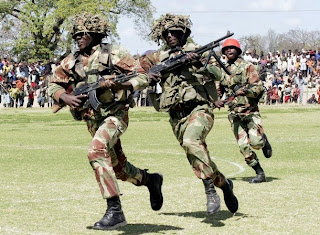
    Zimbabwean Soldiers Who Beat Civilians Haphazardly!Camouflage clothing has for a very long time been popular urban clothing. If you are lucky enough, you can get yourself a pair of camouflage pants for as little as $1 on eBay. That bargain you get for your piece of clothing could get you into more trouble than you bargained for if you decide to wear it in Zimbabwe. According to the Defence Act (Chapter 11:02), wearing of camouflage materials by civilians, whether Zimbabwean or from any other country, is forbidden. This was something that was mentioned to me a few years ago but didn’t pay much attention to and quickly forgot about simply because of how in most parts of the world it is just a piece of clothing. At the time I was told that people wearing camouflage clothing were beaten up by soldiers and faced possible arrest.

    Some weeks ago, a popular Zimbabwean DJ, DJ Squila was accused by soldiers of wearing army replica pants without permission. The soldiers proceeded to assault DJ Squila and threw him into a vehicle and drove off. They later threw him out of the vehicle whilst it was moving and he sustained serious head injuries. Luckily enough, a passer by took him to hospital where he received treatment. The Defence Act also states that anyone who without authority sells, offers or exposes for sale, wears or uses any uniform supplied to or authorized for use by any member of the Zimbabwe Defence Forces or other military forces shall be guilty of an offence.

    The act may state that one shall be guilty of an offence but even if one is guilty, it does not give the soldiers such as the ones that assaulted DJ Squila the right to take justice into their own hands. Hearing of such behaviour reinforces all those statements about soldiers being illiterate people who don’t think about what they are doing and the consequences of their actions. This makes them very dangerous group of people who you don’t want to provoke in any way. In a country full of lawlessness it just isn’t worth it wearing camouflage clothing even more so when you have to contend with very poorly paid and disgruntled soldiers.

    Would you dare to wear military clothing in Zimbabwe?

  • Musalad Losing Identity

    Last month, CNN’s Inside Africa featured a Zimbabwean DJ in New York, Chaka Ngwenya who started up an online radio station SARFM Radio through which he says he is trying to help African listeners keep their identity abroad. Identity caught my attention and that lead on to not forgetting about who you are and where you are from. Thinking about ‘Identity’ got me thinking about the term “MUSALAD” that so many young Zimbabweans have been labeled. What exactly is a “salad/musalad/salala?” It is a term that cannot really be given a clear cut definition because of people’s different interpretations of it. My understanding of the term is; someone from a low-density suburb and from a so called group ‘A’ school (private school) who is not streetwise, copies Western culture (mainly American) and speaks English with an accent. In years gone by munozi (nose brigade) was more commonly used due to ‘these people’ speaking nasally.

    I am one of those people who was and still is labelled a munozi and/or musalad but to a much lesser extent as compared to years gone by. Up until just after starting high school I went to these so called group ‘A’ schools until I was shifted to a boarding school out in the rural areas. Within the first few hours of being there I was labelled a munozi. Very soon after that I was given a nickname brought about by me being told to stand up and tell the class my name. When I opened my mouth, the entire class burst into laughter and I didn’t understand what was going on until the teacher eventually asked me to repeat what I had just said whilst a number of my classmates (and the teacher) were still laughing and mimicking what I had said with a very exaggerated nasal intonation. The nickname I was given was what they thought they had heard me say and it stuck through out my time at the school. It wasn’t easy going by day to day and having to deal with the discrimination (which is how I saw it) but as time went by I got used to it and paid less attention to it. Those years of my life were probably my quietest and I only spoke when I really needed to so that I didn’t have to deal with the onslaught if I spoke. I did make a few friends and those who got to know and respect me saw more than just what was on the surface.

    Masalad are viewed by many as, “vanhu varasa tsika” (people who have lost their traditional ways). This Shona term, tsika refers to knowing and being able to use the rules, customs and traditions of society to be regarded as a respectable person. Not all masalad are a lost cause. Those who went to schools where they mixed with other races, they had and still have different accents to those from a rural background. For most when they got back home it was back to their traditional ways but they would take along what they picked up in their environment. They way that they speak is different but it is not necessarily fake or put on. Yes, there are some where it is a bit over the top and obviously put on and bound to draw a lot of attention and criticism. The video shows what I would consider to be over the top. The people in the video do live in the United States but you could very easily come across people in Zimbabwe who have never stepped out of the country speaking like them.

    It is not only masalad who get discriminated against. An example I can use from years and years ago is that before I left the private school, an SRB (someone with a Strong Rural Background) was awarded a scholarship to do his ‘A’ levels there. He was ostracised because of his mannerisms and the way he spoke English with a very heavy Shona accent. He was a very nice guy but his background and the environment he was in did not do him any favours.

    I have been criticized by family and friends who said I had an identity crisis because of the many white friends I had and the ‘white things’ I did (whatever they were). Yes, I did mix and mingle with a lot of white people but that did not make me less of a Zimbabwean. The discrimination encountered by both groups of people (masalad and SRBs) is unwarranted at times because we should not be judging a people by the way they speak, what they wear and how they carry themselves. As long as those in question know who they are and where they come from they should be treated with respect. When cultural identity has been lost there should be cause for concern because you will have lost a lot of who you are.

  • The Ridiculous Cost of a Zimbabwean Passport

    Zimbabwean PassportFrom the 7th to the 10th of May staff from the Zimbabwean Embassy in Australia (Mr Moses Chikanyairo and Ms Pelagia Mbanda) were in Wellington to assist all Zimbabweans who wished to apply for a passport. For a number of people news of their visit was welcome as there is no Zimbabwean Embassy in New Zealand meaning that people have to travel to Australia or make alternative arrangements if they want to apply for a new passport. Having embassy staff in the country gave people the opportunity to pick-up a passport application form to fill out which they would then send to Zimbabwe and get friends or family to aide in processing the application. Before the arrival of the Embassy staff, information with passport application requirements and associated fees was distributed with the cost for a new passport being: passport forms – AU$30.00, passport fees – AU$190.00, verification of documents – AU$50.00 coming to a total of AU$270 – Click here for new passport application requirements and fee schedule from the Zimbabwe Embassy Australia.
    People went along to where embassy staff were stationed ready to pay AU$30 to pick up an application form but were caught off guard when they were told the fee was AU$80. The embassy staff were only accepting bank drafts which after a conversion from the NZ dollar and associated bank fees came up to approximately NZ$120. That is an exorbitant price to pay for an application form. A New Zealand passport will cost you about NZ$150-$170 depending on where you are in the world, an Australian passport AU$200, a British passport £75 and a U.S. passport US$100. As you can see, if you were to compile a list with the cost of passports from various nations around the world, Zimbabwe passport fees are bound to be close to if not at the top.
    It just doesn’t seem right that one has to pay just for an application form and then the processing fees. For people living in the diaspora, they may run into a few problems when trying to apply for a new passport due to some of the requirements. These include the need to supply a long birth certificate and national identity card. Depending on how long a person has been away from Zimbabwe they may not have this documentation. In the case of a national identity document, they are only issued in Zimbabwe where a personal appearance is required for photos and fingerprinting. This makes things a little more difficult for someone trying to apply for a passport and doesn’t have all the required documentation. In the end all the money that has to be paid and the hops you have to jump through for a passport if you live out of Zimbabwe end up being one big headache when in reality it should be a relatively simple process. It may work out to be a lot cheaper and easier to go through the official ‘unofficial’ channels for a new passport.
    People applying for passports from Zimbabwe are not immune to high passport fees. The Registrar-General’s Office is constantly increasing passport fees to match the economic climate with the last update being on the 14th of April – Click here for a list of fees for a Zimbabwe Passport as at 14 April 2008.

    *FEES UPDATE*Click here for a list of fees for a Zimbabwe Passport as as 17 July 2008.

    The government really needs to re-evaluate what they charge for and how much they charge for passport applications. In the end it may not be worth all the hassle of applying for a passport that takes you nowhere if you are eligible for citizenship in another country.
  • The Zimbabwe Flag

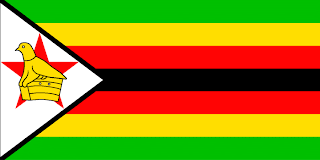
    The Zimbabwe Flag

    I work with people from all over the world and the other day one of my colleagues starting asking people what the symbols and colors on the flags from their respective countries meant. It was very interesting in that some people went into a detailed history as to what they meant and others weren’t quite sure about what their flag meant. This got me to thinking that it is important to know what the colors of your flag mean to better understand where you are coming from. Flags are used to represent a country or nation and are a symbol of national identity. For some people, a flag stirs up a sense of pride as they think of what they or others before them went through and those that died during liberation struggles. The Zimbabwe flag tells its own story with the various colors and symbols that make up the flag.

    The Colours of The Zimbabwe FlagGreen Stripe – represents the Country’s vegetation and land resources.
    Yellow Stripe – represents the country’s mineral wealth.
    Red Stripe – represents the blood spilt during the liberation struggle.
    Black Stripe – represents the black majority.
    White Triangle – represents peace

    The Zimbabwe Bird on The Flag of ZimbabweThe Bird – the bird is the national emblem of Zimbabwe which also features on the coat of arms and the currency. The Image was derived from carved soapstone birds found at the Great Zimbabwe ruins in the late nineteenth century. All the carvings were taken away from the country and all but one have been returned. Legend has it that peace will never return to Zimbabwe until all of the artifacts have been returned to their rightful place.

    The Red Star on The Flag of ZimbabweThe Star – The red star which is located behind the Zimbabwe Bird represents the nation’s aspirations, internationalism and the ruling party’s socialist credentials.

  • The Passport That Takes You Nowhere

    In Zimbabwe’s early years travel was so easy for a number of her citizens. Getting together all the necessary items to take your family on holiday was not a difficult task. Applying for a getting a passport if you didn’t have one was simple. Getting money for travel, accommodation and spending was not a problem either. Best of all, passage into a number of countries worldwide was a breeze. You could travel to quite a few visa free and if you needed a visa the application process was simple and approval almost certainly guaranteed.Nowadays, it is a completely different story.
    Traveling on a Zimbabwe passport can be a little tricky. You need a visa to visit a number of countries. A few years ago Zimbabwe introduced machine readable passports but some of the Zimbabweans in the Diaspora have not yet gotten a chance to get themselves one. They are still traveling on the old style non-machine readable and handwritten passport. These old passports can lengthen processing times at border controls and. I have an old style passport and have even been stopped at the air bridge. This happened to me when boarding flights in Johannesburg, Dallas and Stockholm. The authenticity of my passport is what was being questioned. This was such an inconvenience and embarrassing as I was made to stand aside with an official standing next to me waiting to question me as my flights boarded.A few weeks ago I got to listen in on a conversation between a Zimbabwean and the former Immigration Minister (New Zealand). He mentioned how it was in his era that they started up a unit Immigration Profiling Group (IPG) that handles all visa applications from a list of countries that they deem as high risk. These countries are where there is political unrest of whom its citizens may decide to not return if allowed passage into New Zealand. He mentioned that Zimbabwe was at the top of the list of African countries. Visa applications normally take weeks but if you have the misfortune of being a citizen of a country whose applications have to go through IPG you are looking at a wait time of about 6 months. This is ridiculous when all you want to do is visit a country even after that six month wait period your application may be declined. If you are a 23 year old person who has not travelled at all and doesn’t have any real reason to return to your homeland you can forget about it. This is sure to be the same for a number of Western countries around the world who are imposing sanctions against Zimbabwe.

    Anything and everything is just becoming harder for Zimbabweans but, there are a number in the Diaspora who have been able to become residents of the countries they are living and working in which does give them a bit of peace of mind in knowing that they do not have to worry about what to do when their visas/permits expire.