Tag: Mugabe

  • Zimbabwe’s Military coup, Mugabe must go, continuing to live our lives

    Zimbabwe’s Military coup, Mugabe must go, continuing to live our lives

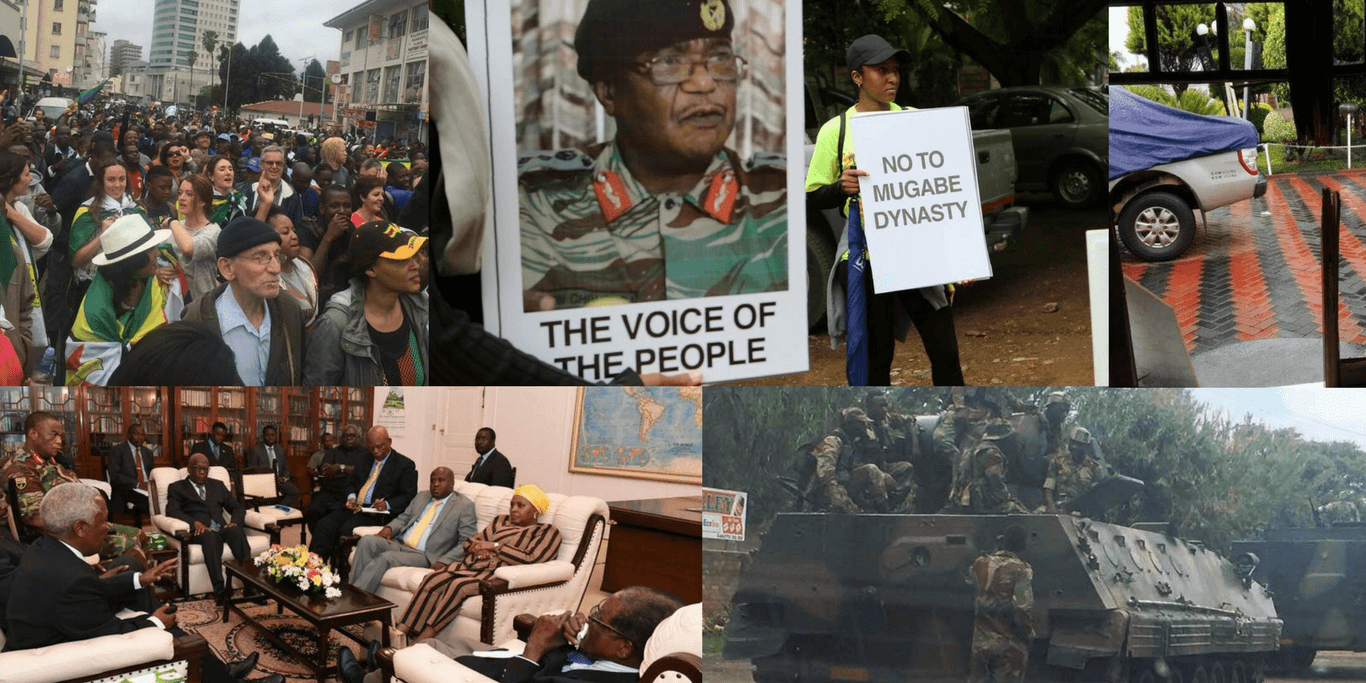
    If you are part of a Whatsapp group or an avid social media user, then mid last week, you would have started getting messages and seeing updates about tanks and military personnel making their way to Harare. On the back of Emmerson Mnangagwa’s recent sacking as Vice-President of Zimbabwe, the Commander of the Zimbabwe Defence Forces General Constantino Chiwenga, released a statement and with the events the followed, many jumped to speculation of a military coup.

    General Chiwenga’s Statement 13 November 2017

    https://www.facebook.com/LivingZimbabwe/posts/2260874480604698

    Early the next morning, there was apparent gun fire and explosions somewhere in Harare, the military went on to take over the Zimbabwe Broadcasting Corporation and eventually made a statement outlining their motivations behind the actions they had taken.

    Major General SB Moyo’s (Chief of Staff Logistics) Statement

    https://www.facebook.com/LivingZimbabwe/videos/2262134067145406/

    This fuelled the speculation even more with many seeing this as that the time finally coming where Mugabe’s reign comes to an end. Yes, there have been suggestions that this is the case. Offical statements have been released here and there but no definitive statement that outlines the way forward for Zimbabwe.

    Very excitable times for many as many want to see Mugabe go and this could be it. On the same token, it is a stressful time for others because with Mugabe gone, their future is uncertain.

    That said, we don’t really know what is going on behind closed doors. We don’t really know what the next few days will bring. Whatever the case may be, it is very clear that the masses want Mugabe gone! As we speak, there are thousands of people of all ages and races are marching in Harare and Bulawayo and freely expressing their sentiments.

    After the march everyone will make their way back home and continue on with their lives. At the end of the day, families need to be fed, bills need to be paid and day to day life has to go on. As far as our leadership is concerned, we don’t as yet know what is going to happen in the short or long time. Some people are getting over excited and on the verge of making irrational decisions. If you aren’t directly link with what is going on between the powers that be, don’t forget to get on with what you need to do to live your life. The challenges that you were facing yesterday may still be there today and may still need to be tackled tomorrow!

  • Grace without Mugabe?

    Grace without Mugabe?

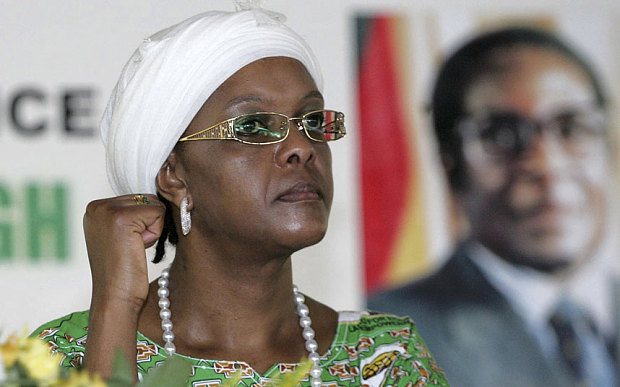
    Once upon a time, Grace Marufu found herself in a position where she was lucky enough to work as a secretary in the President’s office. This then secretary caught President Mugabe’s attention with the encounter progressing into a romantic relationship. The relationship developed even further as the two went on to have children and the couple eventually got married in 1996 and Grace officially became Mrs. Mugabe.

    Being the president’s wife, she has not managed to escape the media spotlight. But, over the years she has managed to get herself into the spotlight through actions of her own. As you can imagine, these moments have been somewhat unglamorous as they have included highlighting extravagant shopping, moments of attacking journalists and dodgy business deals being exposed.

    Amai Mugabe is back in spotlight as she was recently conferred with a PhD from the University of Zimbabwe and has also immersed herself in frontline politics as she was recently nominated to head the Zanu-PF Women’s League.

    Many women around the African continent who have made their way into the upper echelons of politics usually have a story of personal achievement behind them that has propelled them into leadership.

    Now, imagine a scenario where we take Amai Dr Grace Mugabe back to the time when she was a secretary in the president’s office. Imagine the President had not noticed her and she continued life as who she was. She would not have been a Mugabe and everything associated with it would not have been part of her life over the last two and bit decades.

    So now we have Grace stripped of any close association to President Mugabe and still married to her first husband.

    If all the layers are peeled back and you are to look at who she is, and all that she has done, what is it that would define who she is today? Would she be the Grace of today who has a PhD and also the woman heading the Zanu-PF Women’s League?

    Have a think about it for a moment…… If her life hadn’t taken the turn it did some twenty plus years ago, where would Grace be without Mugabe?

    Share your thoughts by leaving a comment below.

  • Don’t blame the youths for their indifference towards Independence Day

    Don’t blame the youths for their indifference towards Independence Day

    By mentioning places like the National Heroes Acre, Nyadzonia, Wha Wha and Sikombela, Zimbabwe’s state media has tried to sensationalise Independence Day that falls on 18th April. Other countries have these national monuments where they honour the heroes and heroins who sacrificed for their countries like the USA has the Arlington National Cemetery which have gained popularity to rank amongst tourist sites. Zimbabwe has failed to raise our historical sites because of the way ZANU controls and manages the monuments.

    Every year, a few select loyalists of the ruling party to go visit shrines like Chimoio. They have turned the shrines into their retreat camps where they regroup periodically to strategize on party policies. The National Heroes Acre is not national in the actual sense. The youth in Zimbabwe view the national shrine as but a burial site for ZANU crooks. It sounds ridiculous when names like Border Gezi and Elliot Manyika who have no documented war credentials are mentioned alongside Jason Moyo and Joshua Nyongolo Nkomo yet ZANU founder Ndabaningi Sithole was denied the hero status.

    Independence Day has lost its lustre because the youth who make up >60% of the population are struggling to get the basics. Many youths anxiously watch as their dreams are shattered despite their academic, sport, or artistic talents. With high unemployment and lack of opportunities for income generating projects, youths concentrate on these more pressing issues other than celebrate an event that has been personalized by a select few. It is difficult to create hype around an event where the background history, information, and event organization is left exclusive to a few. Party loyalists use the event to enjoy what the rest of Zimbabwe is lacking.

    Easter and related paschal events like Judgment Night have overshadowed this year’s Independence Day because no one can personalize Easter.

    As long as government wants to personalize these shrines, we will let them but they should be rest assured that it is them and their fanatics that will attend those ceremonies. There is no reason to create hype around an event where one has to endure either scorching sun or cold winter drizzle packed at the National Sports Stadium for the whole of the official proceedings. It unfathomable to get excited about a happening where the same man says the same rhetoric he has shared for the past 3 decades like a broken record. The attendees return home empty handed, unchanged to reawaken to the harsh realities of poverty that faces them.

    To many, Independence Day brought no meaningful changes to their lives. The same oppressive laws and organs that existed before 1980 still exist today. The masters simply changed faces, General Peter Walls and Ian Smith may be gone, but Zimbabweans still feel unsafe in their own country. To many youths, Independence Day is a commemoration of the day when slave master turned black. In the rural areas, local political leaders target civil servants (whom the government underpays) when it comes to fund raising for the event. On the day of this event, the same civil servants are sidelined at the festivities. The day to celebrate freedom is to most the day when the slave master manifests.

    Yes, we may try to create hype around the 18th of April and the day deserves as it came after a protracted struggle. However, the way independence (history, celebrations and shrines) has been handled or mishandled has dampened the spirit of most Zimbabweans. The blame is not on the youth for their indifference to the day but on the ZANU PF-led government for treating the event as a party issue.

    This has been a submission by Ittai Bryan.
    You can connect with Ittai Bryan via the following: http://ibmatteu.blogspot.com, http://twitter.com/ibmatteu, http://fb.com/ibmatteu.
    You too can become a Citizen Journalist by submitting your story here: Citizen Journalism by Living Zimbabwe
    The views expressed in the article are those of the author and not necessarily Living Zimbabwe.

  • Should Mugabe Really Be Attending Mandela’s Memorial Service?

    Should Mugabe Really Be Attending Mandela’s Memorial Service?

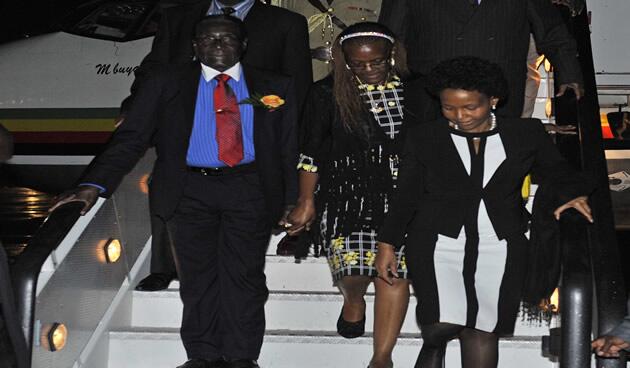
    Last night President Mugabe and his wife Grace joined a long list of world leaders who landed at the Waterkloof Air Force Base just outside Pretoria to attend Nelson Mandela’s memorial and funeral.

    Most if not all of the world leaders attending the funeral had great respect for and revered Madiba and felt the need to pay their last respects. The former and current world leaders attending include people who have clashed with and do not see eye to eye with Mugabe. This is something that presented an interesting logistical challenge for those managing the events.

    One of those people that Mugabe has clashed with is Mandela. It was only a few months ago in an interview with Dali Tambo that Mugabe said the following (the commentary starts approximately 24:30 mins into the video):

    [quote]”They [whites] will praise you only if you are doing things that please them. Mandela has gone a bit too far in doing good to the non-black communities, really in some cases at the expense of [blacks],

    ….. That is being too saintly, too good, too much of a saint.”

    ….. Naturally we will speak good of him [Mandela] but everyone knows he did not do enough for his people”[/quote]

    To add to that, upon hearing news about Mandela’s death it took Mugabe and/or the Zimbabwe Government a lot longer that the rest of the world to respond to the news and send a condolence message. On ZBC, the news was reported about 20 mins into the 8pm News Hour versus it it being the first piece report as it was around the world. Looking from the outside in, this would seem as if as far as Zimbabwe is concerned, the event was a non-event.

    Over the years, comments exchanged have gone both ways with Mandela expressing his disapproval on the way in which matters were being handled in Zimbabwe and going as far as stating that there was a failure of leadership. Mandela was also quoted as saying:

    [quote]”Before I was released from prison, he was the most popular African leader, but when I was released the media said this is the end of Mugabe from the point of view of popularity. In fact he himself didn’t want me to come out of jail,”[/quote]

    This statement is one that the media may or may not be twisting and are saying is the root of a jealousy that caused the dislike that Mugabe has for Mandela.

    The above is only a snippet of what both leaders have had to say about each other and as for some of the reasons why the rift existed, we can only speculate.

    But, Mugabe’s decision to travel to South Africa for the send off leaves you wondering WHY? Does it not?

  • The Zimbabwe 2013 Presidential Election Results

    The Zimbabwe 2013 Presidential Election Results

    President Robert Gabriel Mugabe has been officially declared the winner of the 2013 harmonised elections and effectively giving him a seventh term in office.

    The official Zimbabwe Electoral Commission (ZEC) results are as follows:

    Election Results:

    Robert Mugabe: 2 110 434 votes – 61,09%
    Morgan Tsvangirai: 1 172 349 votes – 33,94%
    Welshman Ncube: 92 637 votes – 2,68%
    Dumiso Dabengwa: 25 416 votes – 0,74%
    Kisinoti Mukwazhi: 9 931 votes – 0,29%

    National Assembly Results:

    Eighth Parliament 210 parliament seats:

    ZANU-PF – 158 seats
    MDC-T – 51 seats
    MDC – zero seats
    Jonathan Samkange (Independent candidate) – 1 seat

  • Widespread Human Rights Violations Threaten Elections in Zimbabwe

    FULL REPORT:

    PRESS STATEMENT

    With just weeks to go before a watershed election, a political atmosphere of intimidation and violence has taken hold in Zimbabwe. Rather than promoting an environment in which civic participation and political tolerance are encouraged, the government of Zimbabwe has engaged in a systematic crackdown on civil society and the human rights community, including arbitrary detention of activists and opposition supporters, and widespread violations against freedom of expression and access to information.

    These are the findings of a report released today by the Robert F. Kennedy Center for Justice and Human Rights (RFK Center) entitled, “A Promise in Peril: How Widespread Rights Violations Undermine Zimbabwe’s Elections.” The report comes one month before Zimbabwe’s July 31 election, and presents findings that were collected during an international delegation organized by the RFK Center in March 2013.

    “The routine intimidation, harassment, and arbitrary criminal prosecutions of human rights defenders, lawyers, and political activists in Zimbabwe threaten the rights of all citizens to participate freely in public affairs,” said Kerry Kennedy, President of the RFK Center. “With an election upcoming, the government must ensure an electoral environment that is consistent with international standards.”

    “These ongoing human rights violations set the stage for the type of violence and chaos that has marred past elections in Zimbabwe. State authorities have engaged in a pattern of suppression that specifically targets groups engaged in voter registration, education, and mobilization initiatives,” said Santiago A. Canton, Director of RFK Partners for Human Rights. “This behavior is unacceptable and represents clear breaches of domestic and international law.”

    In the report, the RFK Center urges the government of Zimbabwe—which is largely dominated by President Robert Mugabe and the Zimbabwe African National Union–Patriotic Front—to immediately cease the continued harassment, intimidation, and violence perpetrated against civic actors. The report also encourages the government to respect international legal conventions to which Zimbabwe is a party or state signatory, including the Universal Declaration of Human Rights, the International Covenant on Civil and Political Rights, the African Charter on Human and People’s Rights, and the Declaration of Principles of Freedom of Expression in Africa.

    This has been a submission by Jeffrey Smith.
    You can connect with Jeffrey Smith via the following:
    You too can become a Citizen Journalist by submitting your story here: Citizen Journalism by Living Zimbabwe
    The views expressed in the article are those of the author and not necessarily Living Zimbabwe.

  • Grace, The Grace Mugabe Interview With Dali Tambo (VIDEO)

    Grace, The Grace Mugabe Interview With Dali Tambo (VIDEO)

    Following on from his interview with President Mugabe (Chimurenga Man, The Robert Mugabe Interview With Dali Tambo (VIDEO)), Dali Tambo also sat down with Zimbabwe’s First Lady, Grace Mugabe.

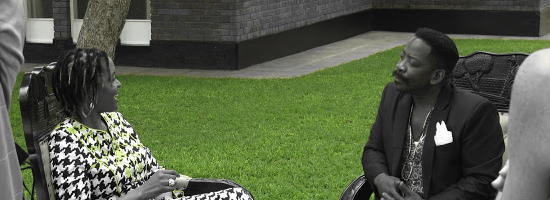
    A few topics were covered during the interview which included how Grace and the president ended up together, how they had kids whilst Sally Mugabe was still alive and those media “rumours” about some of her habits such as extravagant shopping.

    She also spent a lot of time singing praises about her husband as well as emphasising the fact that she is a hard worker and not a lazy person as what some people may seem to think.

    The interview progressed to a family lunch which included a discussion on what kind of a person Robert Mugabe would like to see Bona marry. At the table, Bona and Bellarmine share why they love their mother and father and vice versa with the President and First Lady also being given the opportunity to exchange the same sentiments about each other.

    It is a somewhat interesting watch that may see you raising your eyebrows or shaking your head at certain points.

    Watch it and let us know your thoughts on the interview by leaving a comment below.

  • Chimurenga Man, The Robert Mugabe Interview With Dali Tambo (VIDEO)

    Chimurenga Man, The Robert Mugabe Interview With Dali Tambo (VIDEO)

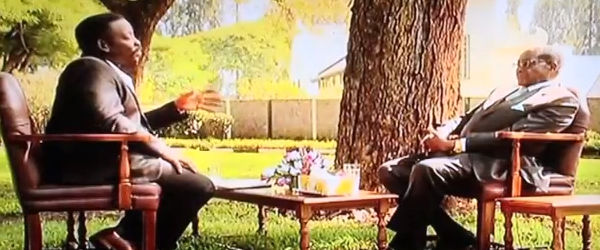
    On the 2nd of June 2013, an episode of People of the South aired on SABC3 where Dali Tambo interviewed President Robert Mugabe. It is one of those interviews that people in Zimbabwe and around the world would be interested in because interviews with Mugabe are a rarity and also that it was marketed as an occasion where viewers got to gain a deeper understanding of and got to see a side of Mugabe that has never been seen.

    The start of the interview (video below) paints Mugabe in the following light,
    “Robert Mugabe is to many the archetypal son of the soil, a strong man, an African gentleman, a controversial man, but above all else, a Chimurenga Man.”

    The interview has had mixed reviews with some people saying that Dali glorified Mugabe by only asking surface questions and not probing or asking the tough questions about the issues that Zimbabwe may be facing. Others look at it as being a good interview, one where has not become the victim of Western media.

    It is an interview that you should watch (if you havent already done so) and make your own assumptions about.

    The interview ends with Mugabe being asked what he would like to be remembered for most with his answer being:
    “There was once a man called Robert Mugabe who in the interests of his own people formed a struggle to liberate them and had ideas, ownership of resources for his own people, and…. the fact that the people should be united, to remain revolutionary, guard against colonial and imperial powers, that seek to undermine the authority…. of governments and what he desired right up to the end that his own people should be masters of their own destiny and that is all. I don’t desire to be know as anything greater than that…….”

    In your own opinion, was the interview good or was it a disappointment?

    Leave a comment with your thoughts.

  • 30 Seconds After – Mugabe’s Motorcade Motorcycle Crash

    30 Seconds After – Mugabe’s Motorcade Motorcycle Crash

    I am one of those people who believe that caring and emotions are definate indicators of being human. Lack of the above makes you any other. While I almost respect RG, I also have my issues with his 80% none human attributes. It is my personal opinion that for the last 32 years this guy has no clue what it is to be Zimbabwean today. You do not need to be informed every minute while you are in your little heaven, experiencing the ups and downs with your people makes you human.

    As for the accident a few days ago, I find myself asking what was going through the minds of

    1. the President, if he was there
    2. the other bikers
    3. the rest of the entourage and the people, witnesses or bystanders thirty seconds later

    Categorically,

    1. I never saw a thing and seriously thinks, “who drives into the back of a lorry mfana angware next time (he should watch out next time)”
    2. if I stop I will be fired or be a victim of an ‘accident’
    3. Sorry, Tiripabasa. Aenda uyu. (we are at work and he is gone).
    4. Ko zvavamusiya achitsva? (how can they leave him to die).

    The burning man represents the real Zimbabweans and where we are 30 seconds later.

    This has been a submission by Rodney Chenge Katsidzira.
    You too can become a Citizen Journalist by submitting your story here: Citizen Journalism by Living Zimbabwe  
    The views expressed in the article are those of the author and not necessarily Living Zimbabwe.

  • Wikileaks United States Embassy Harare Cable on Zimbabwe

    Some of you will know that Wikileaks recently released a number of confidential US embassy cables. As you can imagine, a number of them contained information or sentiments that the United States government may have rather not had the world know about. The US Embassy in Harare was not immune with a 2007 cable being released on what the then ambassador, Christopher Dell had to say about Zimbabwe.

    The full text of the cable (courtesy of Wikileaks) is as follows:

    Source Embassy Harare

    Classification CONFIDENTIAL

    C O N F I D E N T I A L SECTION 01 OF 04 HARARE 000638

    SIPDIS

    SIPDIS

    DEPARTMENT FOR P, AF, AND AF/S FOR MOZENA AND HILL,

    NSC FOR SENIOR AFRICA DIRECTOR B.

    PITTMAN AND B. LEO; USAID FOR M. COPSON AND E. LOKEN

    E.O. 12958: DECL: 07/12/2017

    TAGS: PGOV, PREL, ZI

    SUBJECT: The End is Nigh

    Classified By: Ambassador Christopher W. Dell under Section 1.4b/d

    1. (C) Having said my piece repeatedly over the last three years,

    I won’t offer a lengthy prescription for our Zimbabwe

    policy. My views can be stated very simply as stay the

    course and prepare for change. Our policy is working and it’s

    helping to drive change here. What is required is simply the grit,

    determination and focus to see this through. Then, when the changes

    finally come we must be ready to move quickly to help consolidate

    the new dispensation.

    THE SITUATION

    2. (C) Robert Mugabe has survived for so long because he is more

    clever and more ruthless than any other politician in

    Zimbabwe. To give the devil his due, he is a brilliant

    tactician and has long thrived on his ability to abruptly

    change the rules of the game, radicalize the political

    dynamic and force everyone else to react to his agenda.

    However, he is fundamentally hampered by several factors:

    his ego and belief in his own infallibility; his obsessive

    focus on the past as a justification for everything in the

    present and future; his deep ignorance on economic issues

    (coupled with the belief that his 18 doctorates give him

    the authority to suspend the laws of economics, including

    supply and demand); and his essentially short-term,

    tactical style.

    3. (C) While his tactical skills have kept him in power for 27

    years, over the last seven this has only been achieved by a

    series of populist, but destructive and ultimately

    self-defeating moves. In reaction to losing the 2000

    referendum on the constitution, a vengeful Mugabe unleashed

    his “Green Bombers” to commit land reform and in the

    process he destroyed Zimbabwe’s agricultural sector, once the

    bedrock of the economy. While thousands of white farmers

    saw their properties seized, hundreds of thousands of black

    Zimbabweans lost their livelihoods and were reduced to utter

    poverty. In 2005, having been forced to steal victory by

    manipulating the results of an election he lost, Mugabe

    lashed out again, punishing the urban populace by launching

    Operation Murambatsvina. The result was wholesale

    destruction of the informal sector, on which as much as

    70-80 percent of urban dwellers had depended, and the

    uprooting of 700,000 Zimbabweans. The current inflationary

    cycle really began with Murambatsvina, as rents and prices

    grew in response to a decrease in supply.

    4. (C) And now, faced with the hyperinflationary consequences

    of his ruinous fiscal policies and growing reliance on the

    printing press to keep his government running, Mugabe has

    launched Operation Slash Prices. This has once again given

    him a very temporary boost in popularity (especially among

    the police, who have led the looting of retail outlets and

    now seem well positioned to take a leading role in the

    black market economy) at the cost of terrible damage to the

    country and people. Many small grocery and shop owners,

    traders, etc., will be wiped out; the shelves are

    increasingly bare; hunger, fear, and tension are growing;

    fuel has disappeared. When the shelves are still empty

    this time next week, the popular appeal of the price roll

    back will evaporate and the government simply doesn’t have

    the resources to replace the entire private commercial

    sector and keep Zimbabweans fed. It may attempt to do so

    by printing more money, adding even more inflationary

    pressure on a system already reeling from the GOZ’s

    quasi-fiscal lunacy combined with the price impact of

    pervasive shortages. The increasingly worthless Zim dollar

    is likely to collapse as a unit of trade in the near

    future, depriving the GOZ of its last economic tool other

    than sheer thuggery and theft of others’ assets.

    5. (C) With all this in view, I’m convinced the end is not

    HARARE 00000638 002 OF 004

    far off for the Mugabe regime. Of course, my predecessors

    and many other observers have all said the same thing, and

    yet Mugabe is still with us. I think this time could prove

    different, however, because for the first time the

    president is under intensifying pressure simultaneously on

    the economic, political and international fronts. In the

    past, he could always play one of these off against the

    other, using economic moves to counter political pressure

    or playing the old colonial/race/imperialist themes to buy

    himself breathing room regionally and internationally. But

    he is running out of options and in the swirling gases of

    the new Zimbabwean constellation that is starting to form,

    the economic, political and international pressures are

    concentrating on Mugabe himself. Our ZANU-PF contacts are

    virtually unanimous in saying reform is desperately needed,

    but won’t happen while the Old Man is there, and therefore

    he must go (finding the courage to make that happen is

    another matter, however, but even that may be coming closer).

    This is not some sudden awakening on the road to

    Damascus, but a reflection of the pain even party insiders

    increasingly feel over the economic meltdown. We also get

    regular, albeit anecdotal, reports of angry and

    increasingly open mutterings against Mugabe even in ZANU-PF’s

    traditional rural bastions. Beginning in March, the

    other SADC leaders finally recognized (in the wake of the

    terrible beatings of March 11 and the international outcry

    that followed–another self-inflicted wound for Mugabe)

    that Zimbabwe is a problem they need to address. Thabo

    Mbeki appears committed to a successful mediation and is

    reportedly increasingly irritated with Mugabe’s efforts to

    manipulate him or blow him off altogether. If Mugabe

    judges that he still commands all he surveys by virtue of

    being the elder statesman on the scene, he may be

    committing yet another serious blunder. Finally, one does

    well to recall that the only serious civil disturbances

    here in a decade came in 1998 over bread shortages, showing

    that even the famously passive Shona people have their

    limits. The terror and oppression of the

    intervening years have cowed people, but it’s anyone’s guess

    whether their fear or their anger will win out in the end.

    WHAT WILL THE END LOOK LIKE?

    6. (C) This is the big, unanswerable question. One thing

    at least is certain, Mugabe will not wake up one morning a

    changed man, resolved to set right all he has wrought. He

    will not go quietly nor without a fight. He will cling to

    power at all costs and the costs be damned, he deserves to

    rule by virtue of the liberation struggle and land reform and

    the people of Zimbabwe have let him down by failing to

    appreciate this, thus he needn’t worry about their

    well-being. The only scenario in which he might agree to

    go with a modicum of good grace is one in which he

    concludes that the only way to end his days a free man is

    by leaving State House. I judge that he is still a long

    way from this conclusion and will fight on for now.

    7. (C) The optimal outcome, of course, and the only one that

    doesn’t bring with it a huge risk of violence and conflict, is

    a genuinely free and fair election, under international

    supervision. The Mbeki mediation offers the best, albeit

    very slim, hope of getting there. However, as Pretoria

    grows more and more worried about the chaos to its north

    and President Mbeki’s patience with Mugabe’s antics wears

    thin, the prospects for serious South African engagement

    may be growing. Thus, this effort deserves all the support

    and backing we can muster. Less attractive is the idea of

    a South African-brokered transitional arrangement or

    government of national unity. Mbeki has always favored

    stability and in his mind this means a ZANU-PF-led GNU, with

    perhaps a few MDC additions. This solution is more likely

    to prolong than resolve the crisis and we must guard

    against letting Pretoria dictate an outcome which

    HARARE 00000638 003 OF 004

    perpetuates the status quo at the expense of real change

    and reform.

    8. (C) The other scenarios are all less attractive: a popular

    uprising would inevitably entail a bloodbath, even if it

    were ultimately successful; Mugabe’s sudden, unexpected

    death would set off a stampede for power among ZANU-PF

    heavy weights; a palace coup, whether initiated within

    ZANU-PF or from the military – in which Mugabe is removed,

    killed, exiled or otherwise disposed of, could well devolve

    into open conflict between the contending successors. Similarly,

    some form of “constitutional coup” i.e., a change at the top

    engineered within the framework of ZANU-PF’s “legitimate”

    structures could well prove to be merely the opening bell

    in a prolonged power struggle. None of the players is

    likely to go quietly into the night without giving everything

    they have, including calling on

    their supporters in the security services. Moreover, experience

    elsewhere would suggest that whoever comes out on top

    initially will struggle, and more than likely fail, to halt

    the economic collapse. Thus, there is a good prospect of

    not one but a series of rapid-fire “transitions,” until

    some new, stable dispensation is reached.

    9. (C) The final, and probably worst, possibility is that Mugabe

    concludes he can settle for ruling over a rump Zimbabwe,

    maintaining control over Harare and the Mashona heartland,

    the critical forces of the National Reserve Force and CIO

    and a few key assets–gold, diamonds, platinum and Air

    Zimbabwe to fund the good times. Under this scenario the

    rest of the country, in one of the comrade’s favorite

    phrases, could “go hang,” leaving it to the international

    community to stave off the worst humanitarian consequences.

    WHAT OF THE OPPOSITION?

    10. (C) Zimbabwe’s opposition is far from ideal and I leave

    convinced that had we had different partners we could have

    achieved more already. But you have to play the hand you’re dealt.

    With that in mind, the current leadership has little executive

    experience and will require massive hand holding and assistance

    should they ever come to power.

    11. (C) Morgan Tsvangarai is a brave, committed man and, by and

    large, a democrat. He is also the only player on the scene

    right now with real star quality and the ability to rally

    the masses. But Tsvangarai is also a flawed figure, not

    readily open to advice, indecisive and with questionable

    judgment in selecting those around him. He is the indispensable

    element for opposition success, but possibly an albatross around

    t heir necks once in power. In short, he is a kind of Lech Walesa

    character: Zimbabwe needs him, but should not rely on his executive

    abilities to lead the country’s recovery. Arthur Mutambara is young

    and ambitious, attracted to radical, anti-western rhetoric and

    smart as a whip. But, in many respects he’s a light-weight

    who has spent too much time reading U.S. campaign messaging

    manuals and too little thinking about the real issues. Welshman

    Ncube has proven to be a deeply divisive

    and destructive player in the opposition ranks and the

    sooner he is pushed off the stage, the better. But he is

    useful to many, including the regime and South Africa, so

    is probably a cross to be borne for some time yet. The

    prospects for healing the rift within the MDC seem dim,

    which is a totally unnecessary self-inflicted wound on

    their part this time. With few exceptions–Tendayi Biti,

    Nelson Chamisa–the talent is thin below the top ranks.

    The great saving grace of the opposition is likely to be

    found in the diaspora. Most of Zimbabwe’s best

    professionals, entrepreneurs, businessmen and women, etc.,

    have fled the country. They are the opposition’s natural

    allies and it is encouraging to see signs, particularly in

    South Africa and the UK, that these people are talking,

    HARARE 00000638 004 OF 004

    sharing ideas, developing plans and thinking together about

    future recovery.

    12. (C) Unfortunately, among the MDC’s flaws is its inability to

    work more effectively with the rest of civil society. The

    blame for this can be shared on both sides (many civil

    society groups, like the NCA, are single-issue focused and

    take the overall dynamic in unhelpful directions; others,

    like WOZA, insist on going it alone as a matter of

    principle), but ultimately it falls to the MDC as the

    largest and the only true political party, to show the

    way. Once again, however, these are natural allies and

    they have more reason to work together than fight against each

    other.

    STAYING THE COURSE, PREPARING FOR CHANGE

    13. (C) If I am right and change is in the offing, we need to

    step up our preparations. The work done over the last year on

    transition planning has been extremely useful, both for

    stimulating a fresh look at our own assumptions and plans

    and for forging a common approach among the traditional

    donor community. But the process has lagged since the

    meetings in March in London and should be re-energized. It is

    encouraging in this respect that USAID Washington has

    engaged the Mission here in discussing how we would use

    additional resources in response to a genuinely

    reform-minded government . I hope this will continue and

    the good work done so far will survive the usual

    bloodletting of the budget process.

    1. (C) The official media has had a field day recently whooping

    that “Dell leaves Zimbabwe a failed man”. That’s not quite

    how it looks from here. I believe that the firm

    U.S. stance, the willingness to speak out and stand up,

    have contributed to the accelerating pace of change.

    Mugabe and his henchman are like bullies everywhere: if

    they can intimidate you they will. But they’re not used to

    someone standing up to them and fighting back. It catches them

    off guard and that’s when they make mistakes. The howls of protest

    over critical statements from Washington or negative coverage

    on CNN are the clearest proof of how this hurts them. Ditto

    the squeals over “illegal sanctions.” In addition, the regime

    has become so used to calling the shots and dictating the

    pace that the merest stumble panics them. Many local

    observers have noted that Mugabe is panicked and

    desperate about hyperinflation at the moment, and hence he’s

    making mistakes. Possibly fatal mistakes. We need to

    keep the pressure on in order to keep Mugabe off his game

    and on his back foot, relying on his own shortcomings to do

    him in. Equally important is an active U.S. leadership

    role in the international community. The UK is ham-strung

    by its colonial past and domestic politics, thus, letting them

    set the pace alone merely limits our effectiveness. The EU is

    divided between the hard north and its soft southern

    underbelly. The Africans are only now beginning to find

    their voice. Rock solid partners like Australia don’t

    pack enough punch to step out front and the UN is a

    non-player. Thus it falls to the U.S., once again, to take

    the lead, to say and do the hard things and to set the agenda.

    Hundreds, maybe thousands, of ordinary Zimbabweans of all

    kinds have told me that our clear, forthright stance has

    given them hope and the courage to hang on. By this regime’s

    standards, acting in the interests of the people may indeed be

    considered a failure. But I believe that the opposite is true,

    and that we can be justifiably proud that in Zimbabwe we have

    helped advance the President’s freedom Agenda. The people of

    this country know it and recognize it and that is the true

    touchstone of our success here.