Category: People

  • Why the rich will get the job and the promotion

    Why the rich will get the job and the promotion

    Growing up l was fortunate enough to attend one of the better schools in Zimbabwe at high school level and during my studies, l interacted with kids from very rich backgrounds and by rubbing shoulders with them l learnt and noticed a lot of things which made these kids to have soft skills to thrive in the corporate world even at a very young age, it was like they were destined for success in the corporate world.

    Candidates at job interviews expect to be judged on their work experience, education, and skills, but a new study by Yale University researchers provides evidence that interviewees are judged based on their social status seconds after they start to speak. Based solely on a brief listening to an interviewee’s speech, the study shows that the interviewer can immediately spot someone’s socioeconomic level. This includes a person’s income, education and career status.

    Michael Kraus, assistant professor of organizational behaviour at the Yale University School of Management, claims, “Our study shows that even during the briefest interactions, a person’s speech patterns shape the way people perceive them, including assessing their competence and fitness for a job.” “While most hiring managers would deny that a job candidate’s social class matters, in reality, the socioeconomic position of an applicant or their parents is being assessed within the first seconds they speak and we all know how those rich kids can speak A grade English and how we all think that people with a very gud english command are intelligent.

    Again It’s difficult not to be impressed by a candidate with a Havard education, tailor-made suit and a spring in their step. Social class shapes the beliefs that people hold about their abilities and that, in turn, has important implications for how status hierarchies perpetuate. Peter Belmi, assistant professor of leadership and organizational behaviour at the University of Virginia, and Margaret A. Neale, a professor of management at Stanford University, wrote.

    They come to meetings with soft skills that are invaluable to climbing up the corporate ladder: They might have learned how to schmooze at an early age, and feel comfortable talking to senior management as if they’re old friends. They know how to affirm people’s ideas and make them feel good about themselves, and maybe even repackage a couple for themselves.

    Early childhood experiences can be very consequential for children’s long-term social, emotional, and cognitive development.

    Again have you ever noticed that upper-class people are overconfident and that overconfidence, in turn, makes them appear more competent and more likely to attain social rank. In other words, they were more likely to get the job. Not everyone has the innate ability to eye an opportunity with a kind of confidence or, some might say, entitlement. That ambition and confidence is likely instilled in people at a young age and often that happens if you are from a privileged background.

    Upper-class children are well-connected individuals who feel like they were born to rule the world or, at the very least, leapfrog over Takudzwa in HR and make appearances in politics, academia, and cubicles and boardrooms across the land. Impression management can, indeed, trump smarts, a latest research said. “It can provide them a path to social advantage by making them appear more competent in the eyes of others,”

    You ever wondered why some people are so good at organizational politics?? for others, organizational politics started from a young age at school. Do you remember those kids in class who always wanted to be liked by the lecture/ teacher, do you remember when they would remind the teacher that we are supposed to write a in class today? Did you notice how those kids would tend to become head boys or head girls. Now when we get to the workplace they are no longer boot kissing the teacher they are now boot kissing the boss and they are no longer becoming head boys they are becoming your immediate supervisor, they are no longer writing you on the noisemakers list but are now giving you a written warning.
    This has been a submission by Takudzwa Kufa.
    Experienced Professional with more than 3 years’ of experience & recognized skills in handling end to end Human Resource Operations and Business Administration with versatile exposure in the Tourism and Hospitality, Media &NGO industry.
    You too can become a Citizen Journalist by submitting your story here: Citizen Journalism by Living Zimbabwe
    The views expressed in the article are those of the author and not necessarily Living Zimbabwe.

  • How a grandmother keeps snakes away from her Harare home

    How a grandmother keeps snakes away from her Harare home

    Winter has pretty much come and gone and we are well and truly into the heat of things as far as the temperature is concerned. For cold-blooded animals such as snakes and lizards, this brings about the time to come out in full force and do what they do best. It is said that animals such as snakes go into hibernation (brumation to be more correct) in winter but do they really? The video below of a snake crossing a road was taken during winter:

    https://www.facebook.com/LivingZimbabwe/videos/2617643591594450/

    “The last thing that you want to do at the end of the day is get into bed and find a snake in your sheets”

    Those were the words uttered by a grandmother living on Harare’s city fringe. The area in which she lives has traditionally had a healthy snake population. On occasion, a snake would be seen around and sometimes in the house. On one occasion, her three-year-old grandchild spotted a snake that had made its way into the house. Thankfully, the child was instinctive enough to get out of the room as quickly as possible and raise the alarm without the child being harmed.

    In another incident, an acquaintance of hers told the story of an encounter her ‘garden boy’ had with a snake. In a small dim room lit by candlelight, as he was preparing for bed, something possessed him to look under his bed. To his surprise, he found a snake under his bed. A lot of commotion ensued with a lot of shouting and items being thrown at the snake which had now displayed its hood. All of this eventually led to the snake (which they identified as a cobra) being killed. As you can imagine this left him and others living on the property a little shaken at the thought of having been in such close proximity of a deadly snake for who knows how long?

    Incidents like these coupled with a seeming rise in the snake population the area prompted this grandmother to search for and put in place measures to try and keep snakes away.

    Reducing the snake population in the yard

    As a start, she decided to completely clean up her yard. This meant cleaning out those ‘things’ that find themselves piling up here and there. It also meant clearing up often neglected parts of the yard where grass and other vegetation are left to grow wild. By doing this, it took away places where snakes could hide.

    Another step was getting rid of the chicken run which was you can imagine is a snake magnet. Chicken runs offer the prospect of an easy meal with the poultry, eggs and as well as rodents that are also looking for an easy meal.

    Other steps that one could take to reduce the number of snakes in the yard include:

    • keeping the rodent population under control
    • keeping the frog population under control (especially so if you have a water body that they live in)
    • putting shade cloth on the perimeter fence (1m high and dug 30cm into the ground)
    • invite a snake handler to your property to identify possible areas that may attract snakes or where they may hide

    Repelling snakes with Garden Rue

    Garden-rue-Zimbabwe

    One recommendation from a friend and another third step that she took was to plant garden rue around the yard.

    Rue is a plant that many believe repels snakes. There are many people selling this and other plants and touting them as effective snake repellents.

    But, science tells us otherwise. These kinds of plants and other commercially available chemical repellents have strong smells that irritate human noses. A snakes nose and how they smell the world is very different from that of humans. This makes such repellents effectively useless.

    However, as far as this grandmother goes, after taking the steps above, she saw a marked reduction in the number of snakes spotted around her yard. As she took so many measures to control the snake population, there is no real way of pinpointing what the most effective method was or what worked or didn’t work. It may have all been a matter of chance? Whatever the case may be, she is sleeping a little easier.

    How do you deal with snakes that make their way onto your property? Leave a comment below.

    Here is some information that may come in handy if you ever encounter a snake

    What to do when bitten by a snake

    The first thing to do is to try and not get bitten. It is said that a big percentage of snake bites occur when people are trying to kill snakes. If you don’t have the necessary skills to handle a snake, leave it alone and get a hold of someone who does.

    If you or someone else is bitten by a snake, take the following steps:

    • get them to a hospital/trauma centre as soon as possible
    • keep them calm and as still as can be
    • take a photo of the snake (if possible) to aid in treating the snakebite
    • do not cut the bite area and try to suck out the venom
    • do not apply a tourniquet

    Who to call for help when you spot a snake in Harare, Bulawayo & Victoria Falls

    Whenever you come across a snake in an inhabited area and there is no safe and easy way for it getting away on its own, get help! There are a few snake handlers around the country who can be called upon.

    Zimbabwe Snake Handlers is good first port of call for all things ‘snake’ in Zimbabwe https://www.facebook.com/zimsnakers/. You can get in touch with them to find a snake handler in your area.

    The Lion Park & Snake World has a few snake removal contacts listed on their Facebook page and they include:

    Harare

    Ben Grainger 07771758682

    Chawatama Marimo 0772269647 https://www.facebook.com/chawaman/

    Daniel Van Tonder 0775707118

    Ben Vermeulen – Reptile Rescue 0772275550 https://www.facebook.com/Bens.reptile.rescue/

    Steven Shearer 0776825983

    Bulawayo

    Ahmed Esat 0775714014

    Christopher Burton 0772162815

    Norman Crooks 0778730145

    Ross Johnston 0778547331

    Christopher Burton 0772162815

    Norman Crooks 0778730145

    Ross Johnston 0778547331

    Victoria Falls

    Abraham Singano 0782894732

    Devine Matemba 0774020853

    Paul Teasdale 0772368010

    Stuart Danks 0772302747

    Some interesting facts about snakes

    • Zimbabwe has 81 different types of snakes
    • 13 species are potentially deadly 
    • Ophidiophobia is the fear of snakes. Ophis, Greek for serpent
    • The black mamba is considered the most dangerous snake due to its size and very potent venom
    • Puff adders are responsible for most snakebite deaths

    Featured image source: Snouted Cobra by Steven Gilham– Under Creative Commons license

  • Traffic cops clash with kombi drivers

    Traffic cops clash with kombi drivers

    The “Ngongonos” or Knockers have resurfaced again on the streets of Harare. These truncheon wielding traffic control officers who have earned the moniker “ Mangongongo” from touts and drivers manning the illegal undesignated bus stops strewn all over the city center commonly referred to as “Mshika,shika” are bearing down hard on errant kombi drivers and touts.

    According to one Emmanuel, a Kombi driver who plies the Quendon, Westgate route in and out of town and uses the undesignated bus stop at the corner of Mbuya Nehanda and Jason Moyo, “These traffic officers are not only smashing windscreens, but have graduated to smashing tail lights and head lights also, as well as the driver and touts who happen to be in the range of their Billy clubs”.

    Civilians are in constant fear of their lives as these illegal Kombi drivers will perform daring stunts in order to evade capture by the baton-wielding officers of the law, who will impound vehicles caught on the wrong side of the law or in some cases, according to Emmanuel, “they will demand a hefty bribe of about $50, which you either pay or risk getting your vehicle impounded, so running away is the better option as money is hard to come by these days”.

    Lincoln a student at the Harare Polytechnic who boards Kombis at the “Mshika, shika” said “they had now learned that one does not tarry at the door when boarding a kombi as one can be injured or get run over as kombi drivers try to evade capture”, it is unfortunate that most commuters are not as nimble or agile and so they are in constant danger.

    The City council is also in pursuit of errant drivers and will impound vehicles as well and they have been alleged to also collect their own bribes, so touts have to be extra vigilant and keep watch for any council police who maybe on the prowl. Last year a four-year-old boy lost his life, after being knocked down by a driver trying to evade capture at Park Street and Union “Mshika, shika”.

    Despite the dangers posed by these undesignated bus termini, one wonders why they are thriving so much and seem to be a permanent eyesore in the city center. According to one commuter who uses these bus stops, “We have no choice because at the designated bus stops we are charged double the normal fare during peak hours, and during non-peak hours the kombis take hours to load as they are fewer boarders so one is forced to spend a lot of time waiting for the bus to fill up as they only go when the bus is full”.

    Kombi drivers exploit these illegal bus stops because according to one undercover traffic officer who declined to be named, most Kombi drivers use the Mshika, shika because their vehicles are not properly registered or have been condemned at the Vehicle Inspection Department and deemed un road worthy so it is a way for them to make quick money as they can operate their vehicles from these illegal points as they are not allowed to operate from designated bus terminus.

    This has been a submission by Kevin Ngwazane.
    You too can become a Citizen Journalist by submitting your story here: Citizen Journalism by Living Zimbabwe
    The views expressed in the article are those of the author and not necessarily Living Zimbabwe.

  • How do you feel about street vendors in Harare?

    How do you feel about street vendors in Harare?

    Vendors have for the longest, been part and parcel of the economic machine not only in Harare and other parts of Zimbabwe for that matter. They have been there on the roadside selling fruit and vegetable, they have been there darting in and out of traffic at robots selling airtime and other bits and pieces, they have been in car parks selling clothing out of the boots of their cars; and now they are really there, selling whatever it is that they think the public may want to get their hands on as they walk along the streets of the central business district.

    In a number of instances, they can be seen as providing a service of convenience because you can get your airtime, a newspaper, chibage, tomatoes, clothing and so on without leaving the comfort of your car or if you are a pedestrian, you may not have to venture too far out of your way to get what you need.

    However, the number of vendors on the streets has increased exponentially and this could be for a number of reasons with one of them possibly being the lack of gainful employment in the formal sector and people turing to the informal to make ends me.

    Whatever the cause may be, the surge in their numbers has caused contention and the government has given them an ultimatum to move off the streets and set up shop in specially designated areas where they can ply their trade.

    Truth be told, the surge in their numbers has in some cases caused a bit of nuisance because navigating some of the sidewalks in Harare becomes a bit of a challenge when they decide to set up shop there.

    Without a doubt a significant amount of money is exchanged in this informal economy and the government looking to move them to designated areas, this creates an opportunity for them to collect tax revenue. That said, it is a little easier to see why the government may be so keen to see vendors move into ‘controlled’ areas – go here for details.

    On the same token, clamping down on vendors may for them mean losing out on a revenue stream. If this was the only way in which they made ends meet then what do they do to feed themselves and their families?

    Here is a bit of the reaction that people have had about the issue of vendors in days gone by:

    Share your thoughts (by leaving a comment below) on how you feel about vendors on our streets.

  • My Pride

    My Pride

    I have lived in Zimbabwe all my life so I have seen a bit, or a whole lot of what being a Zimbabwean means. Growing up I have learnt how hardworking my people , how dedicated they become to what ever they are applying themselves. I have seen how united we are when it comes to matters that matter the most, noticed how we acknowledge the fact that God does love this country. Being Zimbabwean is knowing what is right and wrong, being able to look at a situation and knowing how to react appropriately. No matter how painful the attacks in SA on our brothers are, we know better, we know how to react better because we understand and value laws of our country, and obviously need the food. God Bless Zimbabwe.

    This has been a submission by Taff.
    You too can become a Citizen Journalist by submitting your story here: Citizen Journalism by Living Zimbabwe
    The views expressed in the article are those of the author and not necessarily Living Zimbabwe.

  • Grace without Mugabe?

    Grace without Mugabe?

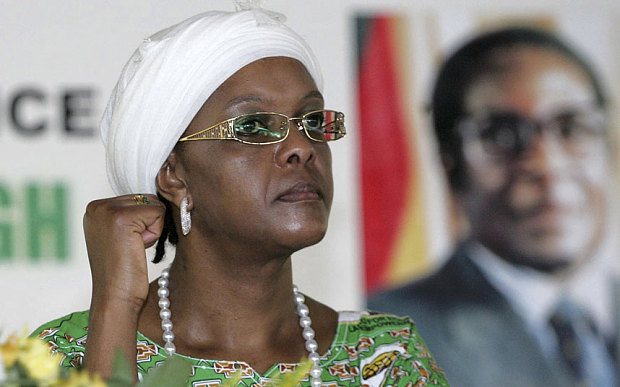
    Once upon a time, Grace Marufu found herself in a position where she was lucky enough to work as a secretary in the President’s office. This then secretary caught President Mugabe’s attention with the encounter progressing into a romantic relationship. The relationship developed even further as the two went on to have children and the couple eventually got married in 1996 and Grace officially became Mrs. Mugabe.

    Being the president’s wife, she has not managed to escape the media spotlight. But, over the years she has managed to get herself into the spotlight through actions of her own. As you can imagine, these moments have been somewhat unglamorous as they have included highlighting extravagant shopping, moments of attacking journalists and dodgy business deals being exposed.

    Amai Mugabe is back in spotlight as she was recently conferred with a PhD from the University of Zimbabwe and has also immersed herself in frontline politics as she was recently nominated to head the Zanu-PF Women’s League.

    Many women around the African continent who have made their way into the upper echelons of politics usually have a story of personal achievement behind them that has propelled them into leadership.

    Now, imagine a scenario where we take Amai Dr Grace Mugabe back to the time when she was a secretary in the president’s office. Imagine the President had not noticed her and she continued life as who she was. She would not have been a Mugabe and everything associated with it would not have been part of her life over the last two and bit decades.

    So now we have Grace stripped of any close association to President Mugabe and still married to her first husband.

    If all the layers are peeled back and you are to look at who she is, and all that she has done, what is it that would define who she is today? Would she be the Grace of today who has a PhD and also the woman heading the Zanu-PF Women’s League?

    Have a think about it for a moment…… If her life hadn’t taken the turn it did some twenty plus years ago, where would Grace be without Mugabe?

    Share your thoughts by leaving a comment below.

  • Exposing Baba Jukwa: Our right to privacy

    Exposing Baba Jukwa: Our right to privacy

    Exposing Baba Jukwa: Our rights to privacy

    On several occasions, state media namely the herald and Sunday mail have published ‘leaked’ emails and information exchanges by prominent politicians and socialites in Zimbabwe. Several names like Eddie cross, Tendai Biti, Elizabeth Macheka and Obert Gutu have been victims of the leaks. Questions arise as to who leaks this information? How do they do it and for what reasons?

    We are aware of the US whistle-blower Edward Snowden, who leaked many NSA documents that show the US government, has been spying on citizens globally. It revealed the agency spied even on allies like German Chancellor Angela Merkel. It is not the US government alone that spies on citizens. Recently there were reports that Ethiopian government was acquiring spy technology (to spy on citizens).

    We have two possibilities: ether the state media fabricates these stories (propagandist machinations) or the information is true. If it is true, then the state media accessed the information from another state department. Whichever way it goes, the state knows who leaks the people’s information and how they do it.

    Last week I attended a workshop that touched on digital security, which proved to be a revelation to the majority of us participants. As I was just digesting what I learnt from the workshop the media was awash with news that baba Jukwa had been caught. I have not much sympathy for Baba Jukwa especially now that he is no longer relevant as elections are over but what grabbed my attention is how they claim they caught him. They (whoever they are) are said to have successfully hacked into his/her email account. The news is spine chilling to someone who values his or her privacy. Those hackers purport that Baba Jukwa is Mxolisi Ncube a journalist with the Zimbabwean.

    Mxolisi Ncube denies the accusations and says he only interviewed the faceless Facebook character. He admits to have corresponded with the Baba Jukwa. Whether Mxolisi is the real baba Jukwa or he is being set up, it is not much of an issue compared to the methods used to try and expose the Baba Jukwa. I wonder how many accounts of ordinary citizens have been hacked so far. How much of our private information has government accessed illegally?

    In the movies, hacking seems a lot of fun and exciting but truth be told; it is an infringement on our basic human rights. Section 57 of the new constitution states that, “every person has the right to privacy…” and part (d) specifically provides for privacy of data or communication. What it means is that no one has the right to access your private and personal information without your consent. It is an infringement for one to browse through my phone (snooping) without my consent. It is our fundamental right yet someone is bragging that he/she successfully hacked Mxolisi Ncube’s emails. Their excuse for hacking is defending national security. We are the people. We are the nation. There is no way they can protect us by hacking into our accounts.

    However, part of the blame lies squarely on us. Many of us are reckless with how we share our personal information online. As I learnt at the workshop, a few things will help us be more secure online.

    1. Always think twice before you accept any friend requests, open strange emails, or download those viral files on apps like WhatsApp. Some of it is carrying spyware.
    2. Have different passwords for your different accounts and only you must know them. A strong password must contain symbols and numerals.
    3. Think before you click on those pop-up ads. Many of them will lead you to unsecure sites where you are asked to type in your personal information.
    4. Never give personal information online. Many of the sites relay the information to hackers.
    5. Always log out from all your open accounts and delete history and cookies after you use a device that is not yours or that is available for the public. Hackers and/or other criminals can use this history can use to enter into your accounts.

    So even if whether we are fans of baba Jukwa or not, the way he has been exposed must worry us. When ordinary citizen Mxolisi Ncube has his right to privacy infringed upon, we all must get vocal or the vices will not stop. After Mxolisi, it is you or I.

    This has been a submission by Ittai Bryan.
    You can connect with Ittai via the following: http://ibmatteu.blogspot.com.
    You too can become a Citizen Journalist by submitting your story here: Citizen Journalism by Living Zimbabwe
    The views expressed in the article are those of the author and not necessarily Living Zimbabwe.
  • Telling The African Narrative Like Komla Dumor

    Telling The African Narrative Like Komla Dumor

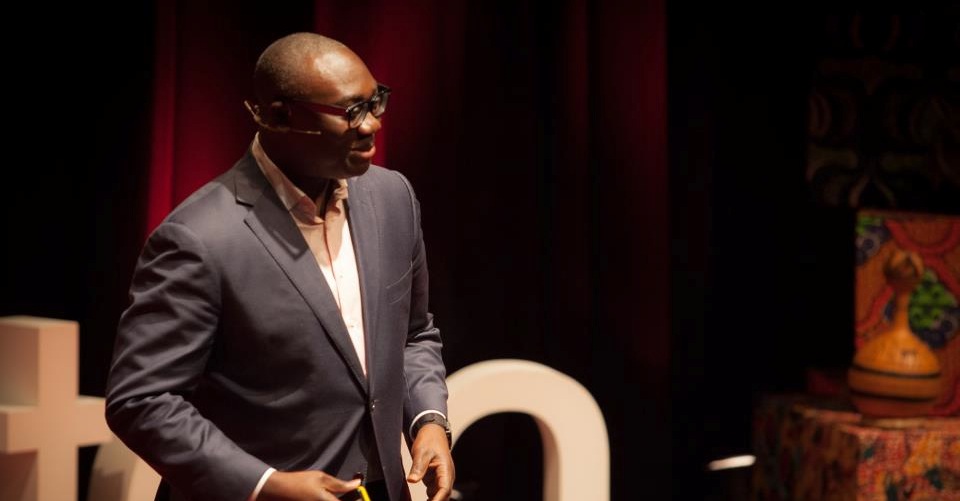
    When it came to telling the world stories about Africa, no-one did it as well as Komla Dumor. He was a person who believed that you needed to understand people and collaborate with them in order to tell Africa’s story. Having this kind of an attitude towards his journalism is one of the things that made him stand out. It also made shows such as BBC’s Focus on Africa a success which did a lot in raising the profile of Africa.

    Sadly, Komla suddenly passed away on the 18th of January, 2014. The news came as a shock and he will be missed by not only by family and friends but by people around the world who he reached through his work.

    In 2013 he spoke at TEDxEuston on telling the African story. This is one of the many things to remember him by and in this talk he also imparts words of wisdom for those who want to tell the African story or that of an African nation that they call home. His presentation draws you in with a mix of realness and humor as he gets across four points that he saw as being essential to telling the African story. They included not just telling one side of the story but having “balance” with a second point being the question of who an expert on Africa is, is it someone from Washington or London?

    He finished off his talk with a proverb that he leaves open for interpretation:

    [quote]The narrative will always glorify the hunter until the lion itself learns how to write[/quote]

    The talk is well worth a watch. Rest in Peace.

    If you have a story to tell, you can share it with the world right here on Living Zimbabwe. To Find out more and to make a contribution, visit Citizen Journalism by Living Zimbabwe.

  • Lessons For Zimbabwe & Africa From Tributes Made At Mandela’s Farewell

    Lessons For Zimbabwe & Africa From Tributes Made At Mandela’s Farewell

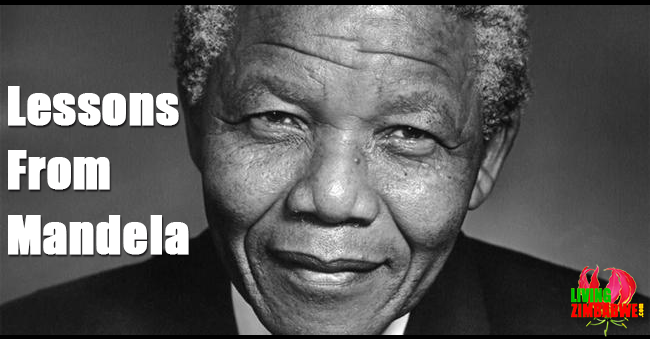
    On Sunday December 15, 2013, the iconic Nelson Rolihlahla Mandela was laid to rest in Qunu, the place that he called home.

    He took his last breath on Thursday 5 December and the 10 days leading up to his return to the soil has been marked with a number of ceremonies. This included a memorial service which was attended by the people of South Africa and about 90 current and former heads of state from around the world.

    There were moments throughout the 10 day period that were emotional with people being in a sometimes celebratory mood (celebrating the life that was), a mournful mood, comical such as the news of the sign language interpreter who’s interpreting didn’t mean a thing and a little political such as Zuma being booed and Mugabe being cheered by the crowds.

    A few of the world leaders who attended the memorial and funeral services made speeches to bid farewell to Mandela. The speeches highlighted interactions that the speakers had with Madiba or aspects of his life that inspired them to be who they are today. A lot of the speeches included lessons and wisdom that leaders and nations at large can take on board and apply as they work towards a better tomorrow.

    Below are extracts of some of the speeches made to honour Mandela:

    Barack Obama (President of the United States):

    [quote]The questions we face today – how to promote equality and justice; how to uphold freedom and human rights; how to end conflict and sectarian war – these things do not have easy answers. But there were no easy answers in front of that child born in World War I. Nelson Mandela reminds us that it always seems impossible until it is done. South Africa shows that is true. South Africa shows we can change, that we can choose a world defined not by our differences, but by our common hopes. We can choose a world defined not by conflict, but by peace and justice and opportunity.[/quote]

    [quote]And finally, Mandela understood the ties that bind the human spirit. There is a word in South Africa, Ubuntu, a word that captures Mandela’s greatest gift: his recognition that we are all bound together in ways that are invisible to the eye; that there is a oneness to humanity; that we achieve ourselves by sharing ourselves with others, and caring for those around us.[/quote]

    The full transcript of Barak Obama’s speech can be found here

    Joyce Banda (President of Malawi & SADC Chief):

    [quote]I learned that leadership is about falling in love with the people and the people falling in love with you. It is about serving the people with selflessness, with sacrifice and with the need to put the common good ahead of personal interests.[/quote]

    [quote]Tata Madiba taught us that even when the challenges of life seem insurmountable, with courage and determination, we can overcome the evils of our societies.[/quote]

    [quote]The ideals of political, social and economic emancipation that he stood for will inspire us forever as a Region.[/quote]

    This was one of the speeches that was both moving and inspirational hence the inclusion of the video below:

    The full transcript of Joyce Banda’s speech can be found here

    Ahmed Kathrada (close friend of Madiba, South African politician and former political prisoner and anti-apartheid activist)

    [quote]Madala, your abundant reserves of love, simplicity, honesty, service, humility, care, courage, foresight, patience, tolerance, equality and justice, continually served as a source of enormous strength to many millions of people in South Africa and the world. You symbolize today, and always will, qualities of collective leadership, reconciliation, unity and forgiveness. You strove daily to build a united, non-racial, non-sexist and democratic South Africa.[/quote]

    [quote]In this spirit, so exemplified in your life, it is up to the present and next generations to take up the cudgels where you have left off. It is up to them, through service to deepen our democracy; entrench and defend our Constitution; eradicate poverty; eliminate inequality; fight corruption, and serve always with compassion, respect, integrity and tolerance. Above all, they must build our nation and break down the barriers that still divide us.[/quote]

    The full transcript of Ahmed Kathrada’s speech can be found here

    Kenneth Kaunda (Former President of Zambia)

    The former Zambian president was not scheduled to speak at the funeral but he took the opportunity to make his way to the podium and bid his friend farewell. The speech was a times a little controversial with his use of the word “boer” as got certain points across.

    [quote]Who is Nelson Mandela, who is he, how do I see him?
    This man is a blessed child of the Lord God Almighty, he followed the commandments that God Almighty our creator has given to the human race; love God your creator with all you heart, all you soul, all your mind, all your strength.
    As to that one he has made his image like you, his commandment is love your neighbour as you love yourself, do unto others as you would have them do unto you.[/quote]

    Where there any other stand out moments from Mandela’s farewell that you felt included lessons that could help make this world a better place?

    To learn more about Nelson Mandela and what made him the man that he was, get your hands on his autobiography, Long Walk To Freedom

  • A Zimbabwean Pastor on Touching Other People’s Women

    A Zimbabwean Pastor on Touching Other People’s Women

    Zimbabwe is a very faithful nation and this is a good thing because ‘the word’ prospers people and not just in terms of their finances. Zimbabwe has had and still has it’s fair share of problems and getting by from day to day may be challenging at times. The presence of God in the lives of believers brings them a multitude of blessings and allows them to navigate their way through the challenges of living in Zimbabwe.

    Despite all the benefits of being a believer, the institutions that deliver the word are dogged by controversy. More often than not, the stories usually revolve around topics such as, the wealth that some of the Pentecostal Pastors have amassed and then there are the sex and adultery scandals that also feature frequently.

    In the video (circulated via social media) below (click here if you cannot view the player), a Pastor decides to air out his thoughts on how certain members of the Church (namely, Elders) conduct themselves. He talks about how whilst praying for people (women in particular), the person doing the praying may in what seems like an inadvertent action, inappropriately touch a woman that is not theirs. All the while, they may have been intent to take advantage of the situation to make inappropriate physical contact.

    The Pastor goes on to ask why the need for lewd and lascivious acts when you are supposed to be praying for someone in church? Even more so, when the person being handled inappropriately is not their wife and may very well be married to someone in the congregation.

    A lot of trust is put into Pastors and behaviour such as that described above leads to scandals that can rock the core of a Church. It can be easy enough for a woman to be fooled into developing a relationship of an intimate nature with someone that they ‘trust’. Relationships of this nature are destructive and even more so when it leads to adultery and to pour more fuel on the fire, are more of an issue if they involve a high ranking church member.

    All of this is nothing new and if anything, it is either getting worse of these indiscretions are becoming more and more exposed. The sad thing in some of these situations is the apparent inaction by church leaders to do something about it. In some cases the rumors of allegations of indecent acts are ignored. In other cases, offenders are moved from one geographic location to another and taking all of their ‘baggage’ with them. The number of instances in which firm action is taken are few and far between and this can’t be good because of the picture it paints about religion.

    This is one of those topics where it can be hard to reach a general consensus on who’s right and wrong, why and how these things happen and what sort of action should be taken to curb it. It would be interesting to hear your take on this type of behaviour within churches.

    Leave a comment below on your thoughts or even better, share your story by submitting an article to Citizen Journalism by Living Zimbabwe.