Category: Technology

  • Learn to code and be part of Zimbabwe’s digital transformation

    Learn to code and be part of Zimbabwe’s digital transformation

    Strive Masiyiwa recently put out a piece on a range of activities that he is carrying out in Botswana. One of them was the set up of a school run through the Muzinda Hub Botswana where people learn how to code. The school aims to equip students with tech skills and business acumen to set them up for success in the digital economy.

    Some interesting statistics mentioned about Muzinda Hub:

    • Since its launch in 2014 alumni have earned US$120 million-plus as freelancers
    • Alumni earn $1500 per month on average

    Students enrolled in the Zimbabwe training program take five months to complete the course. Upon completion, participants are equipped with skills in various programming languages. These include; Python, PHP, HTML, CSS, JavaScript, WordPress and more.

    Some of the most in demand programming languages

    Disclosure: This post contains affiliate links, which means Living Zimbabwe may receive a small commission, at no cost to you, if you make a purchase through a link. 

    Tech jobs are currently in high demand worldwide. A number of reports show the need for software engineers outpaces the number of qualified developers.

    The good thing about a number of tech jobs is that they are location independent. There is no requirement to be in a specific physical location. To add to that, you can work full-time for a company or work for yourself as a freelancer. This flexibility means that one could even take on tech jobs as a side hustle in addition to a 9 to 5. All that you need to work is the right skills, a computer, internet connection, software (a lot of which you can get for free), and the right mindset.

    Armed with the right set of skills, the world is your oyster as far as job opportunities are concerned. If you play your cards right and manage to get clients outside of the country this is guaranteed payment in foreign currency. Considering our current economic conditions, setting yourself up to earn in forex is not a bad idea at all.

    An example of a developer who has taken his knowledge of coding to the next level is Gwinyai Nyatsoka. His passion for code led to him creating an online course on Udemy, iOS 12 & Swift 5 – App Design, UI/UX plus Development. This bestselling course has over 2000 students enrolled. It costs $199.99 to enrol in the course but on occasion, you can get a discount of up to 90%+ off.

    In Gwinyai’s instance, he has used his skills to set up a successful digital agency and create a course. With regards to the course, it would have taken a considerable amount of work to set up it. But, it is now at a stage where each enrolment is earning him passive income.

    You may now be thinking that it’s a good idea to have coding skills under your belt. Now comes the question of what to learn and where to learn how to code?

    What are the best programming languages to learn?

    There are a host of programming languages out there to choose from. This can make it confusing to know what to start your learning journey. We looked through a handful of reports and publications from those in the know in the programming and gig economy world. From this, we compiled a list of the five most popular or most in-demand programming skills featured across the lists. In no particular order, the skills are:

    Java – one of the most popular programming languages which is widely used for back-end development and Android app development.

    Python – an easy to learn general-purpose programming language that can amongst other things be used for web and/or software development and mathematics.

    JavaScript – the most widely used scripting language and the core language of the web used to create dynamic websites.

    C++ – used for system and application development and more so those where speed and efficient memory management are critical.

    PHP – a server-side scripting language used to build dynamic web applications.

    Bonus: SQL – even though it is technically not a programming language, SQL makes the list due to it being in high demand. Structured Query Language (SQL) is used to communicate with databases and perform tasks such as storing or retrieving data.

    Where to learn to code in Zimbabwe?

    If you want to learn how to code, Muzinda Hub is a good place to start. As mentioned above, they run a 5-month course that equips you with skills in coding. There are a couple of other players (who you can find via a quick Google search) in the market where you can learn how to code.

    For one reason or another, what is on offer locally may not be suitable. If you find yourself in that situation, this isn’t the be-all and end-all.

    A good place to look for and enrol in coding courses is Udemy. Udemy hosts a number of coding courses taught by experts in their field. A good thing about the platform is that once you enrol in a course, you have lifetime access – there is no subscription or annual fee. Here are some courses (perfect for beginners) to consider enrolling in: (note: most of the courses are listed close to the $200 mark. On occasion, you can get a discount of up to 95% off. Simply head over to Udemy via the links below and if a discount is available, it will automatically reflect)

    Where to get a job with your coding skills

    Armed with your new set of skills, the next step is to find work. Getting work with an established may be easier said than done as many of them may want someone with experience.

    To get experience consider signing up as a freelancer on marketplaces such as Fiverr or Upwork. Both marketplaces list thousands of jobs across a range of categories thus increasing your chances of getting work.

    You can bid for jobs and over time, build a portfolio that leads to bigger, better and higher-paying jobs.

    Getting paid is simple and easy and the best way would be through Payoneer. The good thing about Payoneer is that you can get paid in multiple currencies. Funds can be withdrawn into local bank accounts but for us here in Zimbabwe, that may not be the best. The best option would be to get a Payoneer Prepaid Mastercard and use the funds as you see fit. (if you are considering signing up for a Payoneer account, make sure to do so today. It takes them a few days to review and approve applications)

    Whether it be as an avenue towards a career in the tech industry or an area that is of interest for you, being able to code has its benefits. It wouldn’t hurt to invest a little time and money in yourself and work towards something that could lead to a better you.

    There is no better time than the present to learn how to code!
  • The real cost of free WiFi in Zimbabwe

    The real cost of free WiFi in Zimbabwe

    Zimbabweans and Zimbabwean businesses are becoming more and more connected to the world wide web. This is a good thing because increased connectivity opens us up even more to a world of opportunity. To add to that, from a business point of view, increased connectivity (more so broadband) can increase business process efficiency. But, that said, connectivity costs in Zimbabwe are comparatively higher than those in other countries in the region which makes access somewhat restrictive to the everyday Zimbabwean.

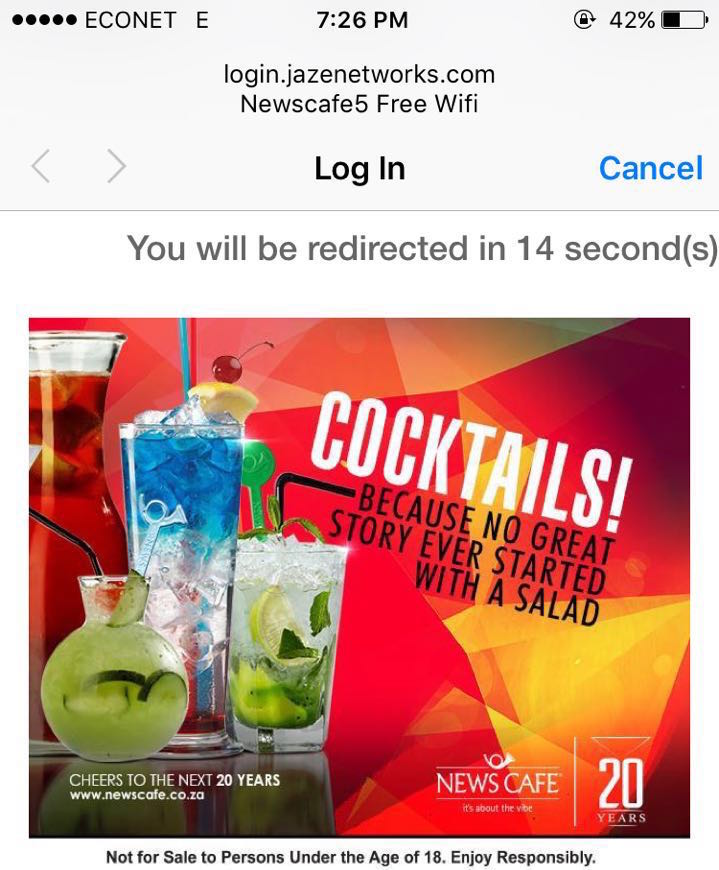
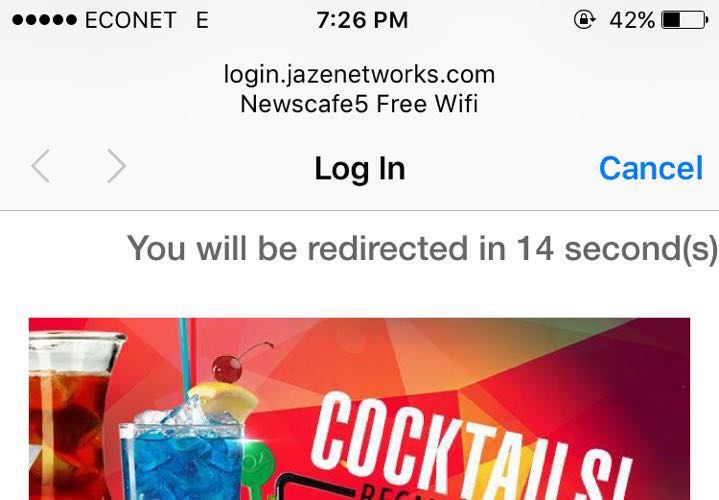
    A number of establishments are as part of their service offering, providing customers with free WiFi. There may however be conditions of use which may include limits on the amount of data available. Or, you may be forced to view an advertisement such as is the case with using the free WiFi at News Cafe.
    (continued below)

    Free-WiFi-News-Cafe-Harare-Zimbabwe-Advertisement-2

    Having free access to the internet would have many jumping for joy, with the cost of having to view an advertisement or having limited data being a small price to pay. But, at the end of the day, the cost of connecting to a free WiFi connection may be much more than you bargained for.

    The risks of using free public WiFi

    When you connect to free WiFi, you don’t know how secure the network is and who else is connected to it. There may be a hacker lurking around who manages to position themselves between you and the WiFi network (Man-in-the-middle attack (MitM)) and gets access to all traffic, therefore ALL the information sent between you and the internet.

    An even more dangerous method that hackers could use when you connect to free WiFi is malware. This is where they install infected software onto your device. The malware can potentially give attackers full access to your device and can take over everything that you do online.

    Once a hacker has a hold of the information that they need, they are free to do the damage that they need to. They could potentially clear out your bank accounts and whatever other damage they may feel they need to inflict depending on what they find.

    How to protect yourself

    The best way to protect yourself on free WiFi is to not connect to a free network in the first place. If that for you is easier said than done, there a options to secure your information and device. One thing to note is that some publications may say that you are safe if accessing an HTTPS website but, with MitM, your data is still accessible to attackers.

    The best way to protect yourself is with a virtual private network (VPN) where all information transferred between you and the internet is passed through a secure tunnel where data is encrypted and out of the reach of attackers. For a brief explanation on what a VPN is, take a look at the video below or read: Become anonymous online with a VPN & prevent the Zimbabwe government from spying on you.

    https://www.youtube.com/watch?v=yC9hsjjvZ2g

    There are a number of VPN options to choose from and some of them come free. But remember, there can be a cost attached to free. As a start, you can take a look at PureVPN, Hide.me (both offer free plans with limited features) and Norton WiFi Privacy as per the video above.

    So, the next time you decide to connect to free WiFi connect, think about what it could really cost you if you don’t have security measures in place.

  • What to do if WhatsApp gets blocked in Zimbabwe

    What to do if WhatsApp gets blocked in Zimbabwe

    Zimbabwe once again finds itself going tough times and that said, Zimbabweans are speaking out more about their frustrations. Many are sharing their feelings, thoughts and frustrations via social media and other communication platforms such as WhatsApp. The messages have inspired many to speak out and stand up for what they feel is right.

    But, the government does not seem to like what people are doing and saying and has deemed some of these communications as being tantamount to treason. To that effect, POTRAZ put out a statement to inform citizens that communications on social media and WhatsApp will be monitored. They went on the say that people with messages that, “cause despondency, incite violence, threaten citizens and cause unrest, will be arrested and dealt with accordingly in the national interest”.

    If this is of concern to you, you can employ various methods to prevent the Zimbabwe government from spying on you and your online activity.

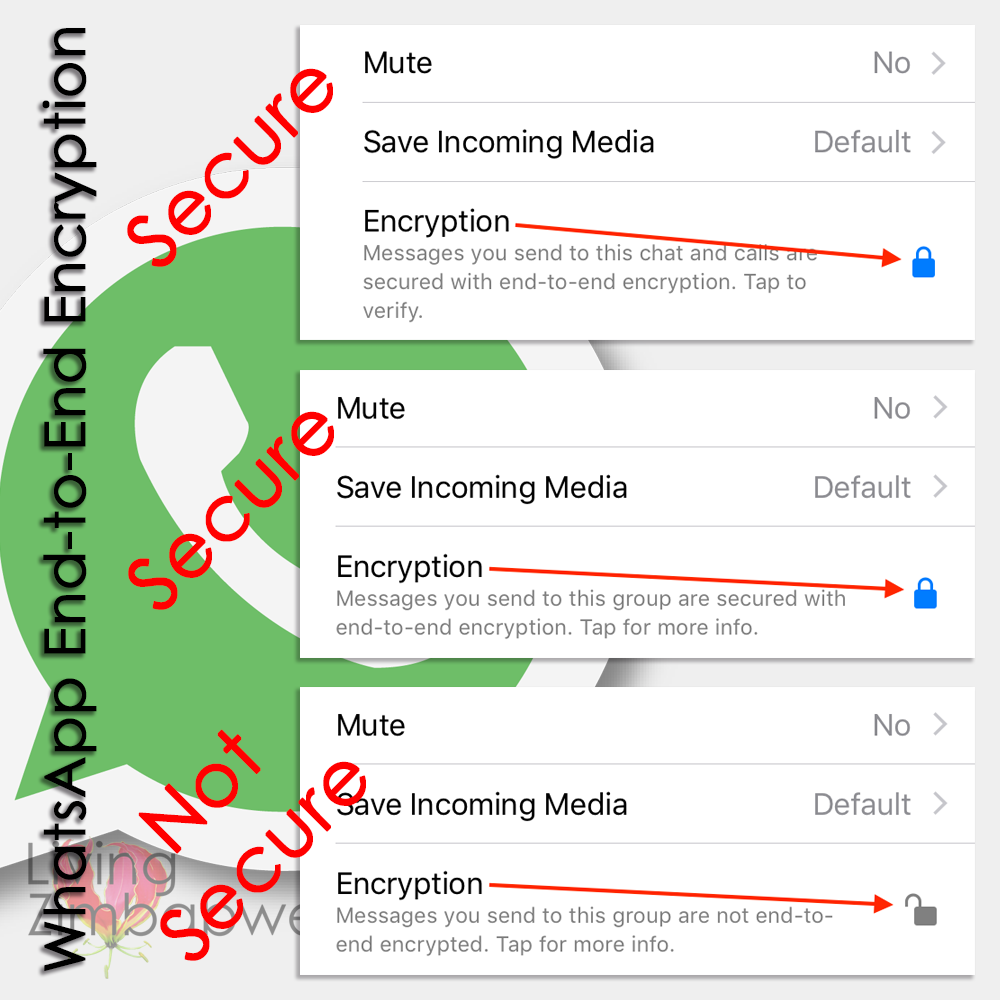
    As far as WhatsApp goes, the company itself says that they offer end-to-end encryption where the only person who can read a message is the person or group chat it is sent to. They go on to say,

    No one can see inside that message. Not cybercriminals. Not hackers. Not oppressive regimes. Not even us. End-to-end encryption helps make communication via WhatsApp private – sort of like a face-to-face conversation.

    But, in order for encryption to be activated, all parties within the conversation have to be using the latest version of WhatsApp. Are you and all of your contacts using the latest version? As already mentioned in the post about being spied on (link above) it was mentioned that in the case of a conversation between two people, it is easy enough to get encryption assurance. All you have to do is tell the other person to update their software. In the case of group conversations, that may be easier said than done. All it takes is just one person to not be using the latest version which effectively makes the conversation insecure and open to prying eyes. (continued below)

    WhatsApp-End-to-End-Encryption-Living-Zimbabwe

    More often than not, it is via groups that a number of the messages that the government doesn’t was spread are shared. So, make sure that everyone within your groups is running the latest version. Besides the added security of a VPN, end-to-end encryption is a good way to ensure that you are shielded from prying eyes.

    Another issue that citizens of Zimbabwe faced last week and may well so face in the future is not being able to use WhatsApp. On the 6th of July, many people reported not be able to use it to communicate. This may (or may not) have been the government/service providers blocking there service as a result of #ShutdownZim2016/#ZimShutdown2016.

    How to unblock WhatsApp

    If you do find yourself not being able to use WhatsApp, setup a VPN (virtual private network) and try it out. Not only will it give you an extra layer of security, it will also unblock any services that become blocked by the government and/or ISPs (internet service providers). See the video below (from PureVPN.com) for a brief rundown on what a VPN is and what it can do for you with regards to any apps that may get blocked.

    https://youtu.be/TNuhOvnaua0

    Do you have any other methods that people can use to unblock WhatsApp if it gets blocked in Zimbabwe?

  • Become anonymous online with a VPN & prevent the Zimbabwe government from spying on you

    Become anonymous online with a VPN & prevent the Zimbabwe government from spying on you

    Over the last few weeks, Zimbabweans have been exercising their freedom of speech and especially so via social media and messaging platforms such as WhatsApp. All that you have to do is log into Facebook or Twitter where you will more than likely come across updates from friends expressing their sentiments on the situation in Zimbabwe. If it’s not them expressing their own sentiments then it may be them sharing various content from other Zimbabweans who have had enough. Even if you aren’t active on social platforms but are on WhatsApp, then you will probably have received an image or video of people expressing their feelings.

    Movements such as #ThisFlag which was started by Pastor Evan Mawarire may have been one thing that really got the fire burning. Using the Zimbabwe flag as a centrepiece, it inspired people to share their frustrations online by either uploading a video of them saying what they have to say or them being part of the movement by proudly displaying their Zimbabwean flag. This eventually led to a call to action being made for citizens of Zimbabwe being asked to shut Zimbabwe down and stay away from work because of inaction from the government.

    #ShutdownZim2016/#ZimShutdown2016 took place on 6 July 2016 and it saw city streets being deserted on a day where they would have otherwise been hustling and bustling.

    https://instagram.com/p/BHhDmh9juiW/

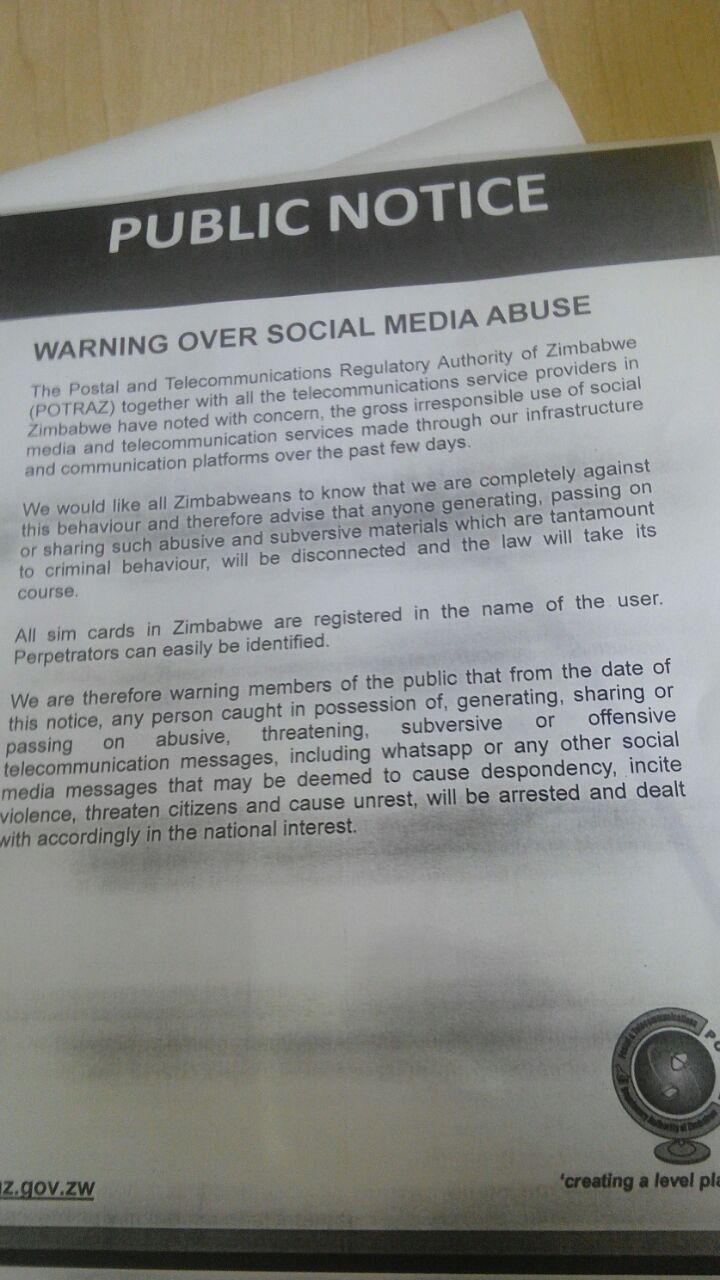
    All of this activity has not gone unnoticed by the government and other associated organisations. The government decided to act on the matter and released a statement via the Postal and Telecommunications Regulatory Authority of Zimbabwe (POTRAZ). The statement served to inform citizens that certain types of communications will not be tolerated in Zimbabwe and anyone caught with or distributing such would be dealt with accordingly. (continued below)

    Warning-Over-Social-Media-Abuse-POTRAZ

    An extract of the statement reads:

    “All sim cards in Zimbabwe are registered in the name of the user. Perpetrators can easily be identified. We are therefore warning members of the public that from the date of this notice, any person caught in possession of, generating, sharing or passing on abusive, threatening, subversive or offensive communication messages, including WhatsApp or any other social media messages that may deemed to cause despondency, incite violence, threaten citizens and cause unrest, will be arrested and dealt with accordingly in the national interest,”

    Strangely so, on the 6th of July, scores of people were not able to use WhatsApp. Was this the government showing that it has the ability to block various forms of communication in their interests? A tweet by Jonathan Moyo caused a bit of a stir as some people took it as an informal admission that there would be difficulties using WhatsApp.

    Whatever the case may be, as far as blocking certain services go, who knows what the government is or isn’t capable of doing? Internet traffic, yes, that is easy enough to monitor. But, services like WhatsApp do say they have end to end encryption which only works when all parties are using the latest version of WhatsApp. More often than not, groups messages aren’t secure. If only one person in the group has not updated their WhatsApp then messages within the group won’t be secure. Are you part of a group that frequently discusses and shares content that could result in your arrest?

    You never really know who may be monitoring your online activity and even with services that say they encrypt data, you can’t always take their word for it. The best thing you can do for yourself if you are concerned about the possibility of being spied upon by the authorities or other unscrupulous individuals online, is to install a VPN.

    What is a VPN (Virtual Private Network)

    Besides giving you a good layer of protection, a VPN which is a virtual private network does three main things and that is to keep you secure online, makes you invisible online and give you internet freedom (being able to access content and/or services that have been blocked by your service provider or government).

    It creates a secure tunnel (so to speak) between you and whatever you are accessing on the internet. A VPN hides your IP address and location and makes you appear as if you are in a location (country) different to where you actually are. It also encrypts your communication thus preventing, hackers, your ISP (internet service provider) and the government from accessing, tracking and monitoring you. Because it gives you the ability to choose your location, this allows you to use services that may otherwise become blocked in Zimbabwe.

    VPNs can be installed on Windows, Mac, iOS, Android and other devices that connect to the internet such as TVs and game consoles.

    How do I set up a VPN

    If you are technically inclined, it is possible to set up your VPN server at home. To set one up on your own, there is a wealth of information on Google on how to do this. Be aware that if the setup is not done correctly it can leave you vulnerable, leaving your IP address and data being visible to prying eyes.

    The other way of setting up a virtual private network is through one of the many VPN providers put there. Most of these providers offer easy setup options that will see your network up and running in only a few clicks. Most of them do come at a cost but some offer free service options that will get you up and running. Hide.me and PureVPN.com offer free options that give 2GB data transfer per month.

    Now it’s time for you to take a look at your digital life and ask yourself, ‘is my data secure and is my online activity hidden from the government or anyone else who might want to spy on me’?

  • Become anonymous online with a VPN & prevent the Zimbabwe government from spying on you

    Over the last few weeks, Zimbabweans have been exercising their freedom of speech and especially so via social media and messaging platforms such as WhatsApp. All that you have to do is log into Facebook or Twitter where you will more than likely come across updates from friends expressing their sentiments on the situation in Zimbabwe. If it’s not them expressing their own sentiments then it may be them sharing various content from other Zimbabweans who have had enough. Even if you aren’t active on social platforms but are on WhatsApp, then you will probably have received an image or video of people expressing their feelings.

    Movements such as #ThisFlag which was started by Pastor Evan Mawarire may have been one thing that really got the fire burning. Using the Zimbabwe flag as a centrepiece, it inspired people to share their frustrations online by either uploading a video of them saying what they have to say or them being part of the movement by proudly displaying their Zimbabwean flag. This eventually led to a call to action being made for citizens of Zimbabwe being asked to shut Zimbabwe down and stay away from work because of inaction from the government.

    #ShutdownZim2016/#ZimShutdown2016 took place on 6 July 2016 and it saw city streets being deserted on a day where they would have otherwise been hustling and bustling.

    https://instagram.com/p/BHhDmh9juiW/

    All of this activity has not gone unnoticed by the government and other associated organisations. The government decided to act on the matter and released a statement via the Postal and Telecommunications Regulatory Authority of Zimbabwe (POTRAZ). The statement served to inform citizens that certain types of communications will not be tolerated in Zimbabwe and anyone caught with or distributing such would be dealt with accordingly. (continued below)

    Warning-Over-Social-Media-Abuse-POTRAZ

    An extract of the statement reads:

    “All sim cards in Zimbabwe are registered in the name of the user. Perpetrators can easily be identified. We are therefore warning members of the public that from the date of this notice, any person caught in possession of, generating, sharing or passing on abusive, threatening, subversive or offensive communication messages, including WhatsApp or any other social media messages that may deemed to cause despondency, incite violence, threaten citizens and cause unrest, will be arrested and dealt with accordingly in the national interest,”

    Strangely so, on the 6th of July, scores of people were not able to use WhatsApp. Was this the government showing that it has the ability to block various forms of communication in their interests? A tweet by Jonathan Moyo caused a bit of a stir as some people took it as an informal admission that there would be difficulties using WhatsApp.

    Whatever the case may be as far as blocking certain services go, who knows what the government is or isn’t capable of doing? Internet traffic, yes, that is easy enough to monitor. But, services like whatsapp do say they have end to end encryption which only works when all parties are using the latest version of WhatsApp. More often than not, groups messages aren’t secure. If only one person in the group has not updated their WhatsApp then messages within the group won’t be secure. Are you part of a group that frequently discusses and shares content that could result in your arrest?

    You never really know who may be monitoring your online activity and even with services that say they encrypt data, you can’t always take their word for it. The best thing you can do for yourself if you are concerned about the possibility of being spied upon by the authorities or other unscrupulous individuals online, is to install a VPN.

    What is a VPN (Virtual Private Network)?

    Besides giving you a good layer of protection, a VPN which is a virtual private network does three main things and that is to keep you secure online, makes you invisible online and give you internet freedom (being able to access content and/or services that have been blocked by your service provider or government).

    It creates a secure tunnel (so to speak) between you and whatever you are accessing on the internet. A VPN hides your IP address and location and makes you appear as if you are in a location (country) different to where you actually are. It also encrypts your communication thus preventing, hackers, your ISP (internet service provider) and the government from accessing, tracking and monitoring you. Because it give you the ability to choose your location, this allows you to use services that may otherwise become blocked in Zimbabwe.

    VPNs can be installed on Windows, Mac, iOS, Android and other devices that connect to the internet such as TVs and game consoles.

    How do I set up a VPN?

    If you are technically inclined, it is possible to set up your VPN server at home. To set one up on your own, there is a wealth of information on Google on how to do this. Be aware that if the setup is not done correctly it can leave you vulnerable, leaving your IP address and data being visible to prying eyes.

    The other way of setting up a virtual private network is through one of the many VPN providers put there. Most of these providers offer easy setup options that will see your network up and running in only a few clicks. Most of them do come at a cost but some offer free service options that will get you up and running. Hide.me and PureVPN.com offer free options that give 2GB data transfer per month.

    Now it’s time for you to take a look at your digital life and ask yourself, ‘is my data secure and is my online activity hidden from the government or anyone else who might want to spy on me’?

  • What Zimbabwe searched for on Google in 2014

    What Zimbabwe searched for on Google in 2014

    Google, Bing and Yahoo are search engines that a lot of us turn to when looking for information on all sorts of topics. The searches that we do may seem arbitrary but at the end of the day, they give us an insight into what our interests are and what may be important to us.

    As we go along searching the internet for A, B, C, all the search engines keep track of and collate all of our searches (unless you search in incognito or private mode). The search engines use this information to their advantage and they do make some of the information publicly available. Here is a run down of the top Google searches per month in Zimbabwe for 2014:

    January – CHAN results

    chan-results-top-google-search-zimbabwe-january-2014

    Zimbabweans have an insatiable appetite for football and the start of the year saw the 2014 African Nations Championship being played in South Africa with many of us glued to our screens to watch all the drama unfold.

    February – Bona Mugabe

    bona-mugabe-top-google-search-zimbabwe-february-2014
    After CHAN, our attention was diverted to Bona Mugabe who tied the knot with Simba Chikore in an elaborate wedding that was attended by high level dignitaries and at a cost that was said to have run into the millions.

    March – Malaysia plane

    malaysia-plane-top-google-search-zimbabwe-march-2014
    Malaysia Airlines Flight 370 did not only see Zimbabweans but the entire world turn their attention to MH370 which on the 8th of March took off from Kuala Lumpur, Malaysia on its ways to Beijing, China and disappeared en-route with over 200 passengers on board. To this day (as far as the ‘world’ in concerned – there are a few conspiracies about it’s disappearance), the where about of the aircraft is still a mystery.

    April – UEFA results

    uefa-results-top-google-search-zimbabwe-april-2014
    April saw people once again being able to get a football fix and saw the quarter and semi-finals of UEFA Champions League with the final result being a 4 – 1 win for Real Madrid over Club Atlético de Madrid.

    May – Alick Macheso

    alick-macheso-top-google-search-zimbabwe-may-2014
    2014 was a particularly difficult year for sungura musician Alick Macheso which included reports of him performing an unspeakable act on his child and the tumultuous divorce to his second wife, Tafadzwa Mapako.

    June – World Cup fixtures

    world-cup-fixtures--top-google-search-zimbabwe-june-2014
    For the third time in the year, Zimbabwe and the world got a good dose of football and had the opportunity to watch various nations from around the world battle it out in Brazil to be crowned world champions.

    July – Argentina

    argentina-top-google-search-zimbabwe-july-2014
    The lead in to July also saw people searching for football related information. The top search was simply Argentina and July was the month in which the World Cup Finals were held between Germany and Argentina with Germany being crowned the world champions after a 1 – 0 win.

    August – Ebola

    ebola-top-google-search-zimbabwe-august-2014
    A few West African countries were affected by an Ebola virus outbreak which was recorded as the worst in history. Thousands of people lost their lives and many countries around the world went into panic mode and put measures in place to try and stop the virus from reaching their nations.

    September – SCOAN

    scoan-top-google-search-zimbabwe-september-2014
    SCOAN, The Synagogue, Church Of All Nations which is lead by the very popular and controversial Prophet T.B. Joshua topped search results after one of its buildings collapsed. More than 100 people lost their lives with most of them being from South Africa and the count also included an MDC official from Zimbabwe.

    October – Grace Mugabe

    grace-mugabe-top-google-search-zimbabwe-october-2014
    This was the year where Grace Mugabe rose to prominence by first of all being awarded a PhD that she apparently completed in two months and then a few months after that, being named as the head of Zanu-PF’s Women’s League. October was the month when Amai Dr Grace Mugabe went around on her ‘Meet The People Tour’ and had a lot to say (some of it not so gracefully) about various figures within Zimbabwe’s political arena.

    November – Myles Munroe

    myles-munroe-top-google-search-zimbabwe-november-2014
    For the second time in the year, Zimbabweans searched the internet for information linked to a religious figure. On the 9th of November, Christian evangelist Dr Myles Munroe was involved in a plane crash that took him, his wife and the lives of seven other people.

    December – Zanu PF Congress

    zanupf-congress-top-google-search-zimbabwe-december-2014
    At the start of December, thousands of Zanu PF delegates from around the country descend on Harare for Zanu PF’s Elective Congress. The congress was seen by many as more that just that as certain actions were taken that pretty much saw Joice Mujuru’s fate being sealed and Grace Mugabe ascending to the head of the Women’s League.

    Your turn; given that this is what we searched for the most on Google, does it give a good reflection of what we find important?

  • Robbed In Harare By Car Immobiliser Jammer Thieves

    Robbed In Harare By Car Immobiliser Jammer Thieves

    Most if not all of the cars of today come with the wonderful convenience of being able to unlock and lock the car with the push of a button. This feature also goes as far as immobilising and alarming a vehicle and in theory securing it.

    When this advancement became common place, those with sticky fingers probably found it to be a major annoyance because it made their trade a little more challenging. But, with the will to steal, thieves will eventually find a way to get their hands on what they want.

    For cars with immobilisers, modern day thieves have equipped themselves with devices that give them easy uninhibited access to vehicles after the owners have walked away from them.

    At the start of the week, one of our colleagues was the victim of a robbery that seems to have been orchestrated in such manner. X was on their way home from work and stopped at a supermarket for a few minutes to pick up some groceries. This was not an unusual occurrence but upon returning to their vehicle the unusual had happened. A few belongings that had been left in the car were missing, the doors were unlocked and there was no sign of a forced entry.

    Fortunately the car was not stolen but unfortunately a laptop and various documents were taken. Immobilisers are immobilisers are wonderful and convenient but they can give us a false sense of security. We have become accustomed to pushing a button whilst we walk away from our vehicles and expecting them to be locked and secure.

    As you can see from what happened to our colleague in some situations, this is no longer the case. This kind of theft can happen to anyone and it won’t even take the thieves more than a minute to get away with something of value. Yes, you may have insurance but can you imagine calling your insurer and trying to submit a claim on such an event? You more than likely won’t be covered for the loss.

    One thing that we should get away from is falling into a somewhat false sense of security and becoming complacent. To increase your chances of not becoming a victim of such a robbery, you could take the following steps:

    • Do a visual (you see it lock) and audible (your car beeps) check to see that your car is locked
    • Pull on the door handle to make sure the car is locked
    • Hide valuables (boot) even better, don’t leave any valuables in the car
    • Be aware of where you park you car and park where there are lots of people

    Have you been the victim of such a crime? Is there anything else that you can think of that people can do to reduce the chances of becoming a victim?

  • Exposing Baba Jukwa: Our right to privacy

    Exposing Baba Jukwa: Our right to privacy

    Exposing Baba Jukwa: Our rights to privacy

    On several occasions, state media namely the herald and Sunday mail have published ‘leaked’ emails and information exchanges by prominent politicians and socialites in Zimbabwe. Several names like Eddie cross, Tendai Biti, Elizabeth Macheka and Obert Gutu have been victims of the leaks. Questions arise as to who leaks this information? How do they do it and for what reasons?

    We are aware of the US whistle-blower Edward Snowden, who leaked many NSA documents that show the US government, has been spying on citizens globally. It revealed the agency spied even on allies like German Chancellor Angela Merkel. It is not the US government alone that spies on citizens. Recently there were reports that Ethiopian government was acquiring spy technology (to spy on citizens).

    We have two possibilities: ether the state media fabricates these stories (propagandist machinations) or the information is true. If it is true, then the state media accessed the information from another state department. Whichever way it goes, the state knows who leaks the people’s information and how they do it.

    Last week I attended a workshop that touched on digital security, which proved to be a revelation to the majority of us participants. As I was just digesting what I learnt from the workshop the media was awash with news that baba Jukwa had been caught. I have not much sympathy for Baba Jukwa especially now that he is no longer relevant as elections are over but what grabbed my attention is how they claim they caught him. They (whoever they are) are said to have successfully hacked into his/her email account. The news is spine chilling to someone who values his or her privacy. Those hackers purport that Baba Jukwa is Mxolisi Ncube a journalist with the Zimbabwean.

    Mxolisi Ncube denies the accusations and says he only interviewed the faceless Facebook character. He admits to have corresponded with the Baba Jukwa. Whether Mxolisi is the real baba Jukwa or he is being set up, it is not much of an issue compared to the methods used to try and expose the Baba Jukwa. I wonder how many accounts of ordinary citizens have been hacked so far. How much of our private information has government accessed illegally?

    In the movies, hacking seems a lot of fun and exciting but truth be told; it is an infringement on our basic human rights. Section 57 of the new constitution states that, “every person has the right to privacy…” and part (d) specifically provides for privacy of data or communication. What it means is that no one has the right to access your private and personal information without your consent. It is an infringement for one to browse through my phone (snooping) without my consent. It is our fundamental right yet someone is bragging that he/she successfully hacked Mxolisi Ncube’s emails. Their excuse for hacking is defending national security. We are the people. We are the nation. There is no way they can protect us by hacking into our accounts.

    However, part of the blame lies squarely on us. Many of us are reckless with how we share our personal information online. As I learnt at the workshop, a few things will help us be more secure online.

    1. Always think twice before you accept any friend requests, open strange emails, or download those viral files on apps like WhatsApp. Some of it is carrying spyware.
    2. Have different passwords for your different accounts and only you must know them. A strong password must contain symbols and numerals.
    3. Think before you click on those pop-up ads. Many of them will lead you to unsecure sites where you are asked to type in your personal information.
    4. Never give personal information online. Many of the sites relay the information to hackers.
    5. Always log out from all your open accounts and delete history and cookies after you use a device that is not yours or that is available for the public. Hackers and/or other criminals can use this history can use to enter into your accounts.

    So even if whether we are fans of baba Jukwa or not, the way he has been exposed must worry us. When ordinary citizen Mxolisi Ncube has his right to privacy infringed upon, we all must get vocal or the vices will not stop. After Mxolisi, it is you or I.

    This has been a submission by Ittai Bryan.
    You can connect with Ittai via the following: http://ibmatteu.blogspot.com.
    You too can become a Citizen Journalist by submitting your story here: Citizen Journalism by Living Zimbabwe
    The views expressed in the article are those of the author and not necessarily Living Zimbabwe.

  • Anonymous Africa – Our End Game For Zimbabwe & Africa (@zim4thewin)

    Anonymous Africa – Our End Game For Zimbabwe & Africa (@zim4thewin)

    Greetings and Salutations fellow Africans and Earthlings.

    We are Anonymous Africa and we were asked to write a short blog explaining our motivations. By now you may have noticed some of our ops hitting Southern Africa. We hope you like our work. We would like to thank you for the overwhelming support you are giving us.

    So far our targets have included:

    • IOL – A partly South African government owned media publication that pushed pro-Mugabe propaganda – www.iol.co.za
    • ZANU-PF – The website for the completely corrupt ruling party in Zimbabwe – www.zanupf.org.zw
    • Zimbabwean Herald – The ZANU-PF owned puppet media publication – www.herald.co.zw
    • ZIMRA – The Zimbabwe Revenue Service, the Zim tax collectors – www.zimra.co.zw
    • ZIM MOD – The Zimbabwe Ministry of Defence – www.mod.gov.zw
    • ANC – The corrupt ruling political party in South Africa that supports Mugabe – www.anc.org.za

    Why are we upset?

    TWe believe most of Africa’s modern day problems stem from corrupt and evil leaders that have sold the people out (mostly to corrupt private commercial interests). Much of Africa has entered a cycle of corruption and we believe we are the generation to start breaking up that cycle. Not only can the youth of Africa change Africa. They have to.

    Who are we?

    The Hacker Manifesto best describes who we are:

    “This is our world now… the world of the electron and the switch, the beauty of the baud. We make use of a service already existing without paying for what could be dirt-cheap if it wasn’t run by profiteering gluttons, and you call us criminals. We explore… and you call us criminals. We seek after knowledge… and you call us criminals. We exist without skin color, without nationality, without religious bias… and you call us criminals. You build atomic bombs, you wage wars, you murder, cheat, and lie to us and try to make us believe it’s for our own good, yet we’re the criminals.”

    We are a tight collective of hackers and coders. Some of our members have been part of anonymous since their origins in the Scientology protests. We have been involved in previous ops from around the world including and not limited to, South America, South East Asia and Europe.

    What are we doing?

    Following what happening in the Middle East we are hoping to help start the launch of the African spring. We believe that the Internet is the last place that free speech truly exists. We hope to use whatever skills and abilities we have to bring as much attention to the crimes and corruptions of our African leaders.

    What do we have planned for the future?

    We have many non-violent forms of electronic protest planned. We also hope in the near future to release an African specific version of wikileaks where Africans can expose corruption without fear.

    This has been a submission by Anonymous Africa.
    You can connect with Anonymous Africa via the following: .
    You too can become a Citizen Journalist by submitting your story here: Citizen Journalism by Living Zimbabwe
    The views expressed in the article are those of the author and not necessarily Living Zimbabwe.

  • Broadband in Zimbabwe Coming of Age

    People in Zimbabwe love being on their cell phones. To see them in action all you need to do is walk on the streets of Harare and you will see that every Tom, Dick and Chikwama has a cell phone and a number of them are using it. People are beginning to access the internet more and more both via computers or a 3G mobile phone if they are lucky enough to have a 3G subscription and be able to afford Econets monthly subscription fee. There are however some spots in Harare where you can get free Wi-Fi access. These include the Harare Information Centre at Unity Square and a major hotel (whose name I will not mention for obvious reasons) in the city whose network you can access but may not actually be free. It is not rare to find people sitting outside HIC or in the hotel parking lot and taking advantage of the free connection.

    However, using the internet in Zimbabwe is an extremely painful process especially if you are accustomed to using broadband connections that are reasonably fast (lets say 10-25 Mbps). Even if you connect to a number of broadband connections you disconnect a while later disappointed that you didn’t achieve what you wanted to or could have achieved. It’s after experiences like that that you get to appreciate fast connections. It is then that you also get to have a bit of an idea about what people mean when they say that in a business setting, internet connection speeds have effects on efficiency and productivity.

    The country does seem to be moving in the right direction and working towards making fast and reliable internet a reality. As already mentioned you can connect to the web via Econet’s 3G network if you were lucky enough to get your hands on a connection before the suddenly stopped signing up new subscribers. It has been reported that Econet is laying down their own fibre optic cables as well as launching a 4G network. Information Technology Minister Nelson Chamisa also recently announced that Zimbabwe have started laying down a fibre optic link that would connect Zimbabwe to the Beira under-sea cable. If this project does go to completion it will be welcome news for all who access the internet as it could lead to true broadband being available. The only question that stands if it does happen is that of how much it will cost. At the moment accessing the internet is not cheap. You can visit various ISP websites such as ZOL, Africa Online or YoAfrica just to name a few.

    These are all very exciting developments that will have a number of positive flow on effects. Telecoms penetration rates are high in Africa and this could present a number of investment opportunities for locals, Diasporans and foreigners who want to cash in on what Zimbabwe has to offer. Please don’t take cashing in to me people literally taking advantage off, cashing in and running away after leaving a big mess. Cashing-in in this context could mean returns on capital investment or profits on sales of devices perfect for mobile browsing such as netbooks, smartphones and the recently released iPad.

    Are you going to take part in the internet revolution that is about to hit Zimbabwe?