Camouflage clothing has for a very long time been popular urban clothing. If you are lucky enough, you can get yourself a pair of camouflage pants for as little as $1 on eBay. That bargain you get for your piece of clothing could get you into more trouble than you bargained for if you decide to wear it in Zimbabwe. According to the Defence Act (Chapter 11:02), wearing of camouflage materials by civilians, whether Zimbabwean or from any other country, is forbidden. This was something that was mentioned to me a few years ago but didn’t pay much attention to and quickly forgot about simply because of how in most parts of the world it is just a piece of clothing. At the time I was told that people wearing camouflage clothing were beaten up by soldiers and faced possible arrest.
Some weeks ago, a popular Zimbabwean DJ, DJ Squila was accused by soldiers of wearing army replica pants without permission. The soldiers proceeded to assault DJ Squila and threw him into a vehicle and drove off. They later threw him out of the vehicle whilst it was moving and he sustained serious head injuries. Luckily enough, a passer by took him to hospital where he received treatment. The Defence Act also states that anyone who without authority sells, offers or exposes for sale, wears or uses any uniform supplied to or authorized for use by any member of the Zimbabwe Defence Forces or other military forces shall be guilty of an offence.
The act may state that one shall be guilty of an offence but even if one is guilty, it does not give the soldiers such as the ones that assaulted DJ Squila the right to take justice into their own hands. Hearing of such behaviour reinforces all those statements about soldiers being illiterate people who don’t think about what they are doing and the consequences of their actions. This makes them very dangerous group of people who you don’t want to provoke in any way. In a country full of lawlessness it just isn’t worth it wearing camouflage clothing even more so when you have to contend with very poorly paid and disgruntled soldiers.
Would you dare to wear military clothing in Zimbabwe?
Last night I read the unfortunate news that Fortune Muparutsa passed away on Saturday 25th October, 2008. This came as a even more of a surprise because just a few weeks ago we went through a period in our household where we searched for and played a number of songs by Zimbabwean artists mainly from the 90s and Fortune’s song “Wangu Ndega” was one of the songs that we played repeatedly not only because of how good it is but because of how it reminded us about the Zimbabwe of times gone by.
Way back when, when that and his other songs were being played over the airwaves or videos his being shown on ZBC TV I can remember the volume being put up and people around me enjoying the music. This was a time in life where CD’s and MP3’s were unheard of and it was all about cassette tapes. My first copy of “Wangu Ndega” was one that I recorded onto tape as it was playing on Radio 3. These were the times where you would use a pen to rewind or fast forward the tape to a particular song or part of a song if your tape player was somehow still able to play music but had lost its fast forward and reverse functionalities. You got to know how many turns in one direction or the other to go to get to a certain point. Life then was relatively simple, hassle free and people in Zimbabwe were much much happier than they are today. That is where listening to Fortune Muparutsa’s song took me. It took me to a point in time when life in Zimbabwe was good. It brought joy then and brought joy now. That is how I will remember him. Rest in Peace.
Last month, CNN’s Inside Africa featured a Zimbabwean DJ in New York, Chaka Ngwenya who started up an online radio station SARFM Radio through which he says he is trying to help African listeners keep their identity abroad. Identity caught my attention and that lead on to not forgetting about who you are and where you are from. Thinking about ‘Identity’ got me thinking about the term “MUSALAD” that so many young Zimbabweans have been labeled. What exactly is a “salad/musalad/salala?” It is a term that cannot really be given a clear cut definition because of people’s different interpretations of it. My understanding of the term is; someone from a low-density suburb and from a so called group ‘A’ school (private school) who is not streetwise, copies Western culture (mainly American) and speaks English with an accent. In years gone by munozi (nose brigade) was more commonly used due to ‘these people’ speaking nasally.
I am one of those people who was and still is labelled a munozi and/or musalad but to a much lesser extent as compared to years gone by. Up until just after starting high school I went to these so called group ‘A’ schools until I was shifted to a boarding school out in the rural areas. Within the first few hours of being there I was labelled a munozi. Very soon after that I was given a nickname brought about by me being told to stand up and tell the class my name. When I opened my mouth, the entire class burst into laughter and I didn’t understand what was going on until the teacher eventually asked me to repeat what I had just said whilst a number of my classmates (and the teacher) were still laughing and mimicking what I had said with a very exaggerated nasal intonation. The nickname I was given was what they thought they had heard me say and it stuck through out my time at the school. It wasn’t easy going by day to day and having to deal with the discrimination (which is how I saw it) but as time went by I got used to it and paid less attention to it. Those years of my life were probably my quietest and I only spoke when I really needed to so that I didn’t have to deal with the onslaught if I spoke. I did make a few friends and those who got to know and respect me saw more than just what was on the surface.
Masalad are viewed by many as, “vanhu varasa tsika” (people who have lost their traditional ways). This Shona term, tsika refers to knowing and being able to use the rules, customs and traditions of society to be regarded as a respectable person. Not all masalad are a lost cause. Those who went to schools where they mixed with other races, they had and still have different accents to those from a rural background. For most when they got back home it was back to their traditional ways but they would take along what they picked up in their environment. They way that they speak is different but it is not necessarily fake or put on. Yes, there are some where it is a bit over the top and obviously put on and bound to draw a lot of attention and criticism. The video shows what I would consider to be over the top. The people in the video do live in the United States but you could very easily come across people in Zimbabwe who have never stepped out of the country speaking like them.
It is not only masalad who get discriminated against. An example I can use from years and years ago is that before I left the private school, an SRB (someone with a Strong Rural Background) was awarded a scholarship to do his ‘A’ levels there. He was ostracised because of his mannerisms and the way he spoke English with a very heavy Shona accent. He was a very nice guy but his background and the environment he was in did not do him any favours.
I have been criticized by family and friends who said I had an identity crisis because of the many white friends I had and the ‘white things’ I did (whatever they were). Yes, I did mix and mingle with a lot of white people but that did not make me less of a Zimbabwean. The discrimination encountered by both groups of people (masalad and SRBs) is unwarranted at times because we should not be judging a people by the way they speak, what they wear and how they carry themselves. As long as those in question know who they are and where they come from they should be treated with respect. When cultural identity has been lost there should be cause for concern because you will have lost a lot of who you are.
Most of the news that you see and hear about Zimbabwe is negative and a lot of it focuses on the millions of people who are in desperate need of help and you can’t help but sympathise with them. I feel compelled to help in some way but being in the Diaspora and so far away from home I don’t even know where to start, what kind of assistance to give and how to give it. When I think about helping out what I picture is a select group of people getting their hands on whatever I send and using it for their own purposes with it never getting to who it was intended for. That, whether it is a real scenario or not discourages me from trying to do anything to help.
My faith and belief in being able to help was recently restored by my wife who after going through the clothes our daughter has out grown decided on sending to Zimbabwe. Instead of giving the clothes away to a charity here or throwing them into one of those ‘clothing bins’ she thought of relatives back home who have babies that would need clothing. All of these clothes have been put into a box and will be on their way to Zimbabwe very soon. After sorting through all the baby clothing we took a look in our wardrobes which are full of clothing, some which has has not been worn in years and some of which has not been worn at all. We are going to sort through this clothing and send if off to Zimbabwe as well where it will hopefully be distributed to people who will need, use and appreciate.
What we are sending home obviously won’t help thousands of people but it will at least benefit a few people. For example, when winter comes around again next year someone will be able to keep themselves a little warmer and a little more comfortable. Knowing that we will be able to do that for someone will bring more joy to our blessed lives. Something else that has also come about is that some of my work colleagues brought in boxes of clothing when they found out about it. This will mean an added cost for shipping but I will use the money generated by this blog to help pay for it. I don’t want this to be a one-off thing and hopefully we will have the opportunity to help more and more people in different ways in the near future.
We do know of some people who volunteer for charitable organisations to whom we will send some of the clothing to distribute appropriately. I don’t know how big philanthropy is with Zimbabweans but if it something that is not big it is something that should be embraced by many. No matter how big or small, everyone should try to do something to help those less fortunate than they are.
Zimbabwe’s “Golden Girl”, Kirsty Coventry was awarded US$100,000 by Robert Mugabe for her spectacular performance at the Beijing 2008 Olympics. She won a gold medal and broke the world record in the women’s 200 meters backstroke and also won three silvers in the 400m individual medley, 100m backstroke and 200m individual medley. The $100,000 is double the $50,000 “pocket money” that she was given by Mugabe on her return from the 2004 Athens Olympics.
The cash award has sparked a bit of controversy because of the country’s current economic situation and for few because of the fact that she is white and based in the United States. Other members of the Zimbabwe Olympic team were given between US$2,000 and US$10,000 each.
The way I see it, she is a Zimbabwe citizen that regardless of her skin colour chooses to represent the nation of her birth at an international level. Her efforts at the Beijing Games took a lot of hard work and at the times she was in the spotlight Zimbabwe was mentioned in a positive manner. As far the cash award goes, yes the country is going through economic hardship but athletes who are representing the country don’t get there just like that. It takes a lot of hard work and training that all comes at a cost. If anything it should also serve to encourage young aspiring Zimbabwe athletes to work towards achieving such goals. At least the money is going to a good use and not towards funding violence or anything else untoward.
I do however wish Mugabe had extended the same kind of courtesy to the countless numbers of white Zimbabweans who did a lot for the country and pretty much lost their livelihoods’ at his hands.
I came across this video a week ago and I must admit that watching it got me a little hot under the collar. The way in which the video was put together got to me and some of the topics that got me upset included:
– mention of needing assistance for rent
– mention of not having eaten meat in a few weeks
– having access to a doctor who offers his services for free and provides them with medication (just to name a few). Part way through I literally yelled “WHAT ABOUT THE BLACK ZIMBABWEANS!?” and I started thinking about the millions who are facing starvation, a number of whom have no shelter and are unable to get medical treatment. “What about the black majority, where were they mentioned in the video?” that was on big question I had and I labelled the video as being racist. Yes, the elderly white people in the video may be in need of help but what about making it more inclusive? Yes, elderly white people are human and have the right to and should be provided with the necessities required to sustain life. Every one is entitled to that. I took offence to the way in which the video was presented and think it could have been presented in a better way and the idea of it being racist kept swirling in my mind.
I started a thread on a forum (click here) to see what people thought about the video and there were a number of people who were clearly quite upset about it and thought that the elderly white people were getting what they deserved. Some even went as far as to say they were getting off lightly and deserved a whole lot worse. There were some people who had different opinions and one that really caught my attention was a person who has tried to help people in the Mashonaland region. He stated that when he has tried to assist in non-white circles has had his efforts viewed upon with a lot of suspicion and had been told he was trying to subvert the people. This doesn’t make reaching certain groups easy for white people who are then not really left with much of a choice but to channel their efforts to where they are effective and appreciated. He went on to say that it is not all blacks who are like that because there are those who welcome aid openly.
A comment that someone else made was a lot of people regardless of colour would be starving were it not for outside support and that in African cultures, children support their parents and less fortunate family members, a practise not common in the Eurocentric culture. The elderly white people may be getting ignored by their children which leaves them in the same boat as many of the Zimbabweans who have nothing.
Text at the end of the video stated that, “hunger in Africa has always been a concern. A problem being addressed for the masses by donor organizations, government help programs and NGO institutions. There is a group of people that fell through the cracks, and do not receive ANY of this help or funding. They are the elderly white people living in Zimbabwe. Life is hunger, destitution and being forgotten if you are old and white living in Zimbabwe.” In my original state, that was something I did not pay attention to on the day I first watched the video. That has played a part in changing the way I view Catherine Sargant and the people of the Bulawayo Help Network. All they are trying to is help people which is commendable and I do need to apologise to Catherine for abusive comments I made.
The comments made by people who were supportive of the efforts of the Bulawayo Help Network also played a part in changing my perceptions. Being Black, White, Coloured, Indian or whatever does not make you immune to the crisis in Zimbabwe. What the network is trying to do is help a group of people who happen to be white and there is nothing wrong with that. If they don’t get help they too will become a statistic of a government that doesn’t have the interests of its people at heart. The anger that I felt may have been a lot of misdirected anger. During the past week I have been thinking about how things in Zimbabwe would be if people were willing to and able to change their perceptions which may be otherwise distorted?
If you feel inclined to help the Bulawayo Help Network, do whatever you can to do so:
Over the past year or so, Zimbabwean journalist and filmmaker Hopewell Chin’ono has been celebrating a number of successes with the most recent one being his win of the CNN-sponsored African Journalist of the Year competition for the documentary, “Pain in My Heart”. His successes are leading towards bigger and better things for himself and his work helps to make a positive change in people’s perceptions of certain issues faced by various communities. To get to know him a bit more I asked him a few questions which he was kind enough to answer.
Q: What got you into journalism and how long have you been at it?
A: I got into journalism in 1990 when I started writing for a music magazine called Prize Beat when I was in high School.
Q: Where do you draw your inspiration from?
A: I draw my inspiration from people who were ordinary and have done more for their community than themselves.
Q: What is the most satisfying thing about the work that you do?
A: I enjoy it when my work changes people’s negative attitude towards other members of society.
Q: Earlier on in the year it was reported that you were blacklisted from covering the March elections. Was there a specific reason why you were on the list?
A: I was never given a specific reason for my banning. They just said I could not report. But I have put it behind me as it reflects work of small minded people.
Q: With the media clamp down in Zimbabwe, how much of a hindrance has that been on you working to your full potential?
A: I have not been able to work properly because you have all sorts of people trying to stop you from just taking out your camera.
Q: This year has been particularly good for you with your recent win of the African Journalist of the Year Competition and the Archbishop Desmond Tutu Leadership Fellowship awarded earlier in the year. Were these awards you ever saw yourself receiving and what do they mean for you and your future?
A: I am motivated by reflecting on what’s around me. Awards are a reflection of what your peers and society think of your work.
Q: Has ”Pain in My Heart” had any sort of impact on the people in the documentary and other people living with HIV/AIDS?
A: It has made sure that the children of the late Angeline are assured of a brighter future.
Q: Will there be a follow up to “Pain in My Heart”?
A: I am working on something different from that. A reflection of the Zimbabwean election.
Q: What advice would you give to young aspiring African journalists?
A: I would say hard work pays and a lot of reading is important to understand issues.
Q: Where can people go to take a look at more of your work?
Small House is a term used to describe the girlfriend or girlfriends of a married man. It is a secret sexual relationship where the girlfriend acts as a second wife and in the process receives a number of benefits such as living expenses, a monthly allowance, shopping sprees, dinner dates (and the list goes on) as would be done within a monogamous relationship. Due to the nature of the relationship, condoms are rarely used and some of them go on to produce children. In most cases the children do not take up their fathers name due to secret nature of the relationship between their parents.
HIV/AIDS is still rife in Zimbabwe and is a big issue that people within these relationships have to contend with. Some men may have more than one small house and the small houses themselves may have more than one person with whom they are having a relationship with. This leads to a web of unprotected sex which could mean the death of them all if one of them becomes infected with HIV. This practice has been dubbed by some as the key drive of HIV/AIDS and it is not hard to see why.
With the current economic situation in Zimbabwe it has become harder for the average Zimbabwean to look after his family let alone maintain his small house. When the maintenance money stops being paid out the relationship ends and people just move on quite easily as there usually isn’t any emotional connection. The small house sees the relationship as a transaction in which she is exchanging sex for money which is a viable source of income given the high rate of unemployment in the nation. There are women who actively seek men with whom to have this kind of relationship with.
The downturn in the economy can be seen as a blessing in disguise if in fact the small house syndrome is a key driver of HIV/AIDS. On the other side of the coin, the downturn has lead to an increase in prostitution which plays a role in the spread of the virus.
Even though having a small house has been seen as something of a norm, a sad thing about the whole situation is the destruction it causes in peoples lives. There are the faithful wives who find out about their husband’s infidelity or even worse, contract HIV and then there are the children born from the relationships who may feel ‘lost’ or never get the chance of being part of a ‘real’ loving family unit. Whatever the case may be, my hopes are that the practise continues on its downward spiral because of the morality and health issues it brings to the table. Is such a feat possible with the way it is ingrained into society?
If you would like to contribute to Living Zimbabwe by writing a post or submitting items such as images, useful information or whatever it may be that has to do with Zimbabwe and its people you can do so via the form below.All submission will be reviewed and if approved will be posted (unedited) within one week of submission.
NOTE: The views expressed in guest submissions are those of the contributor and do not necessarily reflect the views of Living Zimbabwe.
Born on the 21st of February 1924, Robert Gabriel Mugabe has ruled Zimbabwe for nearly three decades. He played a key role in Zimbabwe’s independence struggle and bringing an end to British colonial rule.
He came into power in 1980 as the prime minister of a newly formed Zimbabwe whose independence was internationally recognized on April 18, 1980. In 1987 he went on to become the President of Zimbabwe and has been at the helm since them. Some of his re-election campaigns were not without controversy as there were claims of vote rigging and intimidation. Elections are due to be held in 2008 and it will be interesting to see if Mugabe will continue on as the president.
He went to great lengths to build up Zimbabwe which seemed to be going well for a while. Having trained as a teacher he knows the importance of education and has/had been committed to improving schools for all Zimbabweans. As a result of this, a large number of Zimbabweans are educated and realize the importance of it. Kim Jong-il, Fidel Castro and Hugo Chavez
Zimbabwe was seen as the bread basket of Africa with people wanting to be in and not out of Zimbabwe. A number of people have attributed the fall of the nation to Mugabe’s governance. Mugabe has pointed fingers at the West for various problems that the nation is facing. He is known for his attacks on the West and has fostered relationships with leaders of nations who are at odds with the West such a Mahmoud Ahmadinejad, just to name a few. He has even managed to have his name included amongst the world’s worst dictators.
Despite what a lot of people think about Mugabe, he still has a lot of support and he is still going strong for his age. How much longer he will be around for is anyone’s guess. There is so much that can be said about Mugabe. A lot of what is said about him is that he is the cause of everything that is happening to Zimbabwe. If he is indeed the cause for Zimbabwe’s collapse is there a way that he can start to rebuild it or will a fresh new government have to be put in place to carry out this task?
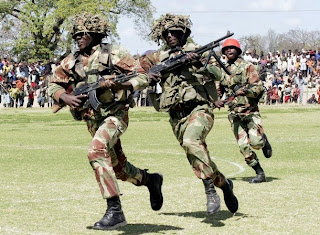 Camouflage clothing has for a very long time been popular urban clothing. If you are lucky enough, you can get yourself a pair of camouflage pants for as little as $1 on eBay. That bargain you get for your piece of clothing could get you into more trouble than you bargained for if you decide to wear it in Zimbabwe. According to the Defence Act (Chapter 11:02), wearing of camouflage materials by civilians, whether Zimbabwean or from any other country, is forbidden. This was something that was mentioned to me a few years ago but didn’t pay much attention to and quickly forgot about simply because of how in most parts of the world it is just a piece of clothing. At the time I was told that people wearing camouflage clothing were beaten up by soldiers and faced possible arrest.





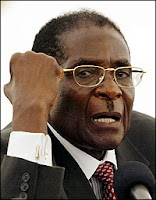 Born on the 21st of February 1924, Robert Gabriel Mugabe has ruled Zimbabwe for nearly three decades. He played a key role in Zimbabwe’s independence struggle and bringing an end to British colonial rule.
 Kim Jong-il, Fidel Castro and Hugo Chavez
 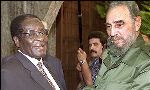 just to name a few. He has even managed to have his name included amongst the world’s worst dictators.
