Category: People

  • Zimbabwe’s Commuter Omnibus Death Traps

    Zimbabwe’s Commuter Omnibus Death Traps

    Commuter omnibuses are a common mode of transportation for many Zimbabweans. If you go into Harare’s CBD you will see them everywhere. In a vehicle such as a Toyota Hiace which is typically built to seat 15 people you can expect to find 20 people packed into one. They may not be the safest form of transportation but people have no choice but to take them in order to get around.

    A number of the commuters on the road are clearly not road worthy which is a recipe for disaster. To add to that, they are driven by people who seem to have a sense of owing the road and can do whatever they want. Watching what they do as they go along their daily activities is scary! You can expect to them operating in the following ways:

    1. Speeding; you can be going 120km/h and have one or two zoom past you as they overtake even though they are only allowed to travel at a maximum of 80km/h (as you can see from the photo taken at night of a vehicle with its brake lights not working).
    2. Drivers competing against each other with total disregard for the road rules such as when overtaking other vehicles not travelling fast enough for their liking. You can have one overtaking to the right as they should but pretty much into oncoming traffic and another brave driver deciding to try his luck off to the side of the road on the left.
    3. Front and rear lights not functioning properly (this is very common with a number of vehicles on the roads of Zimbabwe)

    (click on image for large view)

    Other motorists who have the right of way have to do a bit of defensive driving or give way to commuters. If you don’t, you may end up in a situation you don’t want to be in which could be verbal abuse, a near miss of even a crash.

    All of this put together with a vehicle that is full of people packed liked sardines results in carnage. A lot of the traffic crashes in Zimbabwe involve commuter omnibuses and many lives are lost in one go.

    The Zimbabwe Republic Police have been trying to get unroadworthy commuters off the road and at the same time clamp down on unlicensed drivers in an operation called “100 CBD Decongestion”. How effective such an operation will be should interesting. Corruption is high and the police are very good at turning a blind eye if you have the money.

    If any form of order with respect to commuters will ever be returned is yet to be seen. One question still remains, will commuter drivers ever realise that they are putting the lives of their passengers at risk?

  • Zimbabwe and Human Trafficking

    Zimbabwe and Human Trafficking

    For the past few weeks BBC has been showcasing; Working Lives: Human Traffic that highlights the experiences of people who have succumbed to traffickers. This is something that is a problem all over the world. Those who are in desperate situations are even more prone to becoming victim of traffickers. South Africa is a hot stop for such activities and is a source, transit point and destination for human trafficking. Because of Zimbabwe’s proximity to South Africa and perceived greener pastures across the Limpopo, many of its people are vulnerable.

    A certain individual living in Zimbabwe had been hearing all sorts of stories about the kinds of employment that a number of Zimbabwean women were involved. He wanted to find out a bit more about how they ended up in the situations they were in. A number of them were working as prostitutes in not so inviting areas such as Hillbrow, Johannesburg and against their will. On a trip to South Africa, this person decided to find out how some these women ended up in the situations they were in.

    Here is a quick rundown of how a young woman who has her whole life ahead of her ends up selling her body against her will (please note that this is only one of the many ways that a young woman or child ends up as a victim of such a crime):

    • Recruiters who may or may not be from Zimbabwe end up in Zimbabwe showing off material possessions and lots of cash
    • They befriend people who they think they could easily entice to South Africa to live the life they are living and be able to support their loved ones back home
    • Once the recruiter has left Zimbabwe, they make plans for their target to travel to South Africa and stay in touch with them to put them at ease and make them feel more secure
    • They two arrange with each other to meet at Park Station for example but when the unsuspecting girl arrives in Johannesburg her new friend is nowhere to be found
    • The recruiter who knows when the girl she had recruited is due to arrive from where on in she is pretty much handed over into the hands of the traffickers
    • On arrival in South Africa and not knowing what to do, the girl is also robbed of everything and with no passport (if she entered into the country legally), money or belongings she is left in an even more vulnerable position
    • With her in state of distress, she is approached by a concerned citizen who offers to help her get on her feet and make enough money to either go back home or start a life over there
    • By accepting the offer this girl has gotten herself into situation where she is eventually ‘broken down’ by these syndicates. She then finds herself on the streets working as a prostitute and making hundreds if not thousands of rands a night not for themselves but the human-trafficking syndicates they work for

    Another question that may come to mind is why don’t they get out of these situations once in them. That’s a hard one to answer. The syndicates may be that good at breaking down their victims psychologically to the point where they feel they have no way out. Once there, escape from that world is an impossible dream. Those who do manage to escape but are caught again by the syndicates face very harsh consequences. This serves as a further deterrent for others thinking about doing the same.

    Why even write about human trafficking? To show that Zimbabwe is not immune to such activities as some people may seem to think it. Zimbabwe, like South Africa is also a source, transit point and destination for trafficking. Not all of the victims end up being sexually exploited, some of them end up in forced labour and become modern day slaves. Human trafficking is a billion dollar industry and about half of those trafficked are children. Who is to blame for trafficking and who should be held accountable? Is it the traffickers? The people buying people? Those selling off their family members? The people who solicit prostitutes? Governments? May all are to blame and some more than others.

    Some of you may turn a blind eye to this but for a minute or two, just imagine your daughter, sister, cousin, aunt or someone else you care about is trafficked? Imagine you get to learn that they have been forced into such a situation. Imagine they are being raped multiple times night after night and/or being forced to work day and night without fair compensation?

    More needs to be and can be done by governments in Southern Africa to combat the issue. People are at risk but the situation in Zimbabwe makes people even more vulnerable. Zimbabwe just happens to be one of the countries on a recently released report that is failing to meet international standards in addressing the problem. Until such a time when people can come up with effective ways of combating human trafficking, more and more people will succumb.

    If you would like to find out a bit more about human trafficking, visit the United Nations Office on Drugs and Crime. You may also be interested in taking a look at the Trafficking in Persons Report 2010 by the U.S. Department of State. Maybe there is something you can do to help fight against human trafficking.

  • Power Outages Due To Power Transformer Oil Theft

    One thing that you get used to in Zimbabwe is the erratic electricity supply. The outages can last from hours to days to weeks to months. Some areas may experience outages on a daily basis and in other areas it may only happen every other day. A lot of the time the outages are due to load shedding courtesy of the Zimbabwe Electricity Supply Authority (ZESA) but some are a result of blown power transformers where it could take weeks or months before power is restored.

    Oil theft is to blame for the blown transformers and this seems to be a common occurrence that is happening all over the place. If it is indeed oil theft, only those who are stealing it know what they are doing with it. People are however speculating that they are selling it off to companies in industrial areas, other say that it is being sold to welders to be used in welding machines and some have even gone on to say that they selling it ZESA.

    [ad#Adsense 250×250 white-posts]

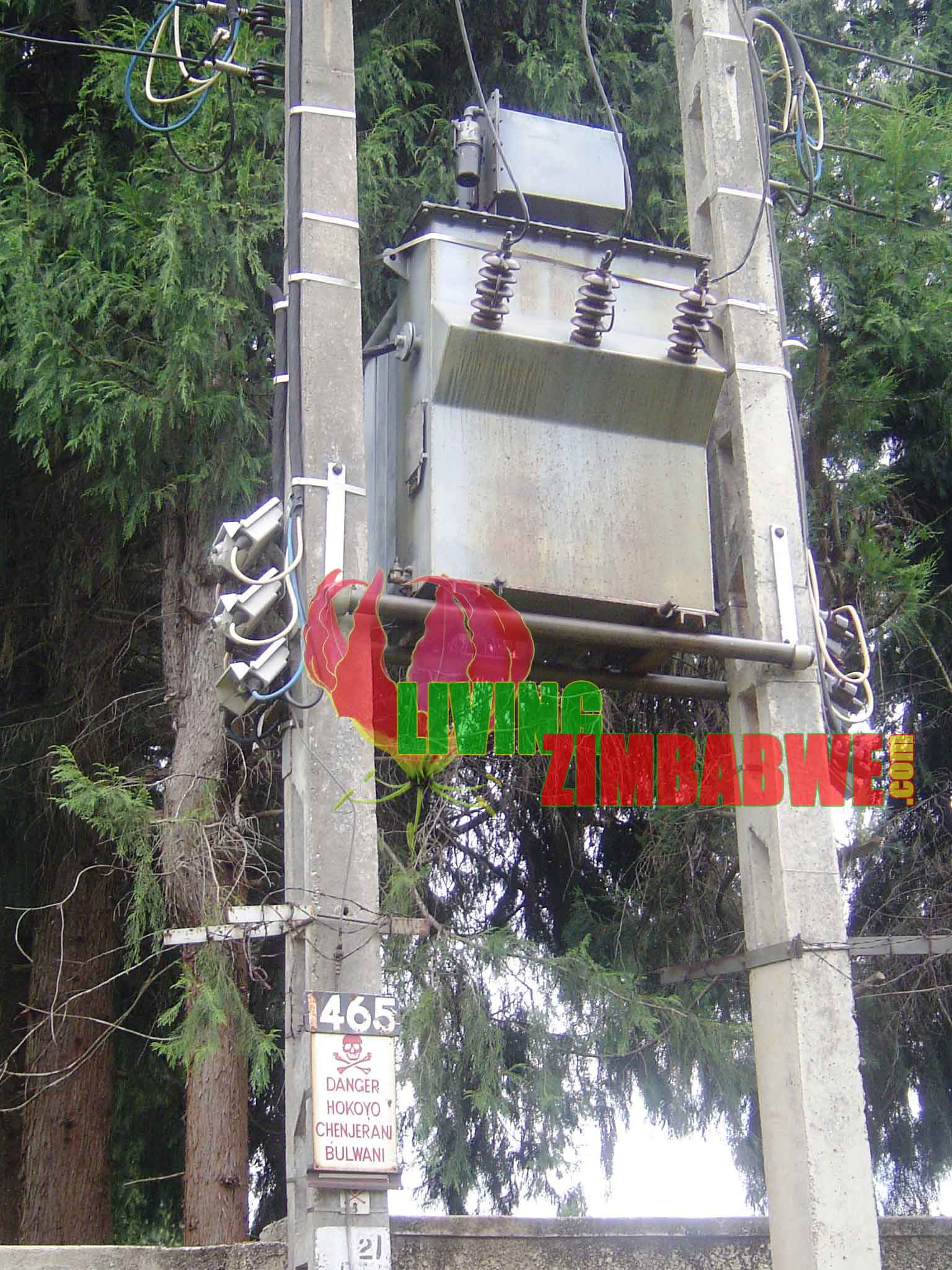
    Whatever the case may be, this is a very selfish act because they are not only leaving people without power for weeks on end, the transformers have to be repaired or replaced and that comes at a cost. Take for example the transformer shown in this post (click on image for larger view). Oil was stolen from it and ZESA informed residents that it could not be repaired and needed to be replaced at a cost of US $12,000. Depending on how lucky you are, ZESA may or may not come to your rescue. In some instances residents who find themselves without power due to thefts have had to band together and come up with the money to get a new transformer. Some even go as far as hiring a security guard to watch over it thus ensuring it does not happen again.

    Questions that come to mind are; would someone in the right mind who has not worked with that kind of equipment disassemble and steal oil from it? Given that they are fiddling around with high voltages where the chances of death are extremely high. That gets you thinking about who would go ahead and attempt to do such. Could it be people working for ZESA or former employees?

    The money that these thieves get from carrying out this act can’t compare to the inconvenience that it puts people through and the amount of money needed to restore things back to normal. Is all of that worth an amount of money that may not take you too far?

  • 1980 – The Year of the People’s Power

    1980 – The Year of the People’s Power

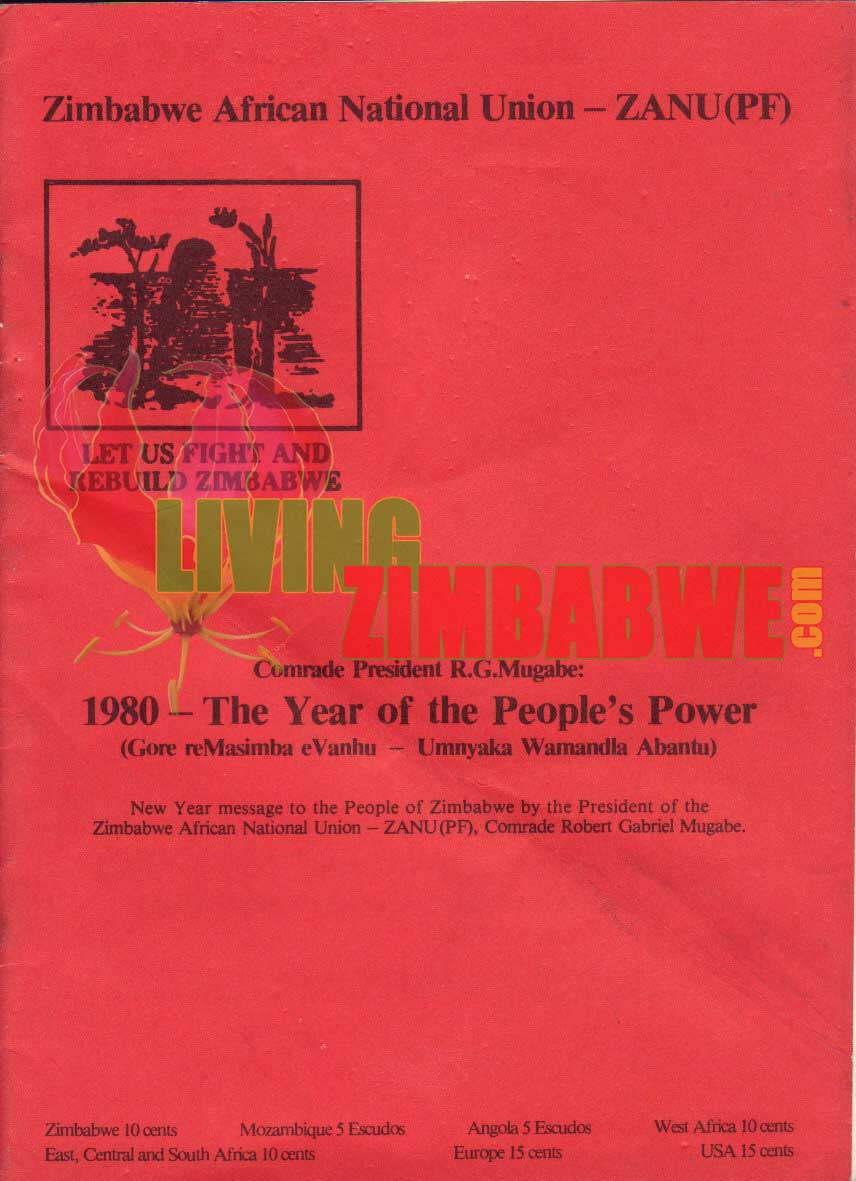
    1980 – The Year of the People’s Power (Gore reMasimba eVanhu – Umnyaka Wamandla Abantu) is a publication that was put out in 1980. It is a New Year Message to the people of Zimbabwe by Comrade Robert Gabriel Mugabe, the President of the Zimbabwe African Union ZANU (PF).

    In it, he talks about the revolutionary triumphs and misfortunes that they face along the way. It also touches on the progress of certain objectives such as the ZANLA Forces Eleven Tasks, British colonisation, traitorous puppets working against the victorious Zimbabwean masses and other significant events in the liberation war (Chimurenga).

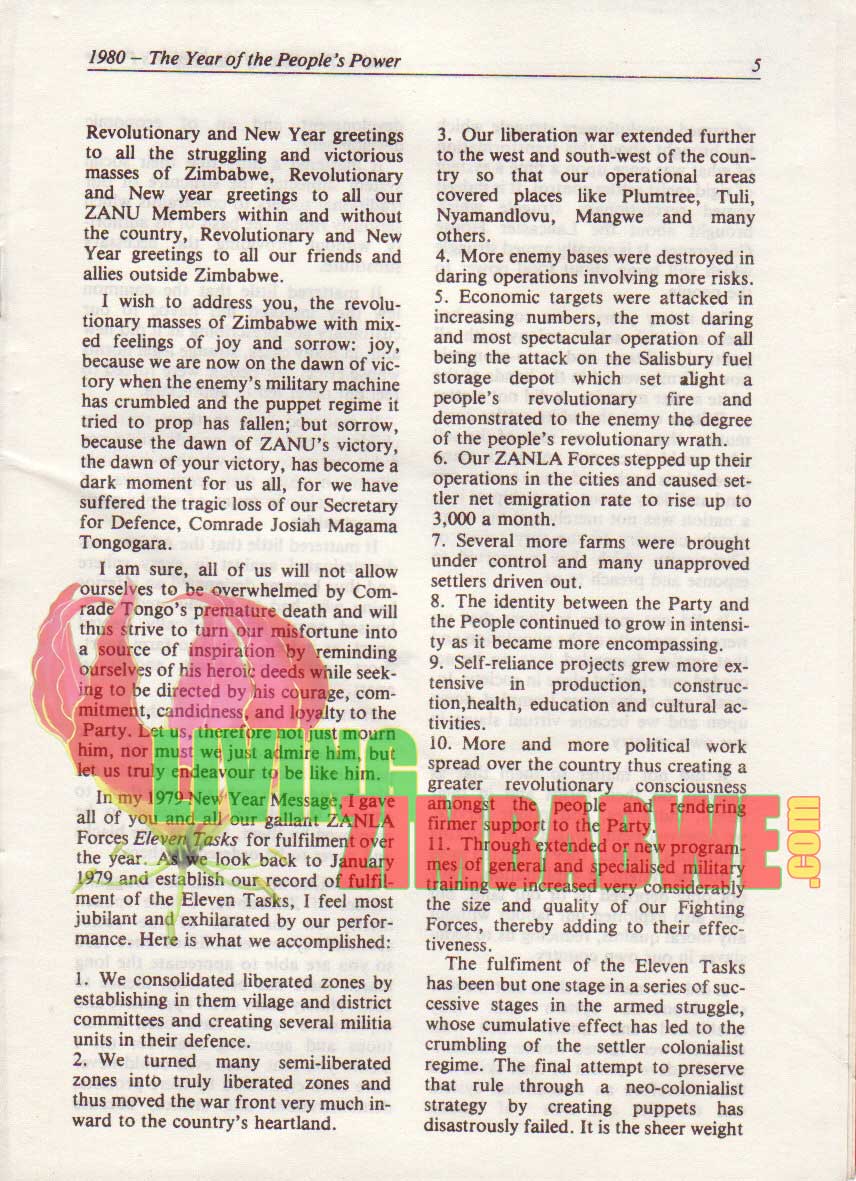
    Here is an excerpt of the first two paragraphs:
    Revolutionary and New Year greetings to all the struggling and victorious masses of Zimbabwe, Revolutionary and New year greetings to all our ZANU Members within and without the country, Revolutionary and New Year greetings to all our friends and allies outside Zimbabwe.

    I wish to address you, the revolutionary masses of Zimbabwe with mixed feelings of joy and sorrow: joy, because we are now on the dawn of victory when the enemy’s military machine has crumbled and the puppet regime it tried to prop has fallen; but sorrow, because the dawn of ZANU’s victory, the dawn of your victory, has become a dark moment for us all, for we have suffered the tragic loss of our Secretary for Defence, Comrade Josiah Magama Tongogara.

    The full 12 page publication is available in PDF format for US$0.50. To purchase the publication visit the Living Zimbabwe Store or by clicking on the Buy Now button below which will take you through to PayPal


    [wpsc_products category_id=’3′ number_per_page=’1′]

  • Politically Charged Graffiti In & Around Harare

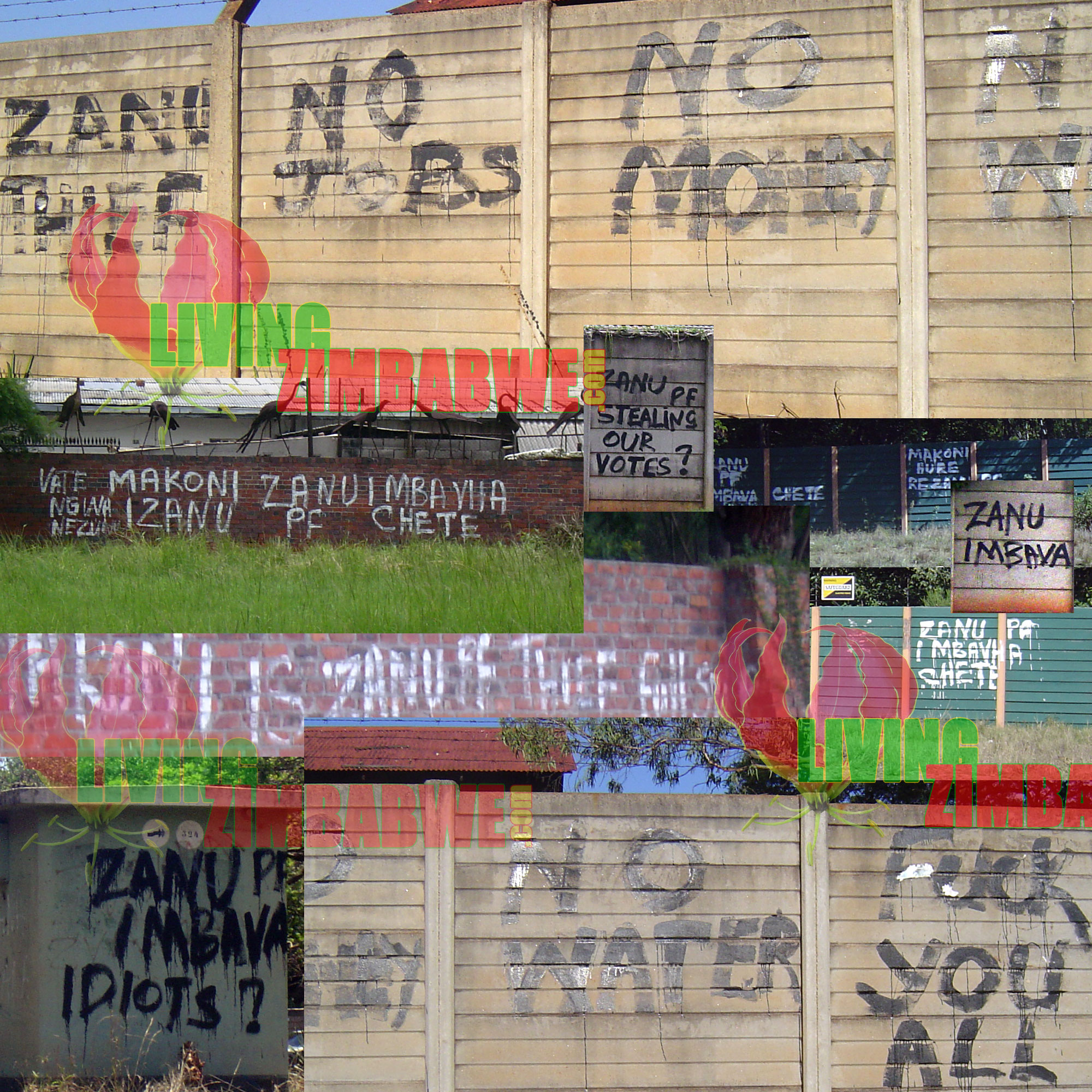
    Driving around Harare, it is hard not to notice graffiti dotted all over the place. Most the graffiti is politically motivated and expresses people’s sentiments on the state of certain affairs in Zimbabwe. A lot of the graffiti points towards disdain for President R. G. Mugabe and Zanu PF and even towards the Chinese who are increasing in number in Zimbabwe.

    Sometimes it is really not that hard to see where people stand with political issues. When listening to political conversations/debates there will be those who 100% support the actions of the last few years and those who clearly have a deep seeded hatred for Mugabe and members of Zanu PF because of their actions, attitudes and stance on various issues. Those with that deep seeded hatred have said that no matter what steps are put in place to rectify situations, they still would not find it in their heart to forgive.

    If people were to step up to the plate and publicly acknowledge wrongdoings and ask for forgiveness, would you find it in your heart forgive?

    Below are only just a few examples of what people had to say:

    [ad#Adsense 468×60, Posts]

    Zanu PF Hate Graffiti in Harare

  • Hopewell Chin’ono vs. Peter Pasipamire and the Truth

    Last week, New Zimbabwe published an article – Film-maker sued over HIV documentary about Hopewell Chin’ono being sued by Peter Pasipamire for alleged non-payment for participation in the moving HIV/AIDS documentary Pain in my Heart. There were inaccuracies in the article which Hopewell has tried to clear up and also share with people in a mass email. You can read the emails (below) for yourself and form your own conclusions now that you have a bit more information than what was originally reported.

    This just goes to show that sometimes the media can get it wrong or be completely biased for one reason or another and you should always take such things with a pinch of salt.

    Dear all,

    I am sure most of you have read the article that was published on Newzimbabwe.com reporting that I am being sued for not sharing the film prize money with one of the characters in the HIV and Aids film that I made in 2007.

    I am sure you are all aware that I donated all the money that I won in prizes from CNN and Kaiser Family Foundation. This money was used to set up a trust to help the kids of Angeline Chiyanike to go to school.

    I went to look for these kids and asked a long distance relative of their mum to look after them on condition that I give her a monthly stipend and pay their fees until they are 18 years old.

    It is standard practice that we do not pay for interviews that are used in documentaries, it is bad journalism to do so. Jeff Kainonge lost his job for doing so and once its discovered that you pay for interviews your reputation as a journalist will be soiled beyond repair.

    I had offered the man who is now suing me to help him with making sure that he gets good access to medical facilities but he demands money arguing that I am giving money to the kids. I am sure you remember that I sent an email to you letting you know that his relatives had turned down that help.

    The reason why I am giving money to these kids is because their mum died whilst I was filming her and what stuck in my mind was when she said her kids will be street kids when she dies.

    The guy who is suing me is being looked after by the River of Life Church in Harare and that was the story-line to ask why a single mum of 2 was not getting help.

    If broadcasters were supposed to pay for interviews would we be able to cover events like Hurricane Katrina or the tsunami if the victims of these tragedies turned around and claimed US$3000 for the interviews?

    I sent an email to the editor of the website. I have posted the emails I exchanged with him below.

    My problems have escalated after posting a trailer for my new film see www.youtube.com/tvnews2000 or

    This film called a Violent Response exposes the people who were behind last year’s post-election violence and captures the violence itself in action. I have received vile emails from people trying to intimidate me from putting it out.

    These are some of the downs of my job but someone has to do it

    Best regards,

    Hopewell

    Mduduzi,

    I acknowledge receipt of your email. Even if you get tons of articles, the cardinal rule in journalism is that you do not publish before you check your facts.

    That is the job of a good editor. The comments in your article from a Chambati are not in court documents but they are meant to tarnish my image as a journalist for unknown reasons.

    I did not make the film as Television International but as a student. Don’t you question statements that you are given when you seek comment? If someone said to me “Mduduzi is a thief” would I be justified to publish that on the basis that someone has said it or I am supposed to check the facts even if its in court documents.

    Would you publish government documents without checking whether they are factual or not?

    The professional thing for you to do is to remove that article since I have given you all the contact details of the people concerned and check your facts first. You know that as a journalist there is nothing important as one’s reputation.

    I do not understand why you think it is important for you to publish a story simply because it has been send by your correspondent even if it carries untrue information.

    I again attach a website with the information that further confirms to you that the film was made as a Masters project not as a Television International production:

    I expect you at the least to accord me the fairness that we as journalists are supposed to give to all people by not publishing information even when it has been brought to our attention that it is not true.

    I have no intention of engaging in phantom battles with people who resent my success as a journalist and filmmaker and who want to use your platform to tarnish my reputation. I also hope that you have no intention of being party to the now typical syndrome of undignified journalism where people print and refuse to verify simply because information has been put in the public domain.

    Who will guard the guards?

    Best regards,

    Hopewell
    – Hide quoted text –
    On Tue, Oct 13, 2009 at 9:23 PM, Mduduzi Mathuthu <–@newzimbabwe.com> wrote:
    Chief,

    We get dozens of stories everyday and if I tried to follow up every name in those stories to find out if they were properly quoted, contacted or treated fairly I would go mad. As a journalist, you know your editor believes what you write which spares them the trouble of staying on the phone all day checking all stories.

    So it happens that the said story came from one of our correspondents in Zimbabwe, quoting from legal papers before the Zimbabwe High Court and stating you were unavailable to comment.

    We have noted your comment you entered under the story and moved quickly to instate your reaction on the story, and I hope everyone gets an idea of what the two sides think about the matter.

    Accept my personal apologies if you were never asked to give your reaction, and rest assured there was no malice.

    Regards,
    ——– Original Message ——–
    Subject: article
    From: “Hopewell Chin’ono” <–@googlemail.com>
    Date: Wed, October 14, 2009 2:07 am
    To: Michael Wayne <–@brunel.ac.uk>, PreChaka <–@kantorimmerman.co.zw>, Dr Chiratidzo E Ndhlovu <–@mweb.co.zw>, ruebonde@zol.co.zw, –@newzimbabwe.com, Dr Hilda Angela Mujuru <–@mweb.co.zw>, Irene Petras <–@zlhr.org.zw>, “Mabasa, Ignatius (Zimbabwe)” <–@britishcouncil.org.zw>, –@britishcouncil.org, Bernard Kwame Ampaw <–@btconnect.com>, –@yahoo.com, Bright Ncube <–@yahoo.com>, alex magaisa <–@yahoo.co.uk>

    Dear Mathuthu,

    I am disappointed that you could run an article on your website accusing me indirectly of being a fraudster and not seeking comment from me.
    Ref –

    I made the film Pain in my Heart as part of my Masters project at Brunel University in 2007. I made contact with Mr Peter Pasipamire (the man accusing me of not paying him for appearing in the film) through Dr Rutendo Bonde who was running the HIV program at the River of Life Church. I asked for patients who were willing to take part in the film project and Mr Pasipamire agreed to do so.

    Anyone who has watched the film will confirm the fact that I asked Mr Pasipamire in the film why he agreed to appear in the film and he states clearly on camera that he wants people to learn about HIV and Aids.

    At no time did I promise to pay Mr Pasipamire any monetary gain as doing so would be unprofessional and unethical on my part.

    It is true that I am giving financial support to the kids who lost their mother whilst I was filming her story. It should be no crime that I chose to help these orphans. Mr Pasipamire has called in police before and he was asked to produce the contract that he signed. He could not produce this document because I never said I would pay him and there is NO contract that exists.

    I have not benefited financially from making this film since I waived my producer’s fee when e.tv ran the film after it won the CNN African Journalist of the year award.

    All the monies that have been donated by Zimbabweans for the kids in the film have been deposited in an account held by the law firm Kantor and Immerman. I have never touched those funds and you can check with Precious Chaka an attorney with the law firm whom I have copied in this email communication.

    I have used my personal funds to help the kids in the film who lost their mum and I have arranged for a long distant relative of their mother to look after them.

    I find it disrespectful that people can decide to make reckless statements about issues they are not privy to instead of getting in touch with the people concerned first. My email address is attached to the youtube version of the film that you have put on your website. You could have easily send me an email to get my side of the story.

    I hope that you will do the decent thing of attaching my comment and speaking to my University Professor who supervised this project, Dr Michael Wayne(–@brunel.ac.uk)-I have copied him too.

    I made this film when I was on a British Council Scholarship and you can get in touch with Ignatius Mabasa- –@britishcouncil.org.zw whom I have copied.

    He will confirm to you that I was never paid a penny by the British Council to make that film. I used my resources as a student to make this film.

    The person who was responsible for my financial issues when I was a British Council Scholar is Denise Rodgers and she will also be able to confirm to you that I never got paid by the British council to make the film. Denise Rodgers can be contacted on- –@britishcouncil.org

    The doctor treating Mr Pasipamire will also confirm to you that I never made an agreement to pay Mr Pasipamire. Her name is Dr Bonde – –@zol.co.zw and I have copied her in this email.

    You have mentioned in your article that the film was screened on BEN(–@bentelevision.com,OBE(–@btconnect.com) and Passion Television(–@passiontv.co.uk stations. I was never paid by these TV Stations for the screening of the film as it was an academic piece of work.
    I allowed them to screen the film as a way of getting the message out.

    The least I expect from you is to put my side of the story and to get in touch with all the people concerned if you wish to get your facts right. What happened to good old journalism?

    Lastly, I find it unprofessional and shocking that Albert Chambati of an organisation you quoted as Justice Aids Trust would say the following statement without seeking to find out what happened first.

    “This case will serve to highlight the abuse of people living with HIV and AIDS, and it might help others in similar situations to come out and challenge those who are abusing them.”

    How can someone have the nerve to go to newspapers and spread malicious rumours without checking their facts first?

    Best regards,

    Hopewell

  • It’s Tough Being Black!

    A few weeks ago I was directed to Africa Online (NZ) to read the review of the Celeb Wedding where Fortune and Zanele tied the knot. Reading through the review got me thinking about something someone said at an event where there were a number of Africans present. All that this person said shaking his head was, “it’s tough being black”! What he was referring to was the manner in which people arrived at the event and the manner in which they conducted themselves throughout the evening. It was a case of look at the car I am driving, look at who I am with, look at what I am wearing and so on. Reading the review of the wedding just got me thinking about how with so many black people it is all about the ‘show’ and ‘keeping up appearances’.

    Going back to the wedding, to me it seemed like the wedding was put on as a show of God knows what for the guests. It is all well and good to celebrate such a day to the fullest and being a Zimbabwean wedding you can expect it to be a jam packed and joyous event. But, when it goes to the point of talking about how we did this, did that, had this, had that it takes a bit of light off what the day was about. Marriage is the union of two souls and when a wedding goes over the top it can take a lot of essence off of that.

    You don’t have to try hard or even look far to find people out there who go to great lengths to make it look as if they have made it when that may not necessarily be the case. For a lot of them, they are struggling to make ends meet and trying to keep up appearances is fuelling their journey towards more debt. On the outside they may look happy and as if they have got it all together but in actual fact there may be amongst other things emotional turmoil.

    This is something that I failed to understand in the early 90’s when I would observe young Zimbabwean’s in the middle of summer sweating up and down 1st Street for hours on end and wearing heavy jeans and a leather jacket. Regardless of the temperature, the leather jacket would not come off because I guess it looked good. This is the same phenomenon I am still seeing today almost two decades later but I still fail to understand it.

    That there is where “it’s tough being black” came from. Some of these people are likely to spend their last few dollars on something to enhance their social standing than something more beneficial such as food. But, who am I to judge? People can do and are entitled to do whatever they want to do but what is the point when nothing meaningful comes from it?

  • Perence Shiri’s would Be Assassin Captured!

    Air Marshall Perence Shiri aka Black JesusAbsolute rubbish! That is what I thought when I read through reports that Frank Muchirahondo, an employee of the United States Agency for International Development (USAID) was captured at the Forbes border post in Mutare on January 22nd whilst trying to flee the country. Absolute rubbish was the exact same thing I thought when reports first surfaced in mid December that there had been an attempt on Perence Shiri’s (aka Black Jesus) life. Reports stated that he was ambushed whilst travelling alone to his farm and was shot in the hand or arm or shoulder (there are a number of different versions of the story). After the incident he was said to have received medical attention at the Manyame Air Force Base hospital. Ever since that alleged attempt on his life, he has not been seen in public and there is no real evidence that he was in fact shot.

    All of this I find very hard to believe because for one, the likelihood of someone like Perence Shiri travelling alone are slim to none not only because of him being the Air Marshall or a member of Joint Operations Command (JOC) but also because of his history of being at the forefront of Gukurahundi. These are more than enough to warrant that he is escorted wherever he goes. To add to that, an unnamed Senior Air Force of Zimbwbe official said it totally false that Shiri had been admitted to the military hospital.

    At the time the reports came out, Minister of Home Affairs, Cde Kembo Mohadi stated, “The attack on Air Marshal Shiri appears to be a build-up of terror attacks targeting high-profile persons, Government officials, Government establishments and public transportation systems.” The alleged incident was seen by many as something that was made up so that Mugabe could declare a state of emergency which would effectively sideline MDC and leave him in complete control of Zimbabwe.

    It is events like this that are among the increasing number of lies that the government has told in the past few months. Some weeks before the ‘shooting’, a number of activist including Jestina Mukoko were abducted and for weeks the authorities denied having any involvement in the abductions. Not to everyone’s surprise, the abductees were found to be alive and in police custody just before Christmas.

    All of these events are just a taste of the lies that the Zimbabwe government is capable of coming up with. They can blatantly lie to its people and the world about what they are doing and not doing and it even more evidence to show that they cannot be trusted. Even with that being the case Tsvangirai and a number of other leaders still believe that a unified government can be formed in Zimbabwe. What is the point of going ahead with a unity government if you know for sure that one party cannot be trusted?

  • Working To Death To Feed A Family

    The New Zimbabwe Dollar So many Zimbabweans in the diaspora are working hard to support their families they left back home. There are a few who don’t necessarily send any sort of support to their families but feel compelled to because they know things are tough. Those who are supporting their families are finding it harder and harder to do so because of the global credit crunch. They are finding that their cost of living is increasing and they are also having to send more and more money home to meet their families needs.

    As already mentioned, people are feeling the pinch as the cost of living rises significantly due to the global credit crunch and after taking care of the all the bills, credits cards, loans and so on that they need to attend to, there isn’t very much if any left over to send home. What is making it even harder now is the dollarization of the Zimbabwe currency. Yes, the dollarization of the currency and the introduction of foliwars (Foreign Exchange Licensed Warehouses and Shops) may have been a God send in that it has made food more readily available if you have the forex. On the other hand, it has pushed the prices of basic commodities and just about everything else meaning larger amounts of hard currency are needed to meet day to day needs.

    A short number of years ago, you could manage to do a bit with a couple of hundred pound sterling or U.S. dollars but in this day in age that amount of money does not go very far. The need to send more money means having to work more. Some people are on the clock almost 24 hours a day for days on end doing what it takes to keep themselves and their families alive. Some have literally worked themselves to death – the irony.

    When there is food available it is expensive, decent medical attention requires payment in foreign currency, some schools have even started setting their fees in U.S. dollars which after a near collapse of state run schools may put education further out of reach. The Zimbabwe dollar is becoming less of an accepted form of payment and the dollarization has put so much out of reach for so many people and may actually be killing Zimbabwe. The credit crunch isn’t helping diasporans who are trying to support loved ones. Not only Zimbabweans at home are suffering, those abroad are finding it more and more difficult to survive and help their families at the same time. This poses one question: is it really worth it being wherever they are in the world as opposed to being at home and trying to make ends meet there?