
Category: Business & Economy

  • Will Chinamasa’s mid-term fiscal policy review help us or hurt us?

    Will Chinamasa’s mid-term fiscal policy review help us or hurt us?

    For the everyday consumer life in Zimbabwe has progressively become difficult. Basic commodities are readily available but they aren’t in easy reach. As the days and weeks pass by, the economic situation has made one commodity harder to come by. Zimbabwe is going through a liquidity crunch which has made the dollar a rare commodity.

    Without cash in hand, consumers are being careful about what they spend their money on and how much of it they spend. There are however economists out there who say that the liquidity crunch is largely an exaggeration created by companies that have accumulated debt and have failed to turn around their businesses. That they are essentially using a liquidity crunch as an excuse for their poor business models.

    But, can that be said in the case of for example a general practitioner who at one point had a steady flow of patients over the years and who has over the months noticed an 80 to 90% drop in the number of patients seeking treatment? More often than not the patients present themselves when their condition is at an advanced stage and when asked why they took so long to seek help, their response has mostly been due to lack of money. Even after they have eventually been seen by a GP, they may not follow a prescribed treatment course due to once again, a lack of funds to buy medication.

    In this scenario, the GP practise is not generating enough income to cover costs which includes paying staff. The same thing may also apply to the pharmacy where a patient would have bought medication in that they may see a drop in revenue. The reduction in the amount of cash flowing through the system has a cascading effect and negatively affects many people. Has this been the result of poor business models?

    The government has also been affected by the economic slowdown and this has led to the Minister of Finance, Patrick Chinamasa introducing various measures in a mid-term fiscal policy review. The measures include an increase in excise duty on petrol from 30 to 35 cents per litre and diesel from 25 to 30 cents per litre, a 25% customs duty on mobile phone imports and a 5 percent excise levy on airtime top-ups for data and voice calls just to name a few.

    Chinamasa may see these measures as being necessary to getting the government and economy back on track but, will they really achieve this goal?

    At some service stations, you can now expect to pay about $1.52/litre for petrol and $1.43/litre for diesel. With just this increase alone, you can more than likely expect the price of everything to go up. It will now be more costly to transport goods and this may lead to increases at the till in order to recoup costs.

    A number of the measures that have already been introduced and those still to be introduced are ones that will inevitable see the people of Zimbabwe having to shell out more money to get by from day to day.

    It is hard to see which of the policies (if any) will have an effect of stimulating the economy which in essence is what it needs. Not a lot seems to have been done to make basic goods and services more affordable for consumers or to increase their purchasing power.

    What are your thoughts on the mid term fiscal policy review? Do you think it will help Zimbabwe or only help to make a difficult situation even more difficult?
  • Does a PayPal ‘Send Money’ Only Service Work for Zimbabwe?

    Does a PayPal ‘Send Money’ Only Service Work for Zimbabwe?

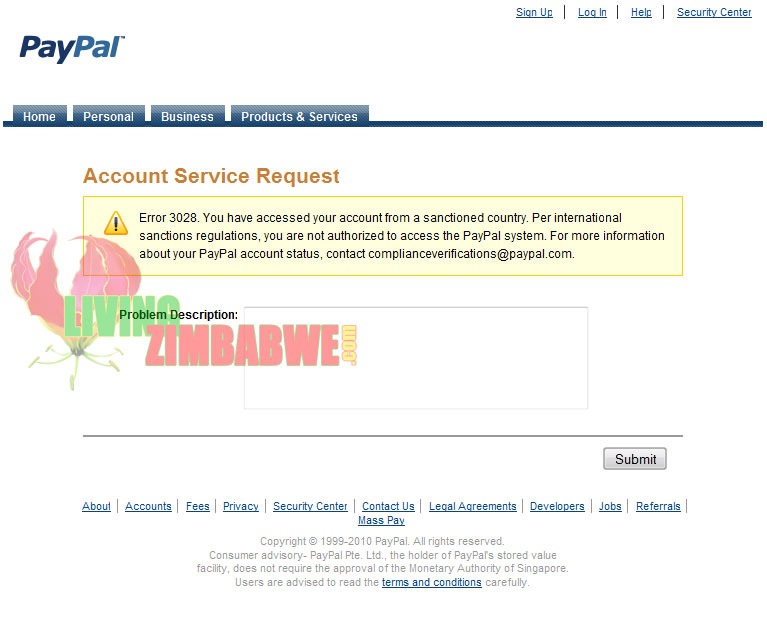
    Over the last few days there has been a lot of hype about the announcement that PayPal would be made available to the people of Zimbabwe. Residents can now sign up for personal or business accounts There has been some debate as to why PayPal was not available in Zimbabwe before this point and the simple answer to that question is sanctions. As you can see from the screenshot below (from 2010), PayPal services could not be accessed due to (users) being in a sanctioned country.

    PayPal-Sanctions-on-Zimbabwe

    The good news for those who really wanted to be able to use their services is that they can now do so without having to revert to weird and wonderful ways of circumventing the restrictions by using Payoneer cards and so on and so forth. The introduction of their services opens Zimbabwean consumers up to a world of online shopping. As a start, items can now be bought on eBay (PayPal’s parent company) with this functionality being extended to being able to pay for goods and services on a countless number of online stores and companies from around the world. The beauty of PayPal is the level of security it provides and that you can make payments to someone online without providing ’that’ particular website with your credit/debit card details.

    However, as far as Zimbabwe is concerned, there are some limitations with the first being the unbanked. If you don’t have a bank account then the chances of you having a credit or debit card are slim to none and this is something that you need in order to have a PayPal account. A considerable chunk of the population don’t transact in the informal sector which would exclude them in creating an account.

    The other side of the coin to providing an option for consumers to make payments is for merchants to be able to accept payments into their PayPal account. Businesses can open a business account which when you look at the signup screen says ‘for merchants who buy and sell online using their company name’. But, in the case of Zimbabwe, the ’sell online’ part of that statement will not apply.  There are currently restrictions in place that do not allow for companies to take advantage of PayPal’s payment solutions; something that we confirmed with PayPal:

    Despite the limitations for merchants, this can be seen as a step in the right direction in that international companies are now a little more open to setting up shop in Zimbabwe. But, as mentioned by a online commentator this move isn’t really in the best interest of Zimbabwean’s because it only serves to funnel money out of the country and doesn’t facilitate for payment inflows for local companies

    In your own opinion, does PayPal really work for Zimbabwe?

  • Bullied By ZIMRA At Harare International Airport

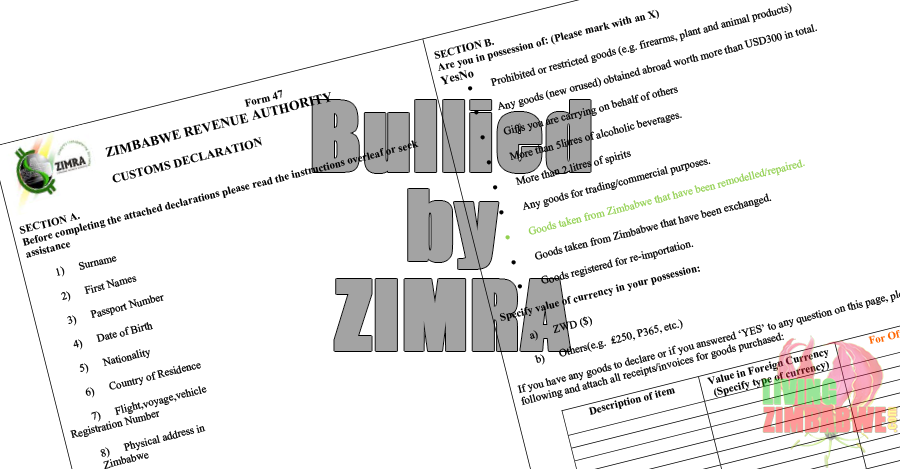
    Bullied By ZIMRA At Harare International Airport

    The following is a letter that one of readers wrote to the The Zimbabwe Revenue Authority (ZIMRA) in response to unpleasant experiences at the hands of their officers and the Zimbabwe Republic Police (ZRP):

    I would like to report two consecutive incidences that made me feel like I was being bullied by those who think they have the power to oppress others.

    I am a Wits student so I fly often. The first incident was when I was with my pregnant sister who had come to SA to buy stuff for her baby. It was on XX November 2013, SAA flight that had left SA at 1930hrs.

    After passport control we managed to get our luggage and because I had big bags ZIMRA people stopped us surprise surprise. We didn’t have receipts for the baby’s stuff only a tax statement listing the stuff since we had left them with SARS. They then told us to go to a room where x-x-x (name censored) (ZIMRA) lady acted like she was doing something but really they were telling us to open our bags. We didn’t want to keep our father waiting and feeling like we were being picked on we only opened my sister’s bag which only had the new things.

    An argument then started and then a guy who used to work at Kariba came. He heard our surname and immediately called my father, who he knew. If I’m NOT mistaken he used to get bribes in BREAD during the economic depression. My father then came and they started acting like they had been nice to us. They told us we were allowed new things under $300 and since we were under that we left.

    “Coincidentally” the police stopped us outside and said they also wanted to open our bags surprise surprise again. They then told us the duty free limit was $100 lower than what ZIMRA had told us. They then said we should go back inside with them, mind you everyone else had left.

    They then made us go through the departures way and had to scan our bags and go through some door back to where we had been. The people scanning our bags continuously said “we are different departments, we don’t work with these guys” having seen that laws were being broken and didn’t want to be mentioned in my complaint.

    The police now joined and insisted we open our bags. We gave them the permission to do so but they weren’t doing anything. All the while my pregnant sister was standing. We asked for their names because they said we could write a complaint if we wanted but they refused to give us their names.

    One policeman and the Kariba ZIMRA guy went to a room and they talked about something. My dad then shook then policeman in the forefront of it all’s hand and they let us go just like that. We ended up leaving at midnight.

    I’m NOT saying he accepted a bribe but that’s how money is usually passed on when people bribe the Police.

    We were only allowed to leave the airport at midnight when everyone including employees had left.

    The 2nd time I was coming from registration on the XX of January 2014 on SAA25, stopped by ZIMRA again I had two small bags. They opened my stuff and they didn’t find anything, again I was the last one to leave. Once I said I was on SAA she immediately told me to go to a room to be searched.

    I am studying actuarial science and randomness is what we study. ZIMRA claims it picks people at random and seeing as it happened to me consecutively I highly doubt that paradigm is feasible because estimating the number of people on each flight and assuming randomness that you claim, the probability of me being picked twice is very close to 0, meaning its highly unlikely to happen in any normal system.

    I am now forced to fly to Lusaka then drive to Kariba because of this bullying, this is another expense I have to incur just to avoid being bullied. How can the management allow the staff to treat people like this?

    Kind regards

    x-x-x (name censored)


    Your turn; what are your thoughts on what this reader experienced and have you been through something similar at the hands of ZIMRA?

    This has been a submission by Anonymous.
    You too can become a Citizen Journalist by submitting your story here: Citizen Journalism by Living Zimbabwe
    The views expressed in the article are those of the author and not necessarily Living Zimbabwe.

  • Lessons in Business From Zimbabwean Entrepreneur Strive Masiyiwa

    Lessons in Business From Zimbabwean Entrepreneur Strive Masiyiwa

    Zimbabwe is one of those places that might be and has been dismissed by some as a lost cause in terms of doing business. It has been described as a country that does not have a conducive environment in which to conduct business for a number of reasons. The International Finance Corporation ranks Zimbabwe at 170 out of 189 countries for it’s ease of doing business so as far as they are concerned, we are pretty much at the bottom.

    Whenever there is a discussion about business in Zimbabwe it is common place to have words and phrases such as corruption, scandal, bribery, mismanagement and misappropriation of funds included in the conversation. This paints a bleak picture that makes the prospect of conducting business in Zimbabwe as being quite a challenge and may even serve as a deterrent.

    That said, there are people who manage to engage in legitimate business activities and some go on to defy the odds and do so without giving in to corrupt practices to realise success. A prime example of someone who has managed to do just that is Strive Masiyiwa. Strive has made most of his money in telecoms and in 2013, Forbes estimated his net worth to be $600 million. Once again, he has managed to amass this wealth whilst saying no to corruption.

    How did he manage to become so successful? That is a question that many have probably asked and one that Strive is answering. His 240,000+ Facebook fans are treated with a regular dose of updates that include stories of how he managed to set up and fund his businesses. The updates also include tips on how to succeed and inspiration for aspiring and current entrepreneurs.

    As you read through and take stock of his updates which are in effect lessons in business, one thing that is clear is that his Christian faith has played and continues to play a pivotal role in his success.

    If you want to know more about how Strive Masiyiwa,

    1. got to where he is today
    2. learn a thing or two to help you realise success,
    follow him on Facebook

    Are there any other incorruptible Zimbabwean business people who you think are worth a mention and have something to share that could help other people realise their desired measure of success?

  • Money Laundering in Zimbabwe; Why The Dirty US Dollar Bills?

    Money Laundering in Zimbabwe; Why The Dirty US Dollar Bills?

    According to a recent report from an international news network, money laundering in Zimbabwe takes on a different meaning because it literally means laundering money with soap and water versus what the phrase means in the traditional sense. For those who have cash in hand, the chances of them being in possession of a clean and crisp US dollar note are not that high. What you are likely to find is a dirty, flimsy, tattered and smelly note.

    The “dirty money” has become the norm but you will find that on occasion you may come across someone not willing to accept your money when paying them for a product or service. This situation can make things difficult for consumers because who would want to end up with a bunch of notes that are not being accepted by anyone?

    In a “normal” economy, notes that have passed their “use by” date are replaced accordingly. In the case of US dollars being used outside of the United States, this would mean a trip back to the Federal Reserve to be destroyed and replaced with brand spanking new notes. But, our economy isn’t quite “normal” and citizens are apparently taking measures into their own hands and are cleaning the money as official channels aren’t doing this for them.

    Another reason for the state of the bills that are in circulation may be that a lot of people have lost faith in the formal banking sector. As Finance Minister Patrick Chinamasa has said, traders “were keeping their money under the pillow” and that it is a market that he intended to tap and bring the value back to the formal sector.

    With the current situation in the banking sector where some depositors have to queue for extended periods of time to make a withdrawal, can you blame people for not wanting to bank their money?

    With all of the above issues in mind, enter Zimbabwe’s mobile operators into the picture. Econet has been working hard at pushing the mobile money transfer product, EcoCash. Telecel has also joined the fray with a similar product offering to rival EcoCash. Given the current liquidity situation these products could be a God send because of the ability to transact electronically and negating the need to go to a bank. The success that these products realise all depends on public update of these offerings.

    As far as now and cash goes, if the situation does not improve, Zimbabwe will have yet another challenge to tackle. The Reserve Bank has added even more currencies to an already multi-currency economy for one reason or another. But, is adding more currencies to the mix the way to go in respect to addressing this issue? We could end up with more dirty notes of all sorts of different currencies and denominations that can’t be used anywhere else but in Zimbabwe.

    What end in sight do you see for Zimbabwe’s multi-currency economy that is filled with dirty money?

  • Can Zimbabwean Diasporans Take A Page Out of Barkue Tubman’s Book?

    Can Zimbabwean Diasporans Take A Page Out of Barkue Tubman’s Book?

    Barkue Tubman was recently featured on CNN African Voices where they highlighted her story of how she left Liberia because of turmoil and after an extended period of time away, returned home to help with it’s redevelopment. The thing that was striking about her story is that it is akin to the lives of many Zimbabweans in the diaspora. Some of these diasporans have made a choice to return home and others are still out there contemplating a move back home.

    Whatever the case may be, in the time spent away from home, people further their education or gain new skills. These acquisitions enable these people to build lives for themselves with some going on to be very successful. More often than not, the things that these people know are very applicable in a Zimbabwean context. Whenever they visit home or talk to people about business opportunities, it can sometimes become apparent that there are gaps in the market that they are able to fill. Some of these gaps may be for services that would be of benefit to a community, city or the nation as well the person who has chosen to fill that gap.

    With that idea in place and down on paper, comes the task of trying to get it off the ground. But, with Zimbabwe being Zimbabwe and Africa being Africa, getting the idea off the ground can prove to be a bit a challenge, a challenge much greater than what would have been faced in the country that this person had been calling home.

    Some may face a raft of road blocks which could include but are not limited to, getting the necessary registration and/or licenses, capital, officials who have not been paid accordingly hampering progress and the list goes on.

    Barkue’s story follows a similar path where she moved to the United States, got an education and had a very successful career in the entertainment industry. On a visit to Liberia, she saw a gap in the entertainment industry that she could fill. She put together a business plan and worked on making it a reality but things didn’t quite turn out the way that she had hoped (you can watch the footage of how and why below). However, she did manage to find opportunities where she could use her skills and it paid off tremendously for her.

    There are a number of Zimbabweans who do want to return home and work for themselves but have a fear that things will not work out as planned. Zimbabwe may have a mix and match of similar and different challenges as far as starting a business goes but, could Barkue’s story serve as one of inspiration? Does it go to show that even if the odds are stacked against you in something you have set your mind on, that we should remain open to and perceptive to other (unrealised) opportunities?

    Should diasporans dispel fears of returning home to either start businesses or become a part of established businesses and contribute to rebuilding the nation?

  • The UAE & Zimbabwe Open Skies Agreement

    The UAE & Zimbabwe Open Skies Agreement

    On 3 October 2012, The United Arab Emirates (represented by Mr. Omar Bin Ghaleb, Deputy Director General of the UAE General Civil Aviation Authority (GCAA)) signed an air services Memorandum of Understanding (MoU) and Air Services Agreement (ASA) with the Government of Zimbabwe (represented by Mr. Munesushe Munodawafa, Secretary for Transport, Communications and Infrastructural Development).

    The agreements which are effectively ‘open skies’ agreements allow for full route access, capacity, number of frequencies and types of aircraft in either a passenger or cargo capacity between the two countries. Also present at the event were various interested parties which included representatives from Emirates, Etihad and RAK Airways. Given that Air Zimbabwe’s international operations are currently grounded, the aforementioned (with Emirates in particular) would be particularly interested in the agreements going through since they face no competition on the route and stand to profit from it.

    As already mentioned, the route will facilitate for increases in freight and passenger services between the two nations and will make trade much easier. But, you can’t help wonder why the push to secure such trading links with Zimbabwe and other Sub-Saharan countries?

    Middle Eastern countries like the UAE have been increasing their investments in Africa and have also been eyeing and buying land in various African nations to ensure a steady supply of food for it’s people. Having open skies agreements with Zimbabwe and other African nations further cements their foothold in Africa with investments that may not necessarily benefit Africans.

    The question is, where will this coupled with Chinese investment leave us in years to come?

  • Can Air Zimbabwe Fly Back Into The Black Like Air Pacific?

    Can Air Zimbabwe Fly Back Into The Black Like Air Pacific?

    Fiji, a former British Colony, a nation that was expelled from the Commonwealth and one that has various sanctions placed upon it, is a small island nation in the South Pacific ocean. It is ruled by what many seem to deem a dictatorial government lead by Commander of the Fijian Military Forces Frank Bainimarama. Does it’s recent history sound somewhat familiar?

    A number of airlines connect Fiji to a few of it’s neighbouring island’s and countries further afield with one of the service providers being Air Pacific, the national carrier. Like a number of airlines around the world who have found the aviation industry a challenge to make a profit in, Air Pacific saw itself slip into the red. But, this year they managed to slip back into the black and recorded an operating profit of $11.5 million versus an operation loss of $2.6 million the previous financial year. This bottom line result was attributed in part to an increase in the tourist numbers.

    As far as ownership goes, Air Pacific is owned by the government but now wholly! The government holds a 51% stake, Qantas 46.3% with the remaining 2.7% being held by other entities. Despite recent attempts by the government to exert greater control over the airline, it is still operating as normal.

    Looking at Air Zimbabwe which is wholly owned by the government, the national carrier is in a serious state of distress and owes millions to various creditors and unpaid staff. At present, Air Zimbabwe is being threatened with losing it’s membership from The International Air Transport Association (IATA) over the renewal of its Operational Safety Audit. If this does happen, it means that the airline will not able to fly to international airports and airspace. But, this may be something that might not be a major concern seeing as they are currently only flying domestically.

    If the government deems it important enough for the country to not lose it’s national carrier and provides it with the minimum it requires in order to get back into full operation what then? The way in which they have been operating over the years has obviously not been working. Privatisation is something that has been spoken about in the past but something that the government does not seem keen on. That said, could them implementing a model such as Air Pacific’s work in transforming Air Zim into a viable airline? The Fijian government is one that likes to be in control but as far as the running of their national airline goes, they are only a majority shareholder. To add to that, it’s operations are overseen by a CEO who has no political affiliations and is not influenced by politics.

    Tourists numbers to Zimbabwe are reportedly on the rise which means that Air Zimbabwe will not be flying empty planes if they get back into full operation. As they continue to not fly international and try to figure out how to stay alive, other airlines are taking advantage of the huge gap they have left in the market. In recent months, South African Airways increased flight frequency into Harare and Emirates which recently started operating a 5 day/week service into Harare announced that they will soon start daily flights into the city. This goes to show that there isn’t a lack of travelers to and from Zimbabwe.

    With the passage of time, regional and international carriers will continue to increase their market share and squeeze the national airline out of a space that they should be dominating. Air Zim may need to quickly learn a lesson on ownership and operation from an airline such as Air Pacific and get themselves to where they should be before it’s too late.

    Is it already too late?

  • The Incredible Potential of Our People And Our Exciting Future

    Zimbabwe has the most incredible people. We are a nation of naturally born entrepreneurs who have a deeply engrained “never give up attitude”. You see business happening on Every corner . The majority of people you speak to are filled with optimism about our exciting future. As we work with more and more entrepreneurs we see a strong spirit of hope, enthusiasm, excitement and passion coming out of each person we connect with and this is the nature of our people.

    Yes we face challenges but all countries face challenges. We all need to stop pointing fingers, work with what we do have and build our future. Our trials make us stronger and teach us to become more creative.

    We are in for an exciting and interesting future and I’m so proud to be a Zimbabwean 🙂

    This has been a submission by Sally Palmer at Sabrebusinessworld. If you have something to share, you too can become a Citizen Journalist by submitting your story here: Citizen Journalism by Living Zimbabwe.

  • Rethinking The Title Of Your Property In Zimbabwe

    Back in the infamous Zim dollar days, everyone wanted to put their property into company names. This way, the buyers avoided transfer fees and the sellers avoided paying capital gains tax. There were other reasons too, but these are probably too shady for a reputable agent such as myself to know about…

    It now seems that there are more disadvantages to owning a property in a company name than the financial advantages of transfer fee avoidance for your future, potential buyers. I have listed some of the points below, but by no means is the list comprehensive:

    1. The myth of not having to pay capital gains tax on the sale of a property owned by a company needs to be debunked as soon as possible. The sale of shares of any description is liable for a 20% capital gains tax. You may be able to find a clever account to perform some creative accounting to avoid the tax, but somewhere down the line these loop holes will be closed and you will be liable for the tax.

    2. If you are over 55 years old and the property you are selling is your principal primary residence (your home, in layman’s terms!), then you may apply to ZIMRA for Capital Gains Tax exemption. If the property is in your name, then it is much easier to explain to ZIMRA that it is in deed your home and you are eligible for the exemption. If it is in a company name, then there will be all sorts of questions and at the end of the day, you may not get the exemption, as a company can’t have a home, because although a company may be a legal entity: it does not need to sleep somewhere!!!!

    3. If the owner of the house was to die, the family would not have to pay death duties on the principal primary residence (yes, the home), but only if the property is in the deceased person’s name. If it is in a company name, the Master of the High Court will demand his pound of flesh, at the most vulnerable time in the grieving family’s life. The last thing you need is trying to find money for the death duties on your home when you have lost a loved one.

    4. There is the ever present fear of the 51% indigenisation bill. Personally, I don’t see this reaching as far a shelf companies which own houses, but then I am the eternal optimist and this is Zimbabwe, so anything goes, and generally the more unexpected the more likely the event will occur. (What a conundrum that is!)

    5. The last point, which comes to mind is the fact that most banks will not loan you money to buy a house in a company name, and so as a buyer you will still have to pay transfer fees to put the property in your name. This whole process thus defeats the reason for the company name and the proposed transfer fee avoidance. Banks are also reluctant to lend you money against a property in a company name. This is because ownership of the company can be transferred without it affecting the change of ownership on the title deeds.

    My advice therefore, is to put your own home in your personal name. If you buy and sell properties as investments then I don’t think it matters which way you choose as you will be selling it on. But remember even if you put it in a company name, you will probably still have to pay tax on the shares. The very best way to avoid this is by putting the property into a trust…I’ll explain this in the next blog!

    For more advice contact me at nicky@pageproperties.co.zw

    This has been a submission by Nicky Versfeld. If you have something to share, you too can become a Citizen Journalist by submitting your story here: Citizen Journalism by Living Zimbabwe.