
18 April 2011 marked the day that Zimbabweans celebrated 31 years of independence. The day brought about a mixed bag of emotions because of the definition of the word INDEPENDENCE but that is a whole story in itself. The 18th also marked the day of the video premiere of We Are Africans – Zimbabwe Mix by JJC, a Nigerian producer, songwriter and vocalist. This Zimbabwe Allstar Remix features Zimbabwean artists Jusa Dementor, Cynthia Mare, Bkay & Kazz, TK Paradza, Decibel, Roby Gee and Jonah. In the day or so that it has been online, It has proved to be quite popular and the three words at the end say it all, “UNITED WE STAND”. The Official We Are Africans Zim Allstar Remix can be downloaded for FREE at – Enjoy!
Author: Living Zimbabwe
-

Applying For A Zimbabwean Passport Without An I.D. Card?
A number of people have emailed us questions related to applying for a new Zimbabwean passport from the diaspora. One question that comes up frequently is that of the need for a Zimbabwe National ID Card when applying for a passport as per the example below:
[quote]My Passport expired and I lost my ID a few years ago here in the UK. How do I obtain my Zimbabwe National identification card while in the UK?[/quote]
[quote]I am a Zimbabwean living in the UK. I lost my ID but I have to renew my passport. Can you please email me how I can go about gettting a Zim ID, preferably without having to go to Zim.[/quote]
We got in touch with two Zimbabwean Consulates (one in the Asia Pacific region and the other in Europe) to find out if it was possible to apply for a new Zimbabwean passport without a National ID card. The response from both of them was that a passport application will not be processed without an identity card.All of the following documents and photocopies are required to be produced in person in order to process a passport application:
[unordered_list style=”tick”]- Birth Certificate (long Birth Certificate)
- National Identity Card (Driver’s Licence Not Accepted)
- Marriage Certificate/National Identity Card in Married Name/Divorce Order
- Two Passport Colour Photographs (Size 3.5 x 4.5cm)
- Citizenship Certificate (For Citizens by Registration)
- Old Passport or Emergency Travel Documents If Any
- Letter on Citizenship Status from the country you have lived in for 5 years and more
[/unordered_list]
This situation can leave people who have lost their passports and are trying to apply for a renewal in what feels like a catch 22. This is because identity cards are only issued in Zimbabwe where registrants have to appear in person in order to get their photos and fingerprints taken.
If you happen to be in a situation like this where you need a new passport but don’t have an I.D. card, the next best thing would be to apply for an emergency travel document and make your way to Zimbabwe and apply for the necessary documents.
-
Wikileaks United States Embassy Harare Cable on Zimbabwe
Some of you will know that Wikileaks recently released a number of confidential US embassy cables. As you can imagine, a number of them contained information or sentiments that the United States government may have rather not had the world know about. The US Embassy in Harare was not immune with a 2007 cable being released on what the then ambassador, Christopher Dell had to say about Zimbabwe.
The full text of the cable (courtesy of Wikileaks) is as follows:
Source Embassy Harare
Classification CONFIDENTIAL
C O N F I D E N T I A L SECTION 01 OF 04 HARARE 000638
SIPDIS
SIPDIS
DEPARTMENT FOR P, AF, AND AF/S FOR MOZENA AND HILL,
NSC FOR SENIOR AFRICA DIRECTOR B.
PITTMAN AND B. LEO; USAID FOR M. COPSON AND E. LOKEN
E.O. 12958: DECL: 07/12/2017
TAGS: PGOV, PREL, ZI
SUBJECT: The End is Nigh
Classified By: Ambassador Christopher W. Dell under Section 1.4b/d
1. (C) Having said my piece repeatedly over the last three years,
I won’t offer a lengthy prescription for our Zimbabwe
policy. My views can be stated very simply as stay the
course and prepare for change. Our policy is working and it’s
helping to drive change here. What is required is simply the grit,
determination and focus to see this through. Then, when the changes
finally come we must be ready to move quickly to help consolidate
the new dispensation.
THE SITUATION
2. (C) Robert Mugabe has survived for so long because he is more
clever and more ruthless than any other politician in
Zimbabwe. To give the devil his due, he is a brilliant
tactician and has long thrived on his ability to abruptly
change the rules of the game, radicalize the political
dynamic and force everyone else to react to his agenda.
However, he is fundamentally hampered by several factors:
his ego and belief in his own infallibility; his obsessive
focus on the past as a justification for everything in the
present and future; his deep ignorance on economic issues
(coupled with the belief that his 18 doctorates give him
the authority to suspend the laws of economics, including
supply and demand); and his essentially short-term,
tactical style.
3. (C) While his tactical skills have kept him in power for 27
years, over the last seven this has only been achieved by a
series of populist, but destructive and ultimately
self-defeating moves. In reaction to losing the 2000
referendum on the constitution, a vengeful Mugabe unleashed
his “Green Bombers” to commit land reform and in the
process he destroyed Zimbabwe’s agricultural sector, once the
bedrock of the economy. While thousands of white farmers
saw their properties seized, hundreds of thousands of black
Zimbabweans lost their livelihoods and were reduced to utter
poverty. In 2005, having been forced to steal victory by
manipulating the results of an election he lost, Mugabe
lashed out again, punishing the urban populace by launching
Operation Murambatsvina. The result was wholesale
destruction of the informal sector, on which as much as
70-80 percent of urban dwellers had depended, and the
uprooting of 700,000 Zimbabweans. The current inflationary
cycle really began with Murambatsvina, as rents and prices
grew in response to a decrease in supply.
4. (C) And now, faced with the hyperinflationary consequences
of his ruinous fiscal policies and growing reliance on the
printing press to keep his government running, Mugabe has
launched Operation Slash Prices. This has once again given
him a very temporary boost in popularity (especially among
the police, who have led the looting of retail outlets and
now seem well positioned to take a leading role in the
black market economy) at the cost of terrible damage to the
country and people. Many small grocery and shop owners,
traders, etc., will be wiped out; the shelves are
increasingly bare; hunger, fear, and tension are growing;
fuel has disappeared. When the shelves are still empty
this time next week, the popular appeal of the price roll
back will evaporate and the government simply doesn’t have
the resources to replace the entire private commercial
sector and keep Zimbabweans fed. It may attempt to do so
by printing more money, adding even more inflationary
pressure on a system already reeling from the GOZ’s
quasi-fiscal lunacy combined with the price impact of
pervasive shortages. The increasingly worthless Zim dollar
is likely to collapse as a unit of trade in the near
future, depriving the GOZ of its last economic tool other
than sheer thuggery and theft of others’ assets.
5. (C) With all this in view, I’m convinced the end is not
HARARE 00000638 002 OF 004
far off for the Mugabe regime. Of course, my predecessors
and many other observers have all said the same thing, and
yet Mugabe is still with us. I think this time could prove
different, however, because for the first time the
president is under intensifying pressure simultaneously on
the economic, political and international fronts. In the
past, he could always play one of these off against the
other, using economic moves to counter political pressure
or playing the old colonial/race/imperialist themes to buy
himself breathing room regionally and internationally. But
he is running out of options and in the swirling gases of
the new Zimbabwean constellation that is starting to form,
the economic, political and international pressures are
concentrating on Mugabe himself. Our ZANU-PF contacts are
virtually unanimous in saying reform is desperately needed,
but won’t happen while the Old Man is there, and therefore
he must go (finding the courage to make that happen is
another matter, however, but even that may be coming closer).
This is not some sudden awakening on the road to
Damascus, but a reflection of the pain even party insiders
increasingly feel over the economic meltdown. We also get
regular, albeit anecdotal, reports of angry and
increasingly open mutterings against Mugabe even in ZANU-PF’s
traditional rural bastions. Beginning in March, the
other SADC leaders finally recognized (in the wake of the
terrible beatings of March 11 and the international outcry
that followed–another self-inflicted wound for Mugabe)
that Zimbabwe is a problem they need to address. Thabo
Mbeki appears committed to a successful mediation and is
reportedly increasingly irritated with Mugabe’s efforts to
manipulate him or blow him off altogether. If Mugabe
judges that he still commands all he surveys by virtue of
being the elder statesman on the scene, he may be
committing yet another serious blunder. Finally, one does
well to recall that the only serious civil disturbances
here in a decade came in 1998 over bread shortages, showing
that even the famously passive Shona people have their
limits. The terror and oppression of the
intervening years have cowed people, but it’s anyone’s guess
whether their fear or their anger will win out in the end.
WHAT WILL THE END LOOK LIKE?
6. (C) This is the big, unanswerable question. One thing
at least is certain, Mugabe will not wake up one morning a
changed man, resolved to set right all he has wrought. He
will not go quietly nor without a fight. He will cling to
power at all costs and the costs be damned, he deserves to
rule by virtue of the liberation struggle and land reform and
the people of Zimbabwe have let him down by failing to
appreciate this, thus he needn’t worry about their
well-being. The only scenario in which he might agree to
go with a modicum of good grace is one in which he
concludes that the only way to end his days a free man is
by leaving State House. I judge that he is still a long
way from this conclusion and will fight on for now.
7. (C) The optimal outcome, of course, and the only one that
doesn’t bring with it a huge risk of violence and conflict, is
a genuinely free and fair election, under international
supervision. The Mbeki mediation offers the best, albeit
very slim, hope of getting there. However, as Pretoria
grows more and more worried about the chaos to its north
and President Mbeki’s patience with Mugabe’s antics wears
thin, the prospects for serious South African engagement
may be growing. Thus, this effort deserves all the support
and backing we can muster. Less attractive is the idea of
a South African-brokered transitional arrangement or
government of national unity. Mbeki has always favored
stability and in his mind this means a ZANU-PF-led GNU, with
perhaps a few MDC additions. This solution is more likely
to prolong than resolve the crisis and we must guard
against letting Pretoria dictate an outcome which
HARARE 00000638 003 OF 004
perpetuates the status quo at the expense of real change
and reform.
8. (C) The other scenarios are all less attractive: a popular
uprising would inevitably entail a bloodbath, even if it
were ultimately successful; Mugabe’s sudden, unexpected
death would set off a stampede for power among ZANU-PF
heavy weights; a palace coup, whether initiated within
ZANU-PF or from the military – in which Mugabe is removed,
killed, exiled or otherwise disposed of, could well devolve
into open conflict between the contending successors. Similarly,
some form of “constitutional coup” i.e., a change at the top
engineered within the framework of ZANU-PF’s “legitimate”
structures could well prove to be merely the opening bell
in a prolonged power struggle. None of the players is
likely to go quietly into the night without giving everything
they have, including calling on
their supporters in the security services. Moreover, experience
elsewhere would suggest that whoever comes out on top
initially will struggle, and more than likely fail, to halt
the economic collapse. Thus, there is a good prospect of
not one but a series of rapid-fire “transitions,” until
some new, stable dispensation is reached.
9. (C) The final, and probably worst, possibility is that Mugabe
concludes he can settle for ruling over a rump Zimbabwe,
maintaining control over Harare and the Mashona heartland,
the critical forces of the National Reserve Force and CIO
and a few key assets–gold, diamonds, platinum and Air
Zimbabwe to fund the good times. Under this scenario the
rest of the country, in one of the comrade’s favorite
phrases, could “go hang,” leaving it to the international
community to stave off the worst humanitarian consequences.
WHAT OF THE OPPOSITION?
10. (C) Zimbabwe’s opposition is far from ideal and I leave
convinced that had we had different partners we could have
achieved more already. But you have to play the hand you’re dealt.
With that in mind, the current leadership has little executive
experience and will require massive hand holding and assistance
should they ever come to power.
11. (C) Morgan Tsvangarai is a brave, committed man and, by and
large, a democrat. He is also the only player on the scene
right now with real star quality and the ability to rally
the masses. But Tsvangarai is also a flawed figure, not
readily open to advice, indecisive and with questionable
judgment in selecting those around him. He is the indispensable
element for opposition success, but possibly an albatross around
t heir necks once in power. In short, he is a kind of Lech Walesa
character: Zimbabwe needs him, but should not rely on his executive
abilities to lead the country’s recovery. Arthur Mutambara is young
and ambitious, attracted to radical, anti-western rhetoric and
smart as a whip. But, in many respects he’s a light-weight
who has spent too much time reading U.S. campaign messaging
manuals and too little thinking about the real issues. Welshman
Ncube has proven to be a deeply divisive
and destructive player in the opposition ranks and the
sooner he is pushed off the stage, the better. But he is
useful to many, including the regime and South Africa, so
is probably a cross to be borne for some time yet. The
prospects for healing the rift within the MDC seem dim,
which is a totally unnecessary self-inflicted wound on
their part this time. With few exceptions–Tendayi Biti,
Nelson Chamisa–the talent is thin below the top ranks.
The great saving grace of the opposition is likely to be
found in the diaspora. Most of Zimbabwe’s best
professionals, entrepreneurs, businessmen and women, etc.,
have fled the country. They are the opposition’s natural
allies and it is encouraging to see signs, particularly in
South Africa and the UK, that these people are talking,
HARARE 00000638 004 OF 004
sharing ideas, developing plans and thinking together about
future recovery.
12. (C) Unfortunately, among the MDC’s flaws is its inability to
work more effectively with the rest of civil society. The
blame for this can be shared on both sides (many civil
society groups, like the NCA, are single-issue focused and
take the overall dynamic in unhelpful directions; others,
like WOZA, insist on going it alone as a matter of
principle), but ultimately it falls to the MDC as the
largest and the only true political party, to show the
way. Once again, however, these are natural allies and
they have more reason to work together than fight against each
other.
STAYING THE COURSE, PREPARING FOR CHANGE
13. (C) If I am right and change is in the offing, we need to
step up our preparations. The work done over the last year on
transition planning has been extremely useful, both for
stimulating a fresh look at our own assumptions and plans
and for forging a common approach among the traditional
donor community. But the process has lagged since the
meetings in March in London and should be re-energized. It is
encouraging in this respect that USAID Washington has
engaged the Mission here in discussing how we would use
additional resources in response to a genuinely
reform-minded government . I hope this will continue and
the good work done so far will survive the usual
bloodletting of the budget process.
1. (C) The official media has had a field day recently whooping
that “Dell leaves Zimbabwe a failed man”. That’s not quite
how it looks from here. I believe that the firm
U.S. stance, the willingness to speak out and stand up,
have contributed to the accelerating pace of change.
Mugabe and his henchman are like bullies everywhere: if
they can intimidate you they will. But they’re not used to
someone standing up to them and fighting back. It catches them
off guard and that’s when they make mistakes. The howls of protest
over critical statements from Washington or negative coverage
on CNN are the clearest proof of how this hurts them. Ditto
the squeals over “illegal sanctions.” In addition, the regime
has become so used to calling the shots and dictating the
pace that the merest stumble panics them. Many local
observers have noted that Mugabe is panicked and
desperate about hyperinflation at the moment, and hence he’s
making mistakes. Possibly fatal mistakes. We need to
keep the pressure on in order to keep Mugabe off his game
and on his back foot, relying on his own shortcomings to do
him in. Equally important is an active U.S. leadership
role in the international community. The UK is ham-strung
by its colonial past and domestic politics, thus, letting them
set the pace alone merely limits our effectiveness. The EU is
divided between the hard north and its soft southern
underbelly. The Africans are only now beginning to find
their voice. Rock solid partners like Australia don’t
pack enough punch to step out front and the UN is a
non-player. Thus it falls to the U.S., once again, to take
the lead, to say and do the hard things and to set the agenda.
Hundreds, maybe thousands, of ordinary Zimbabweans of all
kinds have told me that our clear, forthright stance has
given them hope and the courage to hang on. By this regime’s
standards, acting in the interests of the people may indeed be
considered a failure. But I believe that the opposite is true,
and that we can be justifiably proud that in Zimbabwe we have
helped advance the President’s freedom Agenda. The people of
this country know it and recognize it and that is the true
touchstone of our success here.
-

Time For Zimbabweans in the UK To Head Home Or Be Deported
The UK Border Agency recently released a statement stating that they were going to resume enforced returns of failed asylum seekers. The deportation of Zimbabwean nationals was suspended in 2006 but for some reason the UKBA now feels that it is safe for failed asylum seekers to return home. Understandably so, there are thousands of Zimbabweans in the UK who are not happy with the decision and are in a state of worry.
One force that may have aided in the UKBA making such a decision may have been Mr. Morgan Tsvangirai’s 2009 plea to Zimbabweans in the UK to return home. That statement put people in a precarious position and they did not take too kindly to that and he was heckled and booed with the response being Mugabe should go before that happens. Another reason may be the formation of Unity Government which the Brits must see as working well for them to come up with such a decision. Of late, it has become more apparent that the GPA is not working as hoped and that Mugabe and Zanu PF are still running the show.
The resumption of deportations was bound to reach this point because the UK does not want foreigners in their land. New Immigration laws are constantly being put in place and some see these actions as a way of reducing migrant numbers and getting more Brits to work. Other see them as hidden racist tendencies aimed at reducing the number of migrants. You may disagree with that statement and say racism is restricted to a small portion of the population but that is not the case. A lot of people would rather not have foreign nationals in their country but are not vocal about it. What more for foreigners who come from a nation whose president openly criticises the West and doesn’t bow to their pressure?
If the UK can find the slightest excuse to get people out of their country without breaking any human rights acts they will take them. This seems to be what is happening and now many Zimbabweans may be faced with the decision of either returning home voluntarily or taking their chances and maybe be deported at one point or another.
-
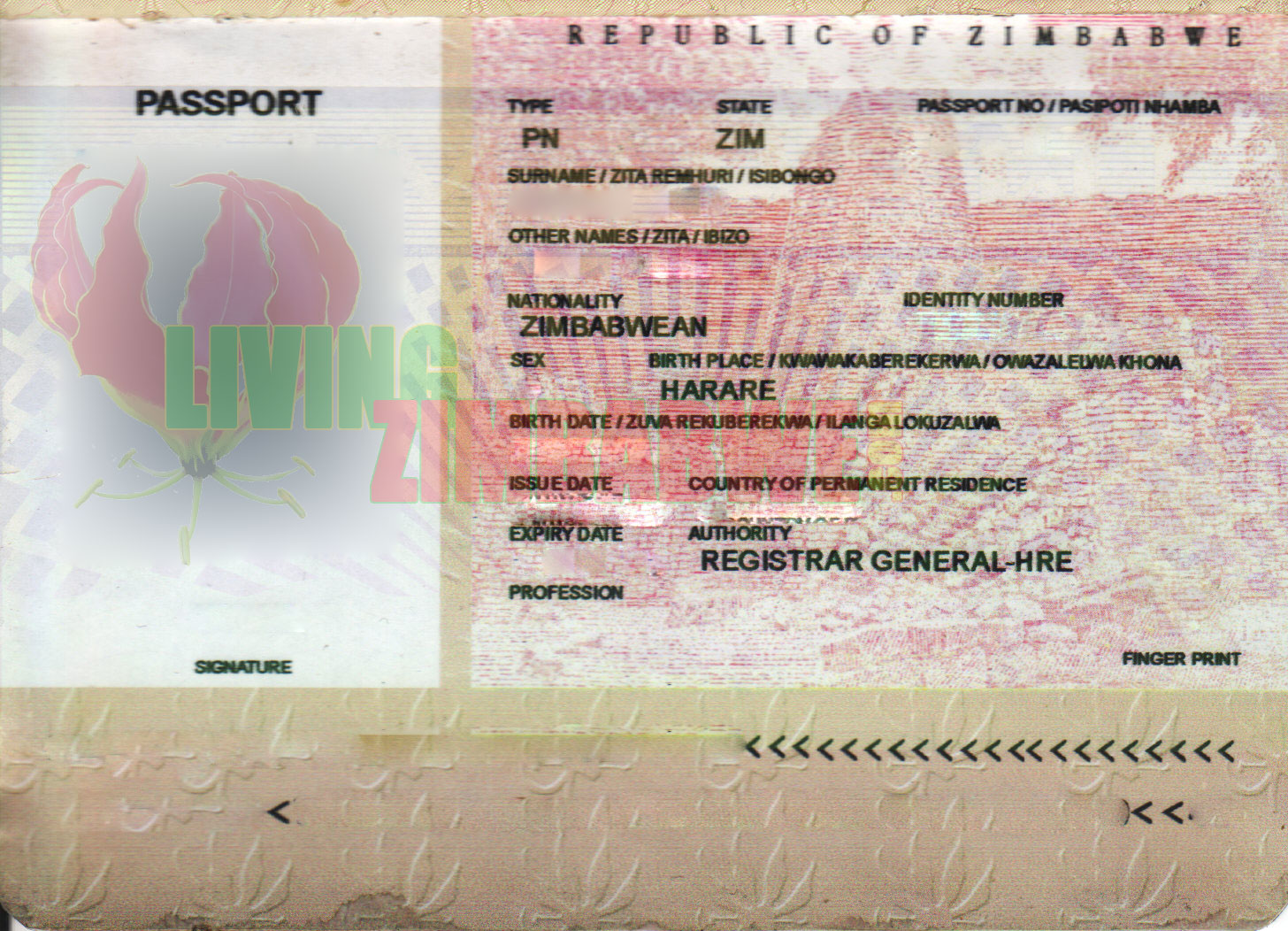
Passport Office Corruption and Fraudulent Zimbabwean Passports
It has been reported that the Home Affairs co-minister Theresa Makone is set to investigate alleged corruption at the Registrar General’s Passport Office. This includes paying for passports at inflated prices and/or having to pay in order to be served.
The minister went on to say that she was not aware of such practises which is absolute rubbish! It is a known fact that in order to get served in a timely manner or even get served at all in government departments you have to be prepared to part with money to get service.
Even though corruption in itself is bad enough, it is the least of people’s worries when it comes to dealing with the passport office. After spending all of that hard earned money of yours to get a travel document you could end up with a fraudulent travel document. Being in possession of a fake Zimbabwean passport or emergency travel document could get you into more trouble and stress than you bargained for (The consequences of being stopped with a fake travel document in or out of Zimbabwe can be left to your imagination).
This is a Zimbabwe passport applicant BEWARE warning. Having to pay corrupt officials is the least of your worries. You need to be sure that you are getting a genuine document.
Below is an image of the details page of a fraudulent Zimbabwean passport [sensitive information has been removed]. Can you spot any differences?
(click on image for large view)
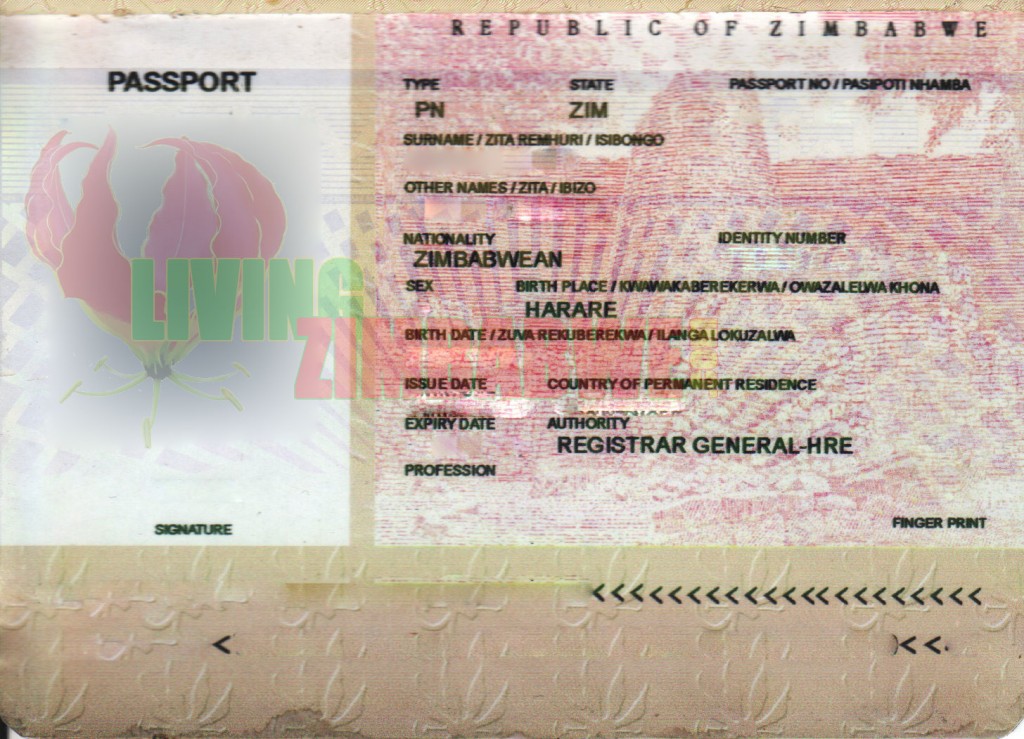
Post idea and image of fraudulent document supplied by an anonymous contributor. Contribute to Living Zimbabwe.
-
The Plight Of A Zimbabwean Asylum Seeker
A Zimbabwean superstar in the making Gamu Nhengu has been causing quite a stir in the UK with her X factor performances. Unfortunately it all came to an end at the weekend and this left a number of fans very unhappy. Now news is going around that her and her family are facing deportation due to a failed visa application.
Her being in that situation got me thinking about the hundreds if not thousands of Zimbabweans who are waiting on asylum applications (even though her and her family are not asylum seekers). Some have been lucky enough to get their application approved quickly. There are others who years down the line are still waiting on the Home Office to make a decision on their claims. Whist they wait they are in a situation where they are neither here nor there.
Being a migrant in itself is enough to take a significant emotional toll on a person. Can you image what it would be like with the added stress of waiting on an asylum claim? For months and months applicants are in a situation where all they can do is sit and wait for someone to make their mind up. Whilst all of that is in progress, they cannot work which means they have to live off whatever assistance they are receiving from the government. For others that also means less or no monetary assistance for family they may be supporting back home. They also obviously cannot travel to Zimbabwe or anywhere else for that matter which can make it tough if a situation arises where their presence would have been expected.
Some people have simply put in claims so that they can legally stay on in the UK and work. They may not have necessarily been persecuted in Zimbabwe and have become illegal with asylum being the option they can think of to become legal.
If all else fails for asylum seekers, The International Organisation for Migration runs a Voluntary Assisted Return and Reintegration Programme (VARRP) to assist asylum seekers who want to return to their country. Who knows how well this programme works? It may just be a way of enticing migrants to leave the country so that the Brits don’t have to worry about them; in other word’s, “here, have some money now get out of our country!”
This is just a bit of what some asylum seekers have to go through. If an application is successful, refugees are allowed to travel wherever they like except to their country of origin. But, that restriction doesn’t stop some brave souls from making their way home. It makes you wonder if it is really worth it going through all of that just so that you can stay in the United Kingdom?
-

Should Air Zimbabwe Be Privatised?
Air Zimbabwe like many other parastatals has been in a downward spiral for the last few years. It has been plagued with all sorts of issues with the majority being of a financial nature. Its pilots are striking at the moment over unpaid wages and this is causing a lot of turmoil. In response to the strike action, the airline fired its pilots after they refused to return to work by a given date.
By doing a bit of analysis it seems as if a major problem is that the airline is a government entity. Because of being a parastatal it succumbs to a lot of political interference. That being said, some of the decisions being made may not be in the best interests of the business as a whole. Without naming names, some decisions seems to be made to suite the personal interests of a select few.
Air Zimbabwe is managed by individuals who don’t seem to have what it takes to review the airline and turn it into a profitable business. The reasons for that may be that they were put in those positions not because they were the right people for the job but because of their affiliations. Another thing that they may be more concerned about is filling their pockets with as much money as they can before they move on. Some of the statements that their executives make just don’t make sense. In the last few hours news has come out that Air Zimbabwe has reportedly purchased 2 Airbus A340 aircraft for $400 million. This is what the chairman Jonathan Kadzura had to say about the supposed purchase, “I have also heard about it (new planes), but to be frank, I am not aware of it.” This and other confused statements leave you in a position where you can’t trust of have much faith in its management.
One of the best things that could be done for the airline would be to privatise it. Making such a move could bring in much needed investment which would not only carry the airline forward but also help it get out of debt. Such a move could also bring about a complete change of management and much needed corporate restructuring.
The major stumbling block in a move towards privatisation seems to be the government itself who just don’t want to let go of it and other failing parastatals. The reasons for this could range from wanting to keep a grip on anything and everything to greed to monopolisation and the list goes on. If they haven’t already done so they need to realise that there are some things that they are not good at and continue to fail it and in the interest of economic recovery should let go of.
If the downward spiral is not brought under control soon Air Zimbabwe is going to crash and burn and leave Zimbabwe with no national airline.
-
Chicken To Change – Mugabe Political Satire
Freshlyground released a music video, “Chicken to Change” a few days ago which will probably attract a bit of attention. At the beginning of the video you see the latex Mugabe saying, “I Robert Gabriel Mugabe do swear that I will be faithful and bear true allegiance to Zimbabwe and observe the laws of Zimbabwe so help me God” and goes on to cross his fingers close to the end of the speech.
With lyrics like, “An iridescent example of honour for the coming generation… You promised always to open the doors for us… Indeed it is you and only you who sleeps with the key… You are chicken to change!” it is plain to see that the video is a message or challenge to Mugabe to let go of the power he has held on to for decades. But, he is too chicken to do so.
The latex Mugabe character is the creation of the well-known cartoonist and co-creator of ZA NEWS, Zapiro. This may mean we will be seeing more of Mugabe on ZA News.
Given Zimbabwe’s political history is taking such a stand against Mugabe really worth the while or is it a waste of time?
Watch the video and draw your own conclusions.
‘Chicken to Change’ Freshlyground / ZA NEWS music video from ZANEWS on Vimeo. -

Vision Inspired People Zimbabwe Appeal
Vision Inspired People Zimbabwe is dedicated to the assistance of African children living in disadvantaged communities and children’s homes in Southern Africa. We aim to provide basic education necessities to school going children and where possible, support orphans educational and social needs.
The VIPZ Assistance Program is an on-going effort by Vision Inspired People Zimbabwe to provide essential items such as clothing, books and school materials to help poverty alleviation in the Southern African region. This year we have managed to collect over 10 000 pens, pencils and rulers, second-hand clothing and children’s books which are all now waiting to be shipped to the target communities.
Vision Inspired People Zimbabwe intends to personally distribute all items with the assistance of our partners in Zimbabwe and South Africa. We also promise to provide feedback to potential donors by sharing images and information on our website or through various communication mediums.
The VIPZ Assistance Program assists Groups and children’s homes in the following countries:
SOUTH AFRICA
ZIMBABWEIf you would like to make a personal contribution or donation, please contact Vision Inspired People Zimbabwe for more information on:
U.K TEL: +44 1204 413839
EMAIL: enquiries@visioninspiredpeoplezimbabwe.orgAlternatively visit our website to make an online donation, send a cheque, do an electronic funds transfer or Bank deposit to the following:
VISION INSPIRED PEOPLE ZIMBABWE LIMITED
HSBC BOLTON BRANCH
SORT CODE 40-12-25
ACCOUNT NO. 32174111
Victoria Square. Address
1-3 Victoria Square
Bolton
Greater Manchester
BL1 1RJVision Inspired People Zimbabwe is dedicated to transparent and efficient delivery of all assistance (monetary/or kind).
Registered Charitable Company with HMRC’s Gift Aid.
*NB: Vision Inspired People Zimbabwe is not a FUND, nor are we involved in the child sponsorship selection process.Guest submission by: Shabaan @ Vision Inspired People Zimbabwe
-

Colcom Pork Pie
Colcom pork pies are one of those food items that have forever been a favourite with many Zimbabweans. They are a tasty snack item that can be taken hot or cold. If you listen close enough to people in the diaspora when they talk about the foods they miss from home, pork pies usually pop up as one of them.