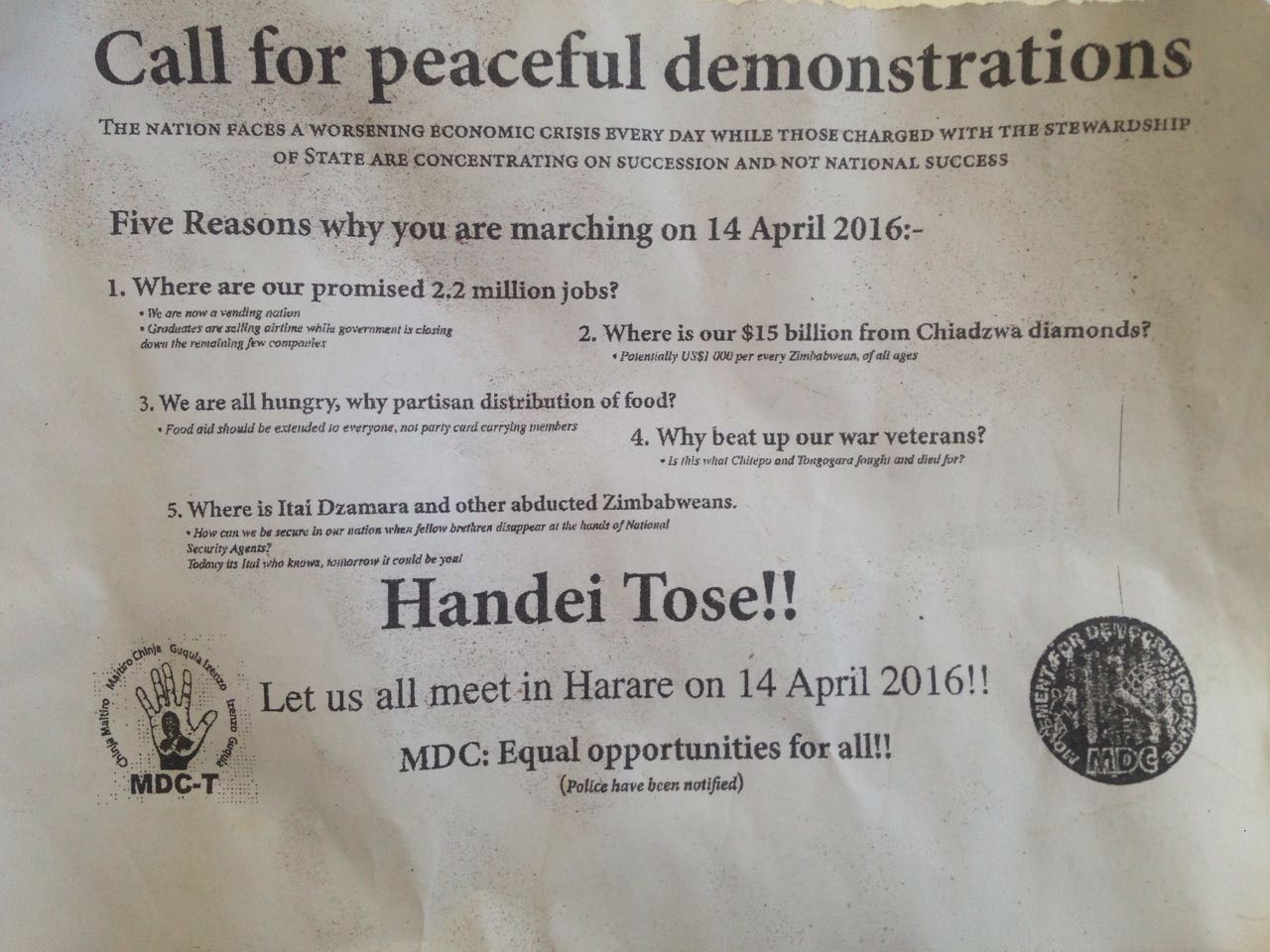
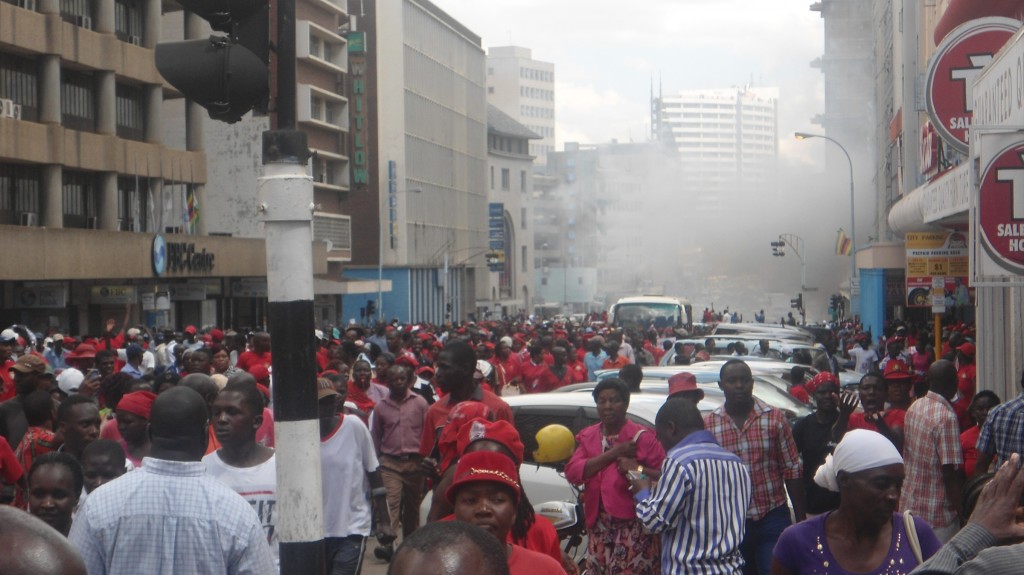
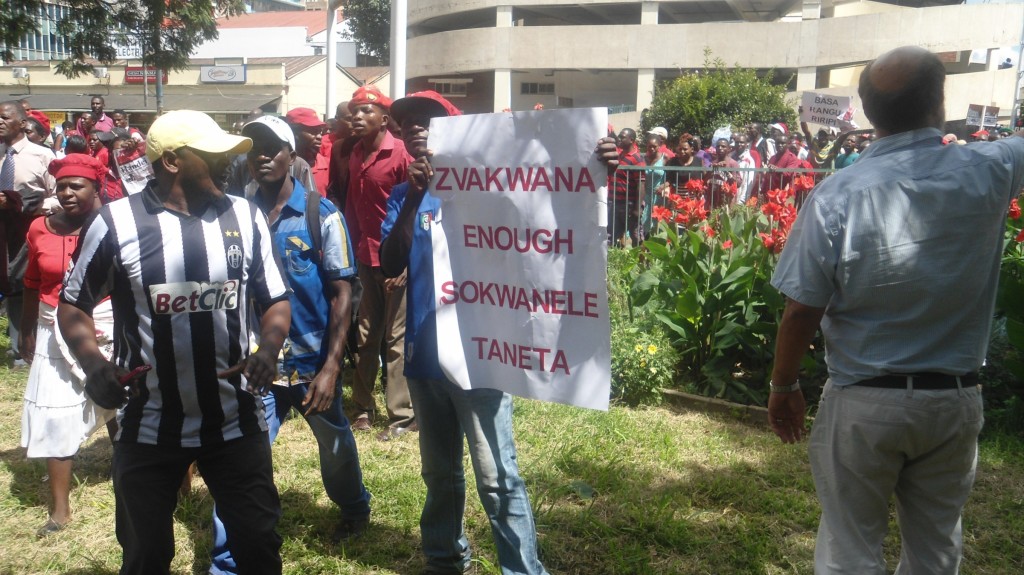
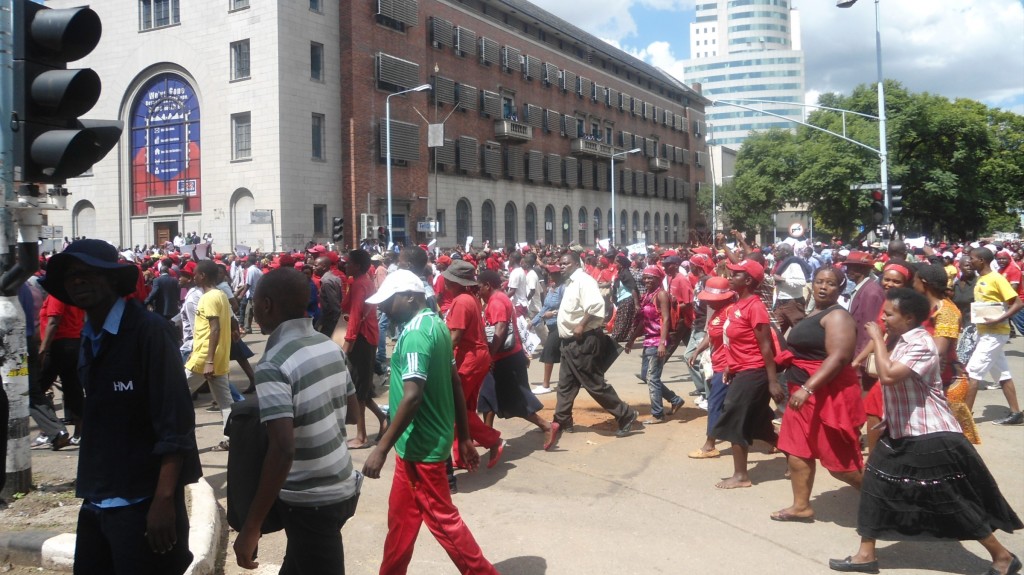
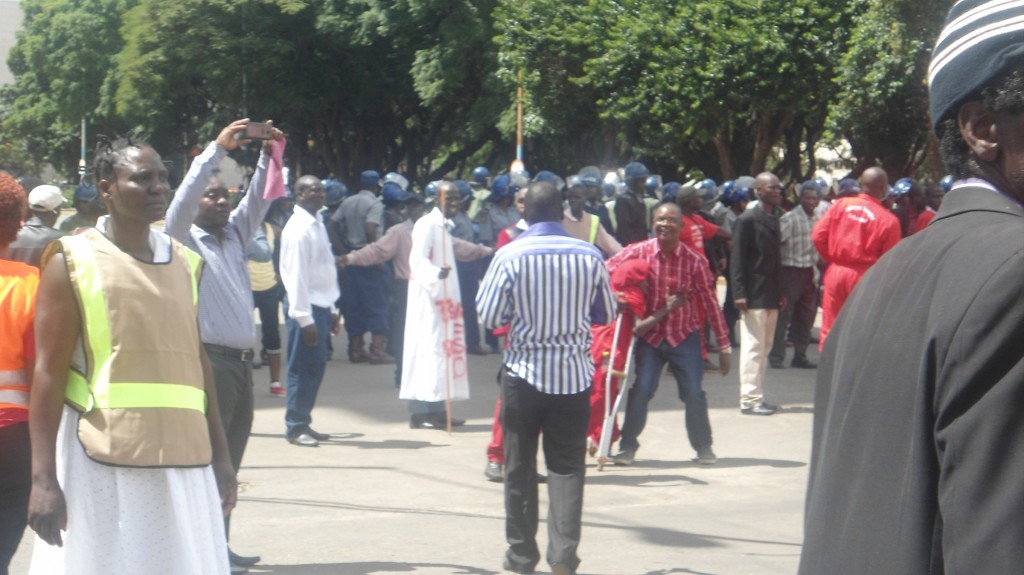
The Movement for Democratic Change held a demonstration in the city centre of Harare today in protest of unemployment, corruption, lack of rule of law and the economic meltdown currently dogging the country.
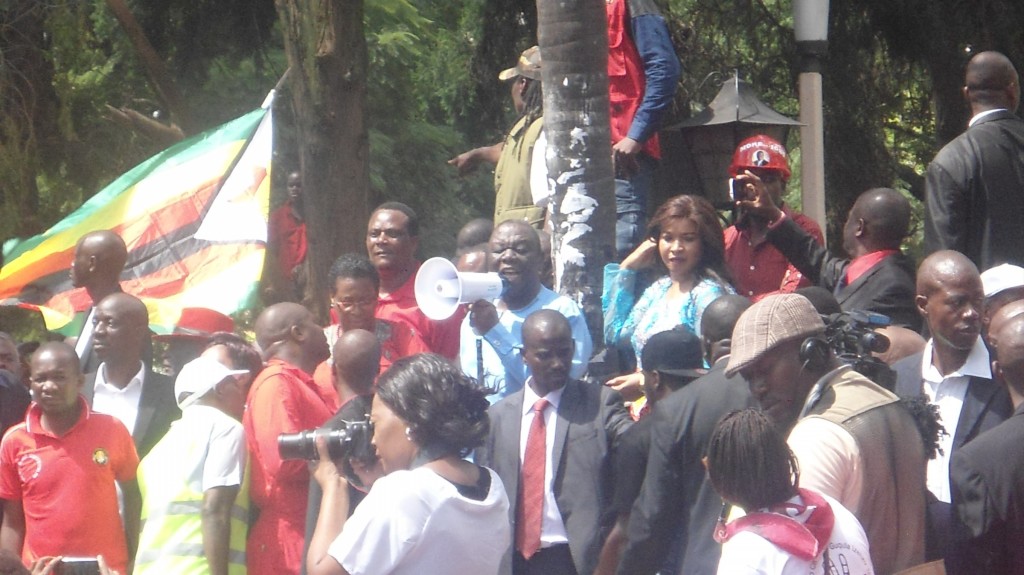
The leader of MDC former Prime Minister Morgan Tsvangirai addressed the protesters at Africa Unity Square where he implored the youths of Zimbabwe to safe guard their future and to stand up for their rights as enshrined in the constitution and “take them and not wait to have them given to them”.
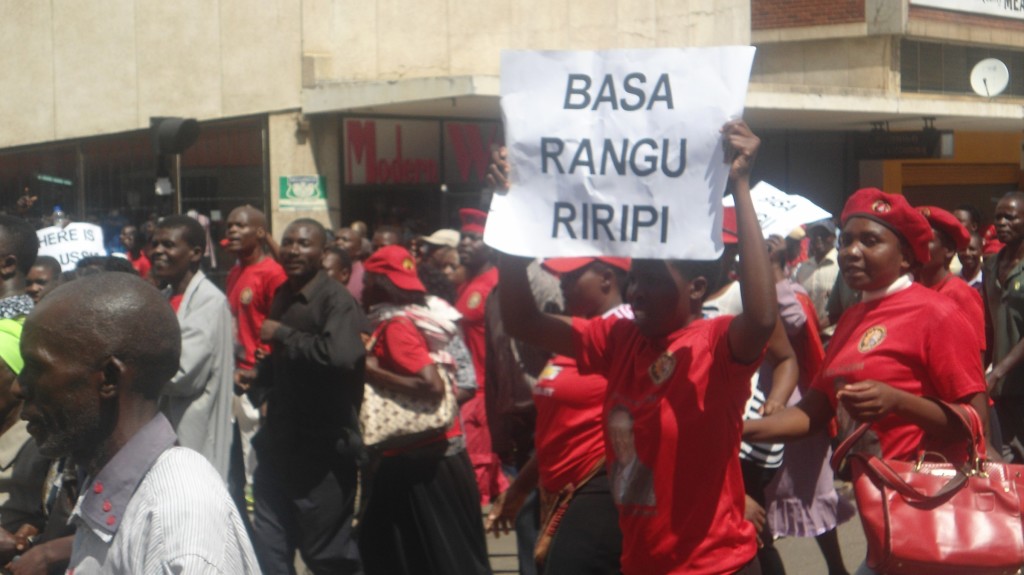
He lamented the rampant corruption in the country and called for the return of the missing 15billion dollars from diamond sales which mysteriously disappeared in the government coffers. The protesters could be seen brandishing placards written “basa rangu riripi” as they were asking for the 2.2million jobs they were promised by the Zanu PF government, according to Mr. Tsvangirai “instead of 2million jobs, Zanu has created 2million beggars”. The Zimbabwe Republic Police were present to keep the peace and there was one isolated incident where tear gas was deployed, but the protest was relatively peaceful.
Teargas being sprayed on protesters
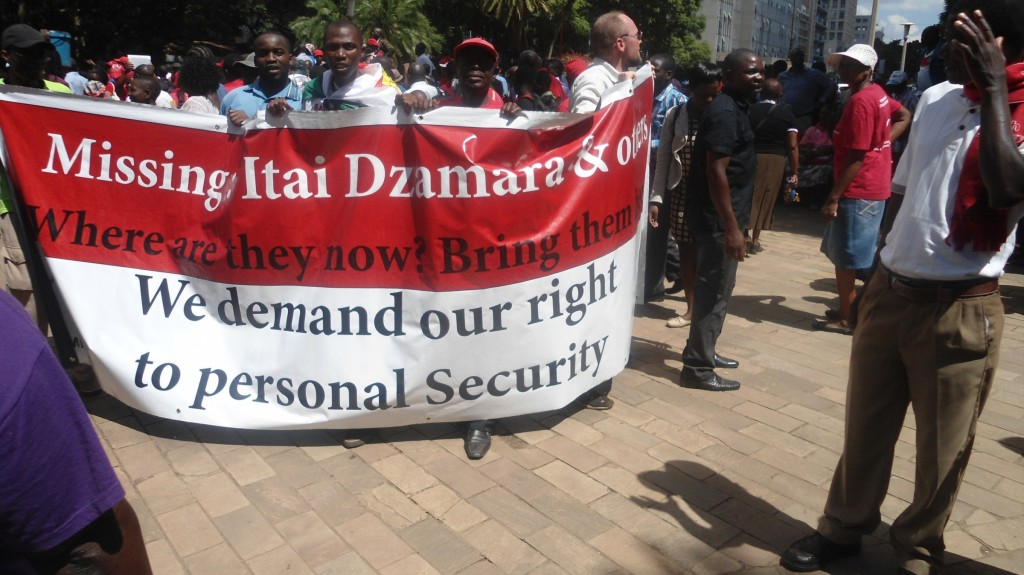
Protesters calling for the return of abducted political activist Itai Dzamara
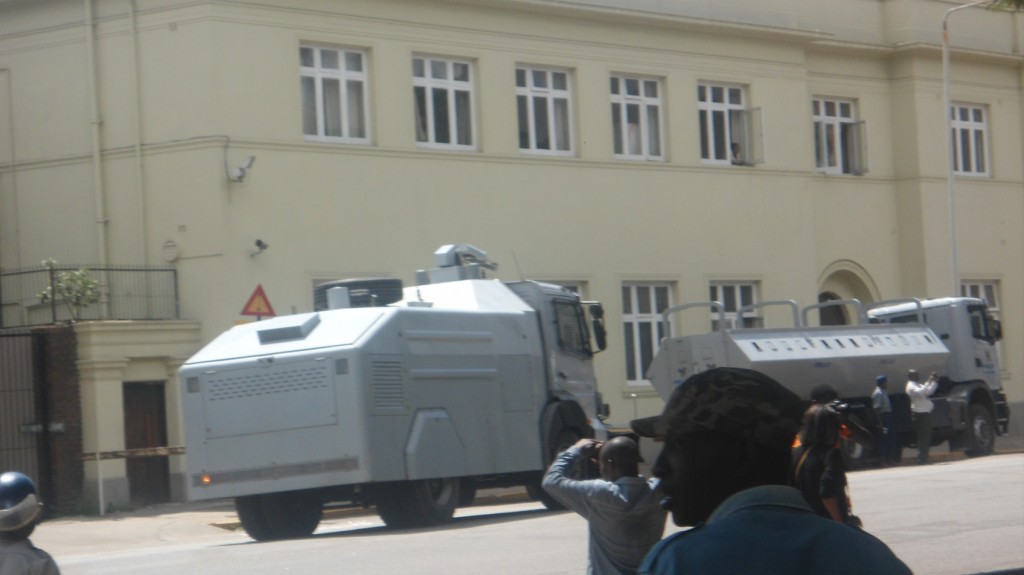
Police water cannons at parliament building
The numbers who gathered for the demonstration at Africa Unity Square
MDC youths expressing their dismay at the alleged overstaying of the Zanu PF government
MDC youths asking for the promised 2.2 million jobs
MDC protesters in Nelson Mandela Ave
MDC leader Morgan Tsvangirai addressing Protesters, with his wife beside him
Heavy armed police presence at MDC demonstration
Call for the return of the missing 15billion dollars from the diamond revenue
This has been a submission by Kevin Ngwazane.
You too can become a Citizen Journalist by submitting your story here: Citizen Journalism by Living Zimbabwe
The views expressed in the article are those of the author and not necessarily Living Zimbabwe.
Step Over Them by Rassie Ai (from the album Return to Life). The song is a song of encouragement and inspiration to the struggling masses of Zimbabwe home and abroad. It seeks to encourage Zimbabweans at home and abroad to “step over’ their challenges and maintain a positive outlook. Speaking to Zimbabweans of all ethnicities and social backgrounds. (see below for live performance of Step Over Them being performed at Stormont Buildings (National Assembly of Northern Ireland) on Commonwealth Day, a poignant platform for the expression of African values and concerns)
Step Over Them – Lyrics
We till the land, plant the seed, watch over dem, African Kings come we claim we throne again
Step over dem
Com we step over them, I see the enemies attack, jump over them
Nah tek no prisoners, so we no handover dem
I no have nothin’ ah hide neither prove fi dem – hey.
Mek we step over them, I see the enemies attack, jump over them
Nah tek no prisoners, so we no handover dem
I no have nothin’ ah hide, nothin’ ah hide.
I originate in distance places, through time and space to a village me ah trace back to Zimba
I do no ina rat race in this land of waste, choo mi case is to go back to Zimba (I do not partake in the rat race in this land of waste, my case is to go back to Zim)
Anywhere you deh so better proud you a Zimba, Shona or Ndebele better know you a Zimba (Whatever tribe you are from be proud to be Zimbabwean, know who you are)
Vanhu veZimbabwe tisu tine simba, same one Zimbabwe build Matombo Dzimba (People of Zimbabwe we have the strength, we built the House of Stone)
Munhu nemunhu ane kumusha inga, kune vekuBikita kune vekuBinga (Every person has a spiritual home, some are from Bikita some from Binga)
Ask who ah revolute ah Congo ah Zimba, ask who ah revolute ah Zambia Zimba (Ask who helped the revolution in Congo, ask who helped the revolution in Zambia)
Do no bring no pill do no bring no syringe ya, Shona or Ndebele better know you a Zimba
Show me your hand and clench your five finger, if you a Zimba do no bother linger (regardless of political affiliation, clenched fist or open palm)
Com, com, com, com we step over them, I see the enemies attack, jump over them
Nah tek no prisoners, so we no handover dem
I no have nothin’ ah hide neither prove fi dem – hey.
Mek we step over them, I see the enemies attack, jump over them
Nah tek no prisoners, so we no handover dem
I no have nothin’ ah hide, nothin’ ah hide.
I know some African , wey can speak more than five lingua Dat is when you find out you ah reason with a Zimba (I know some Africans who speak more than five languages, that’s how you know a Zimbabwean)
If you think ah peace and safety, things serene ya Still ah reminisce Rhodesia, dis ah Zimba (Things have not always been peaceful and serene, do not linger on the past, this now Zimbabwe)
Ghonarezhou to Matopo dat ah Zimba (Ghonarezhou to Matopo is Zimbabwe)
Amhlope Makorokoto dat ah Zimba (Congratulations in Ndebele or Shona, it’s still Zimbabwean)
Zambezi dung ah Limpopo dat ah Zimba (Zambezi to Limpopo it’s Zimbabwe)
Watch babylon wid dem dutty grubby finger Want tek a little piece out Munhumutapa (Those who hate us want to destroy our ancient Kingdom piece by piece)
Zimbabwe step out and we start to wrath ya Babylon mi ah com, better clear da path ya (Zimbabweans step out and harness our anger/outrage)
Mi ah gash dem so bad dem can’t heal with plaster( Clear the path, we are on the way, the battle wounds inflicted will not be healed by plasters!)
Com, com we step over them, I see the enemies attack, jump over them
Nah tek no prisoners, so we no handover dem
I no have nothin’ ah hide neither prove fi dem – hey.
Mek we step over them, I see the enemies attack, jump over them
Nah tek no prisoners, so we no handover dem
I no have nothin’ ah hide, nothin’ ah hide.
‘Member blood of men, women and children never stop from spill (Remember the blood of men, women and children never stops spilling)
Babylon your biggest export is kill, babylon your first resort is kill Babylon your UN report is kill,(Evil nations export death, their first resort is death, the UN reports are full of death)
An eye fi an eye me say limb fi a limb till you stop boost war upon mi little children (It will be an eye for an eye, limb for a limb until you stop killing our youth)
An eye fi an eye, fire burning, ready fi a spark babylon come say a ting (An eye for an eye, fire burning, all it needs is a spark, make your move!)
Com, we step over them, I see the enemies attack, jump over them
Nah tek no prisoners, so we no handover dem
I no have nothin’ ah hide neither prove fi dem – hey.
Mek we step over them, I see the enemies attack, jump over them
Nah tek no prisoners, so we no handover dem
I no have nothin’ ah hide, nothin’ ah hide.
We till the land plant the seed watch over dem
Dem same one send police patrol again
Just get release African parole again
African Kings come we claim we throne again (repeat)
The festive season has come and gone and with it, brought about an influx of diasporans returning home on holiday. For some, the visit was a long time coming and for others, it was part of a frequent commute home to visit family and friends.
Many of the visitors enjoyed their visit and throughout their time in Zimbabwe, they bombarded their Facebook friends and Twitter and Instagram followers with update after update. The updates included tales and photos of everything they were doing, all the wonderful people they were coming across and just good things are, just to name a few.
Most if not all of the diasporans have departed to get back to their lives in whatever part of the world they are now in. The rhetoric about their love for their short stay at home has continued but for some, it has changed to something else. What they saw and experienced when on the ground in Zimbabwe has given them a point of view different to what they were being feed by family, friends and the media.
As far as they are now concerned, Zimbabwe is ripe and they see opportunity for them to actually consider leaving the Diaspora to return home to make a life for themselves. For these people, they saw opportunities for business that they could set up after seeing possible gaps in the market for various products and services. For others, they saw opportunities to partner with established businesses to enhance product and/or service offerings.
Is this the case or were they being blinded by the ‘hepi hepi’ spending of the silly season and the cushion of spending money that they had spent months saving up for? Could the fantastical and sometimes reckless spending by the haves and some who are really have nots have given them false impressions of things being just fine?
The reality for those that are here is that things are tough! Yes, there are the select few who have managed to find a vein of money that has afforded them a very comfortable living. But, for the majority, people have had to become hardened to the conditions and do whatever it takes to try and make ends meet.
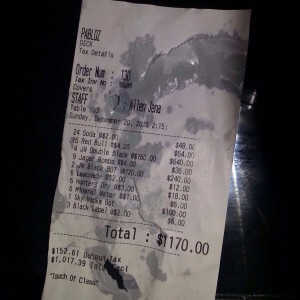
Zimbabwe is a difficult place at the moment and not everyone has the capacity to drink away $1,000+ in a few hours. The pressing issues are trying to cover food, accommodation, transportation costs, school fees, medical expenses and so on.
Yes, many of those who have fantasies of returning would be coming back with a wealth of skill and know-how in a number of areas and what they have to offer could be applied to the Zimbabwean context. Yes, things operate a little differently to the way that they do abroad. This is not to say that what they have acquired can’t be applied, may just need to be adapted so that it works well in Zimbabwe.
Question is, should they be encouraged to return if for some of those who are considering it, their decisions are based on what might have been a false portrayal by others?
This has been an interesting discussion point with varying opinions. We could write more but we’d love to hear your opinion. Share your thoughts by commenting below or if you have a lot more to say than just a comment, you could share your thoughts in an article/post (see here for details).
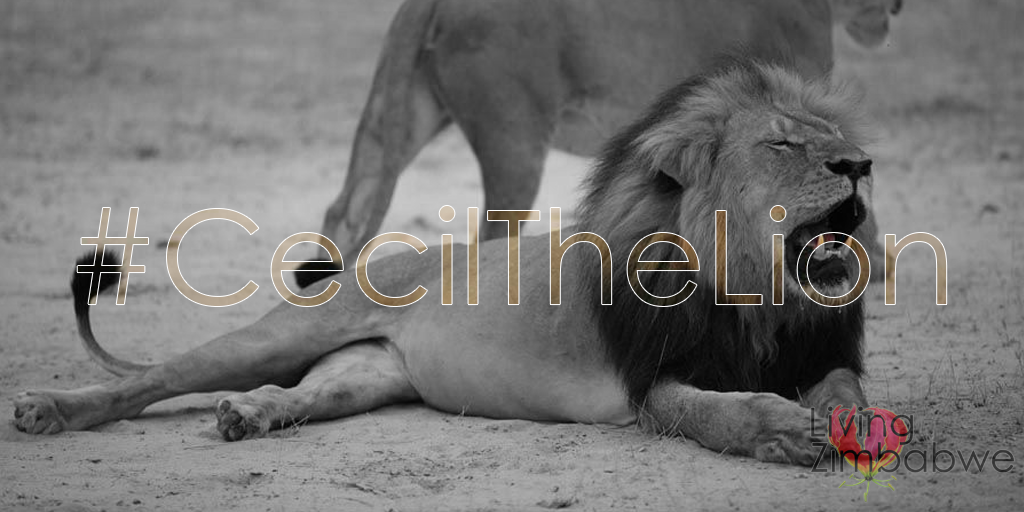
Whether you are a fan of lions or not, whether you like hunting or not, whether you are into conservation or not, whether you love or hate Zimbabwe, a discussion that you more than likely came across or maybe got involved in yourself was that of Cecil The Lion.
If you don’t already know, Cecil was according to many, a much-loved lion that once roamed the plains of Hwange National Park. He was in an unfortunate turn of events hunted by American dentist, Walter Palmer. When news of the killing came to light it caused a huge uproar from a countless number of people and organisations across the world and it also became the story of the moment on many of the major new networks.
That amount of coverage on the death of Cecil made it one of the top stories of 2015. Towards the end of last year, Parsely, a leading digital analytics solution provider, released data on the top stories of the year and how people discovered them namely via search (e.g. Google & Yahoo) or social (Facebook & Twitter). According to their numbers, Cecil was one of the top stories and it had a search to social traffic ratio of 73% meaning that it gained a lot of traction via social media.
Google also released data on the most popular searches throughout 2015. One of the spikes on the timeline in August 2015 was Cecil. This shows that purely from a search perspective it was a popular topic.
In the heat of the debate, people had wide and varying opinions on how they felt about the incident. For those directly involved such as the hunter, the guides and the authorities, there was some finger pointing and he said she said. At the end of the day, there really wasn’t a solid end result bar arresting a couple of local operators and tightening restrictions on hunting. In hind sight, the whole saga may have been a wasted opportunity with what it could have brought.
Whilst all of this was going on, what could have happened is that someone could have taken a step back, analysed the situation and seen how to use it to our advantage.
Some research shows that even though hunting (which in itself is a form of tourism – as controversial as it may be) brings in a considerable amount of revenue. However, it is not the number one tourism revenue generator. Ecotourism comes out on top with the revenue generated from it far surpassing that of hunting.
Till he met his demise, Cecil had been studied in great detail by WildCRU. With this direct link to lion conservation efforts, maybe a story around a ‘conservation’ or ‘ecotourism’ theme could have been crafted to shed a positive light on tourism in Zimbabwe.
With hunting, conservation, tourism and other associated activities already in the spotlight, maybe an organisation, a group of individuals, tour operators, a government department or a joint effort between some of the aforementioned for that matter could have drawn up a marketing strategy. This marketing strategy could have been aimed at getting out a message to say that yes, a lion had met its unfortunate demise; that this is not what we are all about; outlining what we are about and what is on offer as far as ecotourism goes and maybe even enticing potential ecotourists with discounted travel packages.
The above is not the be all and end all of what could have been done to spin the incident around and use it for positive gain. There are always lessons to be learnt from such events. Part of that would involve taking some time to sit back and understand what went wrong and what can be done to fix it and to end up with a favourable outcome for all.
There is a lot of negativity out there in the world and at the end of the day, it is up to us to choose how we respond to it. That response could be a negative one which could only make things worse or we could choose to address the situation and work towards a positive outcome. Let this be the year that you turn negatives into positives.
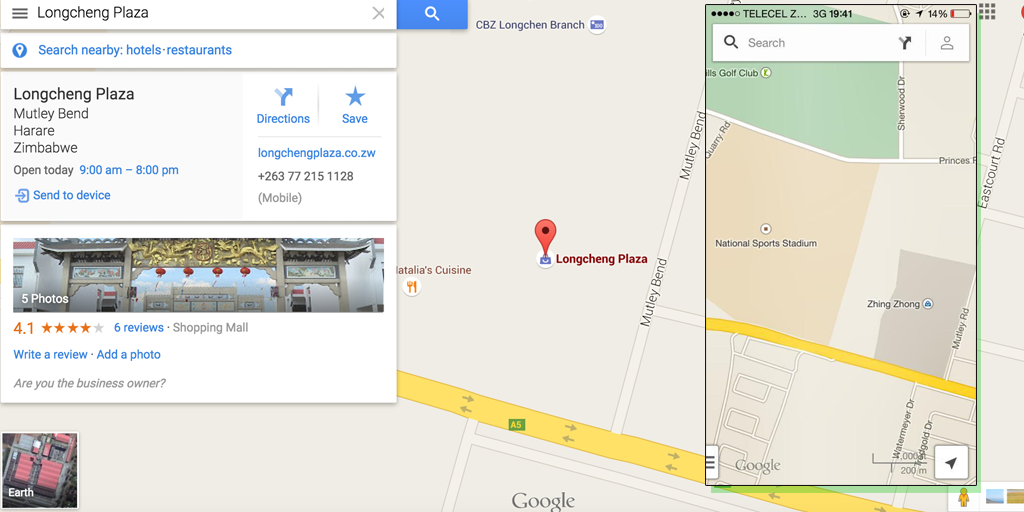
Last month we came across a tweet with a screenshot of a smartphone map app where the LongCheng Plaza in Belvedere’s online listing was marked as Zhing Zhong! For those of you who aren’t familiar with the term Zhing Zhong, it isn’t exactly politically correct. If you do a search for the term, what comes up is the following:
“cheap, fake or sub-standard products of Asian origin. These kind of products are mainly rejects from mass production in China that are dumped on struggling markets.”
As far as LongCheng goes, having that listed as their name wasn’t really the best look. Any business or brand that wants to uphold a certain reputation and get the right message across would not want to misrepresented in any way shape of form. Fortunately, in this particular case, the listing was corrected and they were able to save face.
Now, imagine a situation where someone sets up an online profile using your business name with a custom url (for example Facebook.com/LivingZimbabwe) and makes it look like an official channel used to engage with customers. Once up and running, they can put up whatever content they like and also communicate with current and potential customers and depending on the nature of the content, they could be doing serious damage.
If the content being put up by someone purporting to be you, it could wreak havoc and see a business spending a lot of time and resources to try and make amends and rebuild their reputation.
So, what can be done to avert such a crisis? If your business or brand doesn’t already have an online presence, it may be time to build one or at a minimum, claim your brand or business name online. This can be a simple as buying a domain name such as a co.zw, .com or any other suitable extension.
Other steps that can and probably should be taken include:
Setting up a Google My Business (more so for brick and mortar businesses)
Establishing a presence on the major social media platforms such as Facebook, Twitter, Google+, Instagram and the list goes on
Apart from registering a domain name, the good thing about most of the options listed above is that they are free to set up.
Yes, some may say Zimbabwe is not in that sort of digital space yet. But, the world is becoming increasingly digital and there will be a need to have a presence in this space, not to mention the benefits that come along with it. In a business context, those benefits could include an increase in revenue and brand recognition.
If you have some time on your hands, listen to the podcast below on a discussion about online reviews for local businesses. It may seem very Western-centric rather Americentric and some features may not be available in Zimbabwe but the ideas discussed can be adapted to fit your purposes.
One thing to remember is that claiming your identity on the major networks doesn’t necessarily mean you have to be active on all of them. The need to use them may arise in the future and if this does happen you will not have to worry about having brand consistency across the web.
Are you convinced that you need to take control of your online presence?
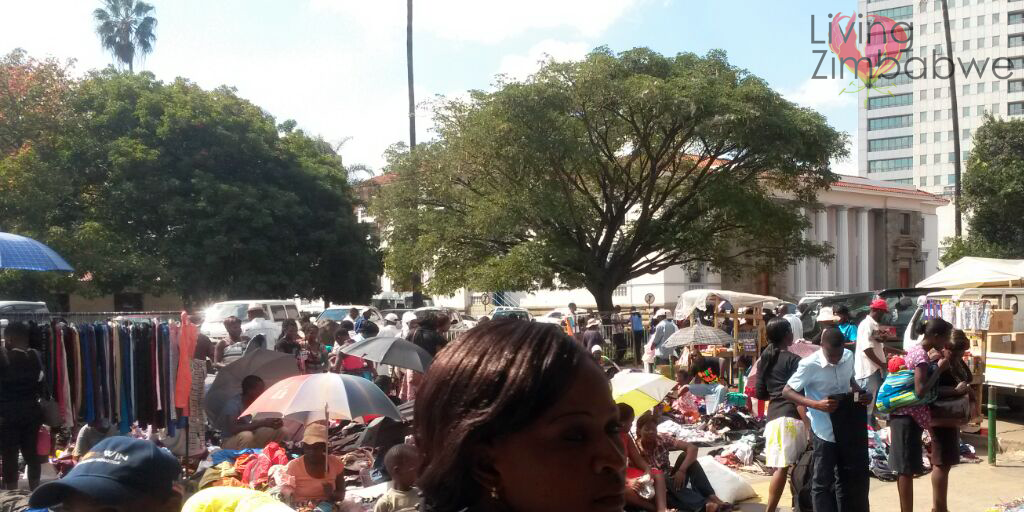
Vendors have for the longest, been part and parcel of the economic machine not only in Harare and other parts of Zimbabwe for that matter. They have been there on the roadside selling fruit and vegetable, they have been there darting in and out of traffic at robots selling airtime and other bits and pieces, they have been in car parks selling clothing out of the boots of their cars; and now they are really there, selling whatever it is that they think the public may want to get their hands on as they walk along the streets of the central business district.
In a number of instances, they can be seen as providing a service of convenience because you can get your airtime, a newspaper, chibage, tomatoes, clothing and so on without leaving the comfort of your car or if you are a pedestrian, you may not have to venture too far out of your way to get what you need.
However, the number of vendors on the streets has increased exponentially and this could be for a number of reasons with one of them possibly being the lack of gainful employment in the formal sector and people turing to the informal to make ends me.
Whatever the cause may be, the surge in their numbers has caused contention and the government has given them an ultimatum to move off the streets and set up shop in specially designated areas where they can ply their trade.
Truth be told, the surge in their numbers has in some cases caused a bit of nuisance because navigating some of the sidewalks in Harare becomes a bit of a challenge when they decide to set up shop there.
Without a doubt a significant amount of money is exchanged in this informal economy and the government looking to move them to designated areas, this creates an opportunity for them to collect tax revenue. That said, it is a little easier to see why the government may be so keen to see vendors move into ‘controlled’ areas – go here for details.
On the same token, clamping down on vendors may for them mean losing out on a revenue stream. If this was the only way in which they made ends meet then what do they do to feed themselves and their families?
Here is a bit of the reaction that people have had about the issue of vendors in days gone by:
Google, Bing and Yahoo are search engines that a lot of us turn to when looking for information on all sorts of topics. The searches that we do may seem arbitrary but at the end of the day, they give us an insight into what our interests are and what may be important to us.
As we go along searching the internet for A, B, C, all the search engines keep track of and collate all of our searches (unless you search in incognito or private mode). The search engines use this information to their advantage and they do make some of the information publicly available. Here is a run down of the top Google searches per month in Zimbabwe for 2014:
January – CHAN results
Zimbabweans have an insatiable appetite for football and the start of the year saw the 2014 African Nations Championship being played in South Africa with many of us glued to our screens to watch all the drama unfold.
February – Bona Mugabe
After CHAN, our attention was diverted to Bona Mugabe who tied the knot with Simba Chikore in an elaborate wedding that was attended by high level dignitaries and at a cost that was said to have run into the millions.
March – Malaysia plane
Malaysia Airlines Flight 370 did not only see Zimbabweans but the entire world turn their attention to MH370 which on the 8th of March took off from Kuala Lumpur, Malaysia on its ways to Beijing, China and disappeared en-route with over 200 passengers on board. To this day (as far as the ‘world’ in concerned – there are a few conspiracies about it’s disappearance), the where about of the aircraft is still a mystery.
April – UEFA results
April saw people once again being able to get a football fix and saw the quarter and semi-finals of UEFA Champions League with the final result being a 4 – 1 win for Real Madrid over Club Atlético de Madrid.
May – Alick Macheso
2014 was a particularly difficult year for sungura musician Alick Macheso which included reports of him performing an unspeakable act on his child and the tumultuous divorce to his second wife, Tafadzwa Mapako.
June – World Cup fixtures
For the third time in the year, Zimbabwe and the world got a good dose of football and had the opportunity to watch various nations from around the world battle it out in Brazil to be crowned world champions.
July – Argentina
The lead in to July also saw people searching for football related information. The top search was simply Argentina and July was the month in which the World Cup Finals were held between Germany and Argentina with Germany being crowned the world champions after a 1 – 0 win.
August – Ebola
A few West African countries were affected by an Ebola virus outbreak which was recorded as the worst in history. Thousands of people lost their lives and many countries around the world went into panic mode and put measures in place to try and stop the virus from reaching their nations.
September – SCOAN
SCOAN, The Synagogue, Church Of All Nations which is lead by the very popular and controversial Prophet T.B. Joshua topped search results after one of its buildings collapsed. More than 100 people lost their lives with most of them being from South Africa and the count also included an MDC official from Zimbabwe.
October – Grace Mugabe
This was the year where Grace Mugabe rose to prominence by first of all being awarded a PhD that she apparently completed in two months and then a few months after that, being named as the head of Zanu-PF’s Women’s League. October was the month when Amai Dr Grace Mugabe went around on her ‘Meet The People Tour’ and had a lot to say (some of it not so gracefully) about various figures within Zimbabwe’s political arena.
November – Myles Munroe
For the second time in the year, Zimbabweans searched the internet for information linked to a religious figure. On the 9th of November, Christian evangelist Dr Myles Munroe was involved in a plane crash that took him, his wife and the lives of seven other people.
December – Zanu PF Congress
At the start of December, thousands of Zanu PF delegates from around the country descend on Harare for Zanu PF’s Elective Congress. The congress was seen by many as more that just that as certain actions were taken that pretty much saw Joice Mujuru’s fate being sealed and Grace Mugabe ascending to the head of the Women’s League.
Your turn; given that this is what we searched for the most on Google, does it give a good reflection of what we find important?
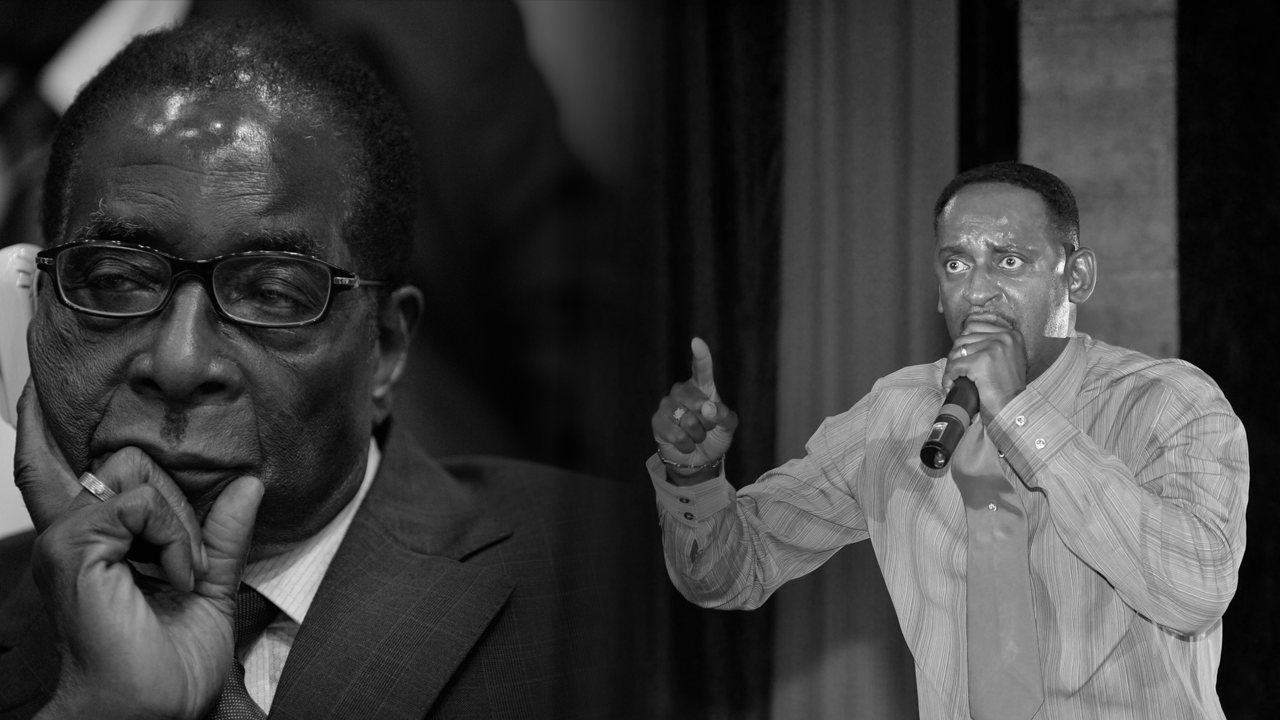
Robert Gabriel Mugabe has been president of Zimbabwe for decades and over that time, he has not shown and still doesn’t show any signs of wanting to let go of power. That said, a question that many a people has had is, how he has managed to hold on to power for so long?
Over the years, people and the media have speculated on how he manages to hold on to power and these have included him turning to the occult to give him the upper hand. At a point in time, there were stories swirling around about Mugabe and the black bag that he carried around with him everywhere he went. Does the bag contain some sort of ‘juju’ that keeps him in at the helm?
A man of God by the name of Apostle Michael Adeyemi ‘Yemi’ Adefarasin from Abuja, Nigeria, recently added more fuel to add to the fire in the conversation on Mugabe and his links with the occult. Apostle Yemi delivered a sermon where he touched on things that people have done in their lives to give satan an opening into it and a legal right over them.
As he progressed through the sermon he mentions how by visiting sangoma’s and the likes, you are effectively entering into a covenant with the devil. This eventually led to him mentioning how Mugabe has paid visits to sangoma’s in Tanzania and has taped into various ‘power’ sources around the continent and resulted in him still being alive and kicking to this day.
Apostle Yemi explains this to have come about through Mugabe’s adoration for Kwame Nkrumah, who has been seen by many as one Africa’s greatest leaders. With Mugabe being Nkrumaised so to speak, he followed suit in seeking assistance from the spirit world.
Have a listen to the extract from the sermon and from there make up your mind up as to what you do or don’t believe. If there is any sort of truth to it all, does it give those who a looking to unseat Mugabe some insight into what sort of action they need to take to make it a reality?
Share your thoughts in the comments section below.
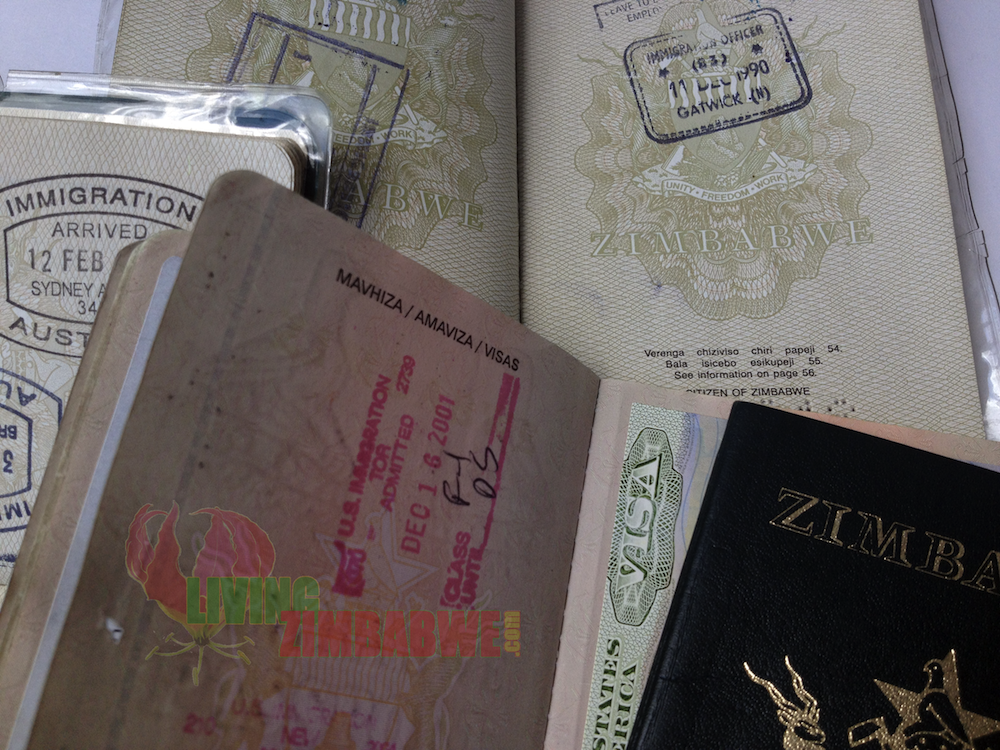
We frequently receive emails from people with enquiries relating to Zimbabwe passport applications. These range from the status of passport applications submitted both at home and at overseas missions and how to apply for passports when faced with certain personal circumstances such as not having all the required documentation and so forth.
Some of the emails that we have received include the following:
am calling to confirm if my passport is ready fr collection. i applied for it on the 4th of July and my receipt number is RG xxxxxxx.
pliz help me on this one i need passport but i do not have bith certificate i lost both and id what must i do
My passport is still valid and I want to apply for a new one since am left with about five months,the problem is I lost my id and can’t go back to zimbabwe anytime soon. So can I apply without any id using a valid passport in south africa. Pliz help
Hi there, would you have any info on how best to renew a Zim passport from the UK? My son is living there, and has been told by the embassy that the renewal of his passport will take 18 months. Thanking you for any leads
Unfortunately these are queries that we can’t help with and all that we can do is to advise them (to the best of our knowledge) on how they can go about finding the answers to their questions. To that end, we got in touch with the Registrar General`s Office (via email) and asked them the best way in which people can contact them to get their queries answered. They got back to us within two days with their response being the following:
Dear Sir/Madam
We kindly acknowledge receipt of your communication.
Clients may directly contact us on our helpdesk regarding any issues that concerns our department.
Regards
Registrar General`s Office
So, if you have queries related to a Zimbabwe Passport, the RG’s office is the best place to go where there is someone on the other end of the line to receive your message. You can contact them via the following:
Contact form on their website: http://www.rg.gov.zw/contactus
Via email: helpdesk @ rg [dot] gov [dot] zw
When someone decides to step up and become a leader, they are signing up to be that person that has the interests of a peoples at heart. If you put the words ‘Africa’ and ‘Leader’ together in the same conversation, you are likely to either have a discussion about those who have made a real and positive difference in people’s lives or those who have left or will leave a legacy of despair.
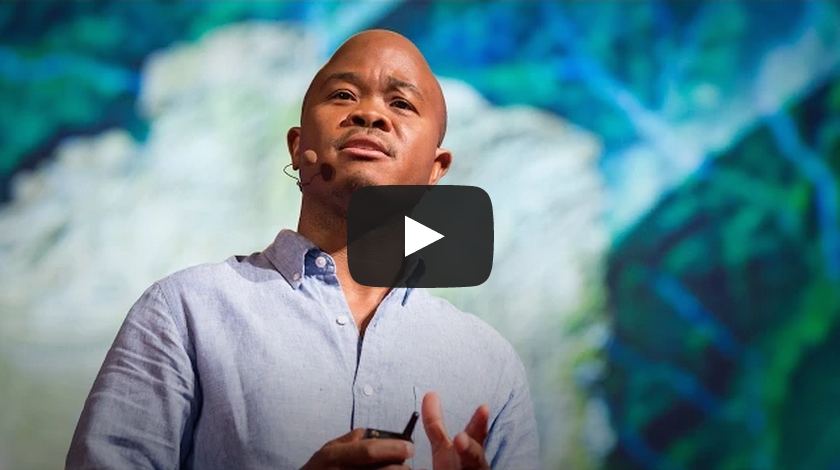
In a recent TED talk in Rio de Janeiro, Fred Swaniker touched on a handful of topics related to Africa and leadership. These included leadership over the generations, where his take on it was that Africa has gone through 3 progressively better generations of leaders. For him, the first generation were the ones who freed us from colonialism and included Kwame Nkruma and Julius Nyerere. The second generation included the likes of Mobutu Sese Seko and Sani Adacha who brought with them havoc, warfare and corruption. The third generation which he termed the stabiliser generation have worked or are working to clean things up and were accountable to the people. In this generation he included Mandela and Kagame but then the 3rd generation and their achievements is debatable given what some of Africa’s current leaders have brought upon their people.
Nonetheless the talk goes on to discuss the next generation of African leaders and the kind of issues they would need to tackle in order to make a meaningful difference. Given the weak state of institutions such as constitutions around Africa, leaders have a great deal of power and the decisions that they make can make or break a nation.
The talk then moves on to the next generation of African Leaders and it is at this point where you really start thinking about ‘who will be next?’ or more importantly who we want next and what we want them to achieve.
This topic is very relevant and even more so in the Zimbabwean context where a change in leadership is imminent.
Watch the talk and then ask yourself a question, who do you want to see leading Zimbabwe after Mugabe?