Author: Living Zimbabwe

  • Musalad Losing Identity

    Last month, CNN’s Inside Africa featured a Zimbabwean DJ in New York, Chaka Ngwenya who started up an online radio station SARFM Radio through which he says he is trying to help African listeners keep their identity abroad. Identity caught my attention and that lead on to not forgetting about who you are and where you are from. Thinking about ‘Identity’ got me thinking about the term “MUSALAD” that so many young Zimbabweans have been labeled. What exactly is a “salad/musalad/salala?” It is a term that cannot really be given a clear cut definition because of people’s different interpretations of it. My understanding of the term is; someone from a low-density suburb and from a so called group ‘A’ school (private school) who is not streetwise, copies Western culture (mainly American) and speaks English with an accent. In years gone by munozi (nose brigade) was more commonly used due to ‘these people’ speaking nasally.

    I am one of those people who was and still is labelled a munozi and/or musalad but to a much lesser extent as compared to years gone by. Up until just after starting high school I went to these so called group ‘A’ schools until I was shifted to a boarding school out in the rural areas. Within the first few hours of being there I was labelled a munozi. Very soon after that I was given a nickname brought about by me being told to stand up and tell the class my name. When I opened my mouth, the entire class burst into laughter and I didn’t understand what was going on until the teacher eventually asked me to repeat what I had just said whilst a number of my classmates (and the teacher) were still laughing and mimicking what I had said with a very exaggerated nasal intonation. The nickname I was given was what they thought they had heard me say and it stuck through out my time at the school. It wasn’t easy going by day to day and having to deal with the discrimination (which is how I saw it) but as time went by I got used to it and paid less attention to it. Those years of my life were probably my quietest and I only spoke when I really needed to so that I didn’t have to deal with the onslaught if I spoke. I did make a few friends and those who got to know and respect me saw more than just what was on the surface.

    Masalad are viewed by many as, “vanhu varasa tsika” (people who have lost their traditional ways). This Shona term, tsika refers to knowing and being able to use the rules, customs and traditions of society to be regarded as a respectable person. Not all masalad are a lost cause. Those who went to schools where they mixed with other races, they had and still have different accents to those from a rural background. For most when they got back home it was back to their traditional ways but they would take along what they picked up in their environment. They way that they speak is different but it is not necessarily fake or put on. Yes, there are some where it is a bit over the top and obviously put on and bound to draw a lot of attention and criticism. The video shows what I would consider to be over the top. The people in the video do live in the United States but you could very easily come across people in Zimbabwe who have never stepped out of the country speaking like them.

    It is not only masalad who get discriminated against. An example I can use from years and years ago is that before I left the private school, an SRB (someone with a Strong Rural Background) was awarded a scholarship to do his ‘A’ levels there. He was ostracised because of his mannerisms and the way he spoke English with a very heavy Shona accent. He was a very nice guy but his background and the environment he was in did not do him any favours.

    I have been criticized by family and friends who said I had an identity crisis because of the many white friends I had and the ‘white things’ I did (whatever they were). Yes, I did mix and mingle with a lot of white people but that did not make me less of a Zimbabwean. The discrimination encountered by both groups of people (masalad and SRBs) is unwarranted at times because we should not be judging a people by the way they speak, what they wear and how they carry themselves. As long as those in question know who they are and where they come from they should be treated with respect. When cultural identity has been lost there should be cause for concern because you will have lost a lot of who you are.

  • Charity Begins At Home

    Lending a Helping Hand to Fellow Zimbabweans

    Most of the news that you see and hear about Zimbabwe is negative and a lot of it focuses on the millions of people who are in desperate need of help and you can’t help but sympathise with them. I feel compelled to help in some way but being in the Diaspora and so far away from home I don’t even know where to start, what kind of assistance to give and how to give it. When I think about helping out what I picture is a select group of people getting their hands on whatever I send and using it for their own purposes with it never getting to who it was intended for. That, whether it is a real scenario or not discourages me from trying to do anything to help.

    My faith and belief in being able to help was recently restored by my wife who after going through the clothes our daughter has out grown decided on sending to Zimbabwe. Instead of giving the clothes away to a charity here or throwing them into one of those ‘clothing bins’ she thought of relatives back home who have babies that would need clothing. All of these clothes have been put into a box and will be on their way to Zimbabwe very soon. After sorting through all the baby clothing we took a look in our wardrobes which are full of clothing, some which has has not been worn in years and some of which has not been worn at all. We are going to sort through this clothing and send if off to Zimbabwe as well where it will hopefully be distributed to people who will need, use and appreciate.

    What we are sending home obviously won’t help thousands of people but it will at least benefit a few people. For example, when winter comes around again next year someone will be able to keep themselves a little warmer and a little more comfortable. Knowing that we will be able to do that for someone will bring more joy to our blessed lives. Something else that has also come about is that some of my work colleagues brought in boxes of clothing when they found out about it. This will mean an added cost for shipping but I will use the money generated by this blog to help pay for it. I don’t want this to be a one-off thing and hopefully we will have the opportunity to help more and more people in different ways in the near future.

    We do know of some people who volunteer for charitable organisations to whom we will send some of the clothing to distribute appropriately. I don’t know how big philanthropy is with Zimbabweans but if it something that is not big it is something that should be embraced by many. No matter how big or small, everyone should try to do something to help those less fortunate than they are.

  • ZANU-PF & MDC Power Sharing Deal: Thoughts, Video, Text

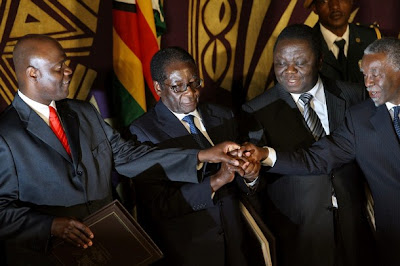
    Robert Mugabe, Morgan Tsvangirai, Arthur Mutambara, Mbeki After Signing the Power Sharing Agreement, 15 September 2008

    15 September 2008 was the day that President Robert Gabriel Mugabe, Morgan Tsvangirai and Arthur Mutambara signed the historic power sharing agreement that leaves Mugabe as President, Tsvangirai as Prime Minister and Mutambara as Deputy Prime Minister. This was something that I did not think would happen because of what Mugabe has had to say about MDC and the number of times an agreement has tried to be reached but failed. For the first time in 28 years Mugabe will not have a complete hold on power. Amongst other things, the agreement leaves President Mugabe in charge of the armed forces and he will continue to chair cabinet. Prime Minister Tsvangirai will be in charge of the police and will lead the new council of ministers.

    In a way the signing of the agreement was history repeating itself as Mugabe went through the same thing on April 18 1980 when he became Prime Minister of Zimbabwe. During his speech, Tsvangirai quoted Mugabe’s speech from 1980 and said, “Let us turn our swords into ploughshares. If you were my enemy yesterday, today we are bound by the same patriotic duty and destiny.” Quoting that up left me feeling more unsure about having Tsvangirai in the position he now sits in. His speech may have gotten louder cheers than Mugabe’s but what he had to say did not seem like something that was from within and something that he meant. It seemed like something that was put together to please whoever was willing to pay serious attention to it or that person who has lost all hope and needed to hear someone say “I will make things better.” Is he going to be the person to rebuild the infrastructure and bring in international support?

    Mugabe’s speech was entertaining and I enjoyed it more than Tsvangirai’s even though he is a man gone mad. He went up to the podium with no notes and spoke his mind. He stated that there were parts of the agreement that he does not like and that the formation of a unity government would not be smooth sailing. Staying true to form, Mugabe took the opportunity to attack the British and American’s and blamed the problems of today on our former colonial power.

    During Mugabe’s speech the camera focused on Tsvangirai now and then and it looked as if he deliberately had his hand over his face with closed eyes as if to show that he could care less about what his new political partner had to say. The other leaders on stage such as Thabo Mbeki and King Mswati looked like they were paying attention to what Mugabe had to say. Tsvangirai’s posture and mannerisms showed a lack of etiquette, the kind of behaviour I would expect from a rebellious boy.

    One thing that Mugabe brought up that caught my attention was ‘democracy’ where he said: “Democracy in Africa. Its a difficult proposition, because always the opposition will want much more than what it deserves. The opposition will want to be ruling party and it will devise ways and means of getting there. Including violence. I’m not just refering to the system as we see it in Africa.” He later said that he was committed to the agreement but I find that hard to believe because of his stance on democracy. With that frame of mind how can someone be confident that the union will be fruitful?

    As far as Mutamabara goes, I was not too impressed by his speech. He sounded unsure of himself and what he had to say. I will leave it at that.

    Power is addictive and once someone gets a taste of it they want more and more. For most if not all this leads to a shift in their purpose and the reason why they wanted to be in the position they are in. All politicians are liars and they will say what they need to in order to be elected. It is up to us to choose whoever we think will work towards our best interests. Mugabe has failed the nation and needs to go but I do not see Tsvangirai as the one will bring the nation back to its former glory and I am not at all optimistic about this agreement. Tsvangirai mentioned that he was praying to God for wisdom, I am praying to God and continue to have faith that Zimbabwe will be delivered from the abyss soon.

    I am lost for words………………….


    Here are some documents that may be of interest:

    Agreement Between Zanu-PF and MDC – 15 September 2008

  • Kirsty Coventry’s $100,000 Handshake from Mugabe

    Kirsty Coventry Being Awarded $100,000 By President Robert Gabriel Mugabe

    Zimbabwe’s “Golden Girl”, Kirsty Coventry was awarded US$100,000 by Robert Mugabe for her spectacular performance at the Beijing 2008 Olympics. She won a gold medal and broke the world record in the women’s 200 meters backstroke and also won three silvers in the 400m individual medley, 100m backstroke and 200m individual medley. The $100,000 is double the $50,000 “pocket money” that she was given by Mugabe on her return from the 2004 Athens Olympics.

    Kirsty Coventry and Her Gold Medal from the Women’s 200 Meters Backstroke – Beijing Olympics 2008The cash award has sparked a bit of controversy because of the country’s current economic situation and for few because of the fact that she is white and based in the United States. Other members of the Zimbabwe Olympic team were given between US$2,000 and US$10,000 each.

    The way I see it, she is a Zimbabwe citizen that regardless of her skin colour chooses to represent the nation of her birth at an international level. Her efforts at the Beijing Games took a lot of hard work and at the times she was in the spotlight Zimbabwe was mentioned in a positive manner. As far the cash award goes, yes the country is going through economic hardship but athletes who are representing the country don’t get there just like that. It takes a lot of hard work and training that all comes at a cost. If anything it should also serve to encourage young aspiring Zimbabwe athletes to work towards achieving such goals. At least the money is going to a good use and not towards funding violence or anything else untoward.

    I do however wish Mugabe had extended the same kind of courtesy to the countless numbers of white Zimbabweans who did a lot for the country and pretty much lost their livelihoods’ at his hands.

    Congratulations Kirsty.
  • Video of Mugabe Being Booed and Heckled in Parliament

    The opening of parliament went ahead as planned on the 26th of this month but it was not as smooth as Mugabe may have hoped. Members of the Movement for Democratic Change took the opportunity to boo and heckle Mugabe as he was addressing parliament. During the speech Mugabe had an irritated and disbelieving look on his face but continued as if nothing was happening. At a dinner later in the day he told dignitaries that the MP’s behaviour was “barbaric and nonsensical”. Watch the video……………


    Mugabe jeered and heckled
    by CNN_International

    Receive regular updates from Living Zimbabwe via email. Enter your email address:

    Delivered by FeedBurner

  • Will There Ever Be An Agreement Between Mugabe and Tsvangirai?

    Mugabe and Tsvangirai at a Deadlock Over Government of National Unity

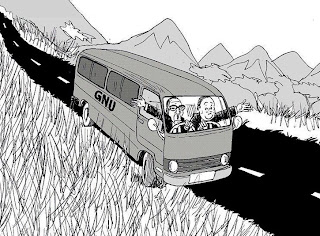
    It has been over a month since ZANU-PF and MDC signed the Memorandum of Understanding (MoU) where the parties agreed to talks to reach a solution on the Zimbabwe situation. As of yet no resolution has been reached and the parties are very much at logger heads. As the cartoon depicts (courtesy of newzimbabwe.com) you have two people wanting to be in control and steering in opposite directions with the only outcome in such a situation being a stall. A stall is exactly what has come of the talks as both parties try to figure out how much power Mugabe or Tsvangirai will have in a unity government. On one hand you have got Mugabe who does not want to and will not let go power and on the other you have Tsvangirai who wants complete power and Mugabe out of the picture.

    Tsvangirai was reportedly offered a Prime ministerial role with Mugabe remaining as President. He refused to sign the document stating that it left him “without adequate authority to engineer economic recovery and overcome repression”. One of his main concerns with the Role of Prime Minister document was paragraph two which states that he would be a Member of Cabinet and its Deputy Chairperson (Click here to read the Role of Prime Minister Document) which leaves Mugabe as the head of cabinet (Click here to read an extract from the Constitution of Zimbabwe outlining the role of the President) and basically an overall say in matters of the state.

    The impasse between the ZANU-PF and MDC has not stopped the political process in Zimbabwe as Parliament is set to open on August 26 even though under the MoU was not meant to happen until an agreement had been reached. Mugabe was reportedly also given the green light to convene parliament by SADC. This move raises a few eyebrows because it seems as if SADC is leaning more towards a government that is headed by Mugabe.

    Whilst Tsvangirai is protesting this move he is slowly getting sidelined once again as parliament opens and on top of that Mugabe has appointed ministers and governors, some of whom lost their seats during the March elections. Many in the West are crying foul over the decision to convene parliament before an agreement has been reached but this will do nothing to stop Mugabe going ahead with his plans. Mugabe is not a stupid man and is doing what it takes to keep in power and it was only earlier in the year that he said MDC would never rule Zimbabwe.

    Chances are Tsvangirai will not get anything better than what he is being offered at the moment, not as long as Mugabe is at the helm. If he does not wake up soon he will be sidelined as has been the case since he started trying to remove Mugabe from office. ZANU-PF and possibly other MDC members will move on and continue to rule the country however they see fit and continue to ignore Tsvangirai’s cries for freedom. In this case is it better to have a deal or no deal at all?

  • Starving White Zimbabweans and the Bulawayo Help Network

    I came across this video a week ago and I must admit that watching it got me a little hot under the collar. The way in which the video was put together got to me and some of the topics that got me upset included:
    – mention of needing assistance for rent
    – mention of not having eaten meat in a few weeks
    – having access to a doctor who offers his services for free and provides them with medication (just to name a few). Part way through I literally yelled “WHAT ABOUT THE BLACK ZIMBABWEANS!?” and I started thinking about the millions who are facing starvation, a number of whom have no shelter and are unable to get medical treatment. “What about the black majority, where were they mentioned in the video?” that was on big question I had and I labelled the video as being racist. Yes, the elderly white people in the video may be in need of help but what about making it more inclusive? Yes, elderly white people are human and have the right to and should be provided with the necessities required to sustain life. Every one is entitled to that. I took offence to the way in which the video was presented and think it could have been presented in a better way and the idea of it being racist kept swirling in my mind.
    I started a thread on a forum (click here) to see what people thought about the video and there were a number of people who were clearly quite upset about it and thought that the elderly white people were getting what they deserved. Some even went as far as to say they were getting off lightly and deserved a whole lot worse. There were some people who had different opinions and one that really caught my attention was a person who has tried to help people in the Mashonaland region. He stated that when he has tried to assist in non-white circles has had his efforts viewed upon with a lot of suspicion and had been told he was trying to subvert the people. This doesn’t make reaching certain groups easy for white people who are then not really left with much of a choice but to channel their efforts to where they are effective and appreciated. He went on to say that it is not all blacks who are like that because there are those who welcome aid openly.
    A comment that someone else made was a lot of people regardless of colour would be starving were it not for outside support and that in African cultures, children support their parents and less fortunate family members, a practise not common in the Eurocentric culture. The elderly white people may be getting ignored by their children which leaves them in the same boat as many of the Zimbabweans who have nothing.
    Text at the end of the video stated that, “hunger in Africa has always been a concern. A problem being addressed for the masses by donor organizations, government help programs and NGO institutions. There is a group of people that fell through the cracks, and do not receive ANY of this help or funding. They are the elderly white people living in Zimbabwe. Life is hunger, destitution and being forgotten if you are old and white living in Zimbabwe.” In my original state, that was something I did not pay attention to on the day I first watched the video. That has played a part in changing the way I view Catherine Sargant and the people of the Bulawayo Help Network. All they are trying to is help people which is commendable and I do need to apologise to Catherine for abusive comments I made.
    The comments made by people who were supportive of the efforts of the Bulawayo Help Network also played a part in changing my perceptions. Being Black, White, Coloured, Indian or whatever does not make you immune to the crisis in Zimbabwe. What the network is trying to do is help a group of people who happen to be white and there is nothing wrong with that. If they don’t get help they too will become a statistic of a government that doesn’t have the interests of its people at heart. The anger that I felt may have been a lot of misdirected anger. During the past week I have been thinking about how things in Zimbabwe would be if people were willing to and able to change their perceptions which may be otherwise distorted?
    If you feel inclined to help the Bulawayo Help Network, do whatever you can to do so:
    Bulawayo Help Network
    phone/fax +263 965 383
    phone +263 928 1340
    mobile +263 116 302 04
    email: byohelp[at]netconnect[dot]co[dot]zw, southcom[at]netconnect[dot]co[dot]zw
  • Selling Zimbabwe Dollars Online Is Profitable

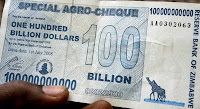
    Zimbabwe $100 Billion Dollar Note - $100,000,000,000At the start of 2007 ZW$10,000 notes were selling for about US$50 on Ebay and a number of people took advantage and sold the notes for more they were worth. With the introduction of the $100 Billion Dollar note ($100,000,000,000), selling notes for more than they are worth is happening again. As of today, there are 111 live auctions for the $100 Billion dollar note on Ebay with the highest bid for a single note being US$152.50 which is well above what one would get for it in Zimbabwe (screen shot below – click on image to enlarge). With the slashing of the zeros taking place the $100,000,000,000 will have a face value of $10 and just about worthless.

    Those who have been quick enough and smart enough have capitalized on the introduction of such notes and listed them on auction sites and sold them for very good profits. Right at this moment, the seller running the auction with a high bid of US$152.50 has 9 other auctions for single notes which if the auctions were to close would net him US$717.89 which is an amount you can’t complain about for $1,000,000,000,000 which at last weeks rates would have gotten you about US$2.

    If you have a few notes in your possession it may not be too late to get in on the action and take advantage of the situation. Even if you miss out on it this time around it is bound to happen again in the near future with the way Zimbabwe’s economy is running. Sign up to Ebay and try your luck. Take a look below:

    No items matching your keywords were found.
  • Q & A with Hopewell Chin’ono

    Hopewell Chin’ono Being Presented With the 2008 CNN MultiChoice African Journalist Award by Ghana's President John Agyekum KufuorOver the past year or so, Zimbabwean journalist and filmmaker Hopewell Chin’ono has been celebrating a number of successes with the most recent one being his win of the CNN-sponsored African Journalist of the Year competition for the documentary, “Pain in My Heart”. His successes are leading towards bigger and better things for himself and his work helps to make a positive change in people’s perceptions of certain issues faced by various communities. To get to know him a bit more I asked him a few questions which he was kind enough to answer.

    Q: What got you into journalism and how long have you been at it?

    A: I got into journalism in 1990 when I started writing for a music magazine called Prize Beat when I was in high School.

    Q: Where do you draw your inspiration from?

    A: I draw my inspiration from people who were ordinary and have done more for their community than themselves.

    Q: What is the most satisfying thing about the work that you do?

    A: I enjoy it when my work changes people’s negative attitude towards other members of society.

    Q: Earlier on in the year it was reported that you were blacklisted from covering the March elections. Was there a specific reason why you were on the list?

    A: I was never given a specific reason for my banning. They just said I could not report. But I have put it behind me as it reflects work of small minded people.

    Q: With the media clamp down in Zimbabwe, how much of a hindrance has that been on you working to your full potential?

    A: I have not been able to work properly because you have all sorts of people trying to stop you from just taking out your camera.

    Q: This year has been particularly good for you with your recent win of the African Journalist of the Year Competition and the Archbishop Desmond Tutu Leadership Fellowship awarded earlier in the year. Were these awards you ever saw yourself receiving and what do they mean for you and your future?

    A: I am motivated by reflecting on what’s around me. Awards are a reflection of what your peers and society think of your work.

    Q: Has ”Pain in My Heart” had any sort of impact on the people in the documentary and other people living with HIV/AIDS?

    A: It has made sure that the children of the late Angeline are assured of a brighter future.

    Q: Will there be a follow up to “Pain in My Heart”?

    A: I am working on something different from that. A reflection of the Zimbabwean election.

    Q: What advice would you give to young aspiring African journalists?

    A: I would say hard work pays and a lot of reading is important to understand issues.

    Q: Where can people go to take a look at more of your work?

    A: I will be setting up a website soon.

  • Eric Moyo Wins Idols East and Southern Africa

    Eric Moyo - East and Southern Africa Idols Winner 200826 year old Zimbabwean Eric Moyo from Bulawayo won the MNET East and Southern Africa Idols contest at the weekend (July 27th) and walked away with a USD$80,000 cash prize and a recoding deal with Sony BMG worth US$25,000. His song choice at the finale was ‘When a Man Loves a Woman’ during which he chocked up with tears when he spotted his parents in the crowd for the first time this season. Next up for Eric is a trip to South Africa to record his first single “This Is My Everything” and soon after start work on his album.

    It is a good thing when Zimbabweans achieve such successes which should be celebrated and even more so as it is a break from all the issues facing the nation. Eric has a unique voice and some people may not be convinced that he is Idol material but you can be the judge of that.