Author: Living Zimbabwe
-
Increasing Calls For Mugabe To Go!
Rice, Bush, Tutu, Odinga, Brown and Sentamu are amongst the growing number of world figures speaking up against Mugabe and saying that it is time for him to step down. Whether or not the increasing number of calls for him to step down will have an effect is yet to be seen.
As far as Mugabe is concerned, he has and is doing all he can to keep Zimbabwe alive. He is just going to continue blaming all of Zimbabwe’s problems on sanctions imposed by the West. Zimbabwe’s information minister Sikhanyiso Ndlovu was quoted as having said the following to reporters earlier in the week:
“I don’t have kind words for all heads of state who have made utterances against Zimbabwe, one by one and I hope this is the last time they open their dirty mouths on Zimbabwe”
“After squeezing and strangling the country with sanctions and contaminating it with cholera and anthrax, the West is seeking to use the window of opportunity provided by the disaster to justify military intervention”
With that being the case, what are the chances of Mugabe listening to ultimatums from the West?
-
Zimbabwean Soldiers Gone Crazy!
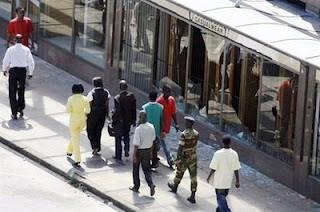 Alex Magaisa wrote an insightful post, “Why did the soldier cross the road?” which highlighted the actions of the soldiers who looted vandalized shops in Harare at the beginning of the month. In the article he highlighted speculation as to why the soldiers acted they way they did. The more commonly held theory that he highlighted was that of the soldiers being sent to wreak havoc by Zanu PF so that a state of emergency could be declared. A state of emergency would effectively put an indefinite hold to any sort of unity government. But, this is only one of the theories out there as to why they behaved they way they did.
Being a soldier means having a high standard of discipline which entails following orders given by high ranking officers and carrying them out without question. So, if the theory of Zanu PF wanting to shake things up was in fact true and soldiers in the Zimbabwe Army were still loyal, it could have some truth to it. Another likely scenario is that the soldiers may have been acting on behalf of their disgruntled Generals who have had enough of the whole Zimbabwe situation. The Generals in a show of just how much power they and the army wields may have wanted to make a point to show the powers that be that things can change. There are so many examples in history where the military has taken over which is something that could happen in Zimbabwe.
Another scenario could be that it wasn’t in fact members of the army but individuals in possession of military clothing. In the past, certain groups of people were given army clothing to go out and intimidate the people of Zimbabwe. For some reason, that uniform strikes fear into the hearts of average people who will only be thinking about staying out of harms way when confronted by someone in uniform even if they are unarmed. These individuals who in the past were given uniform to wear on their ‘missions’ got a bit to carried away with their actions and tarnished the image of the Zimbabwe National Army which is why it became forbidden for civilians to wear camouflage material. These individuals may have banded together and seen it as a way of getting their hands on something to carry them through a few days.
Or, it could simply be a case of soldiers just having had enough and in a moment of madness decided to go on a rampage through the streets of Harare. As Alex pointed out in his article, soldiers are not immune to the economic meltdown, collapsed infrastructure, cholera………… and the list goes on. They and their families have to contend with all of these woes like the rest of Zimbabwe and they being human are bound to snap at some point. It was reported that they went on the rampage after they failed to withdraw cash from a bank. The difference with them is that being soldiers they have to behave accordingly especially when in uniform.
Whatever the truth is, it is scary to see people who are trained to kill acting in such a manner. Even for Mugabe himself (if it was not his doing) it must leave him worrying a bit and with a few ‘what ifs?’ going through his mind. Whatever the case may be, hopefully the events do not escalate into yet another difficult situation that Zimbabwe has to deal with.
-
Cholera, the Zimbabwe Killer
Cholera according to the world health organization is:
an acute intestinal infection caused by ingestion of food or water contaminated with the bacterium Vibrio cholerae. It has a short incubation period and produces an enterotoxin that causes a copious, painless, watery diarrhoea that can quickly lead to severe dehydration and death if treatment is not promptly given. Vomiting also occurs in most patients.
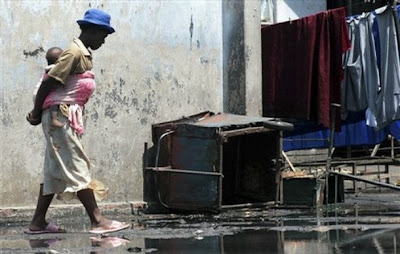
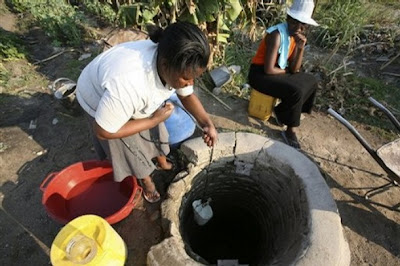
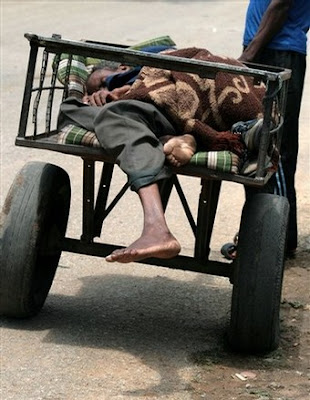
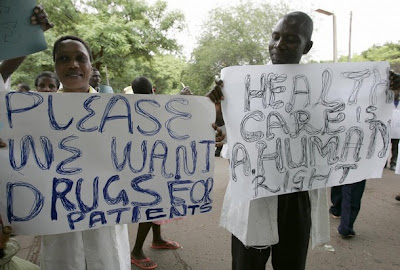
Cholera is hitting Zimbabwe hard at the moment with an estimated 300 people having succumbed, 6,000 reported cases and 1.4 million people at risk. Zimbabwe National Water Authority (ZINWA), the government body responsible for water provisions and sewage management has failed to provide adequate services which has lead to the cholera outbreak. Those who once had running tap water now have no choice but to seek out water in shallow wells and rivers but the pools of stagnant sewage dotted around the streets does not make the situation any better.The already crippled health system is struggling to ease the situation and for all we know, the actual number of people with cholera could be well above the reported estimates. The government has been urged by Zimbabwe’s Medical Association to declare a national disaster which would bring aid to ease the situation. At the moment it seems as if the Zanu PF government may not see the need to take such measures. With the onset of the rainy season the epidemic could get a whole lot worse and see many more people dying.
-
Dare To Wear Camouflage Clothing in Zimbabwe
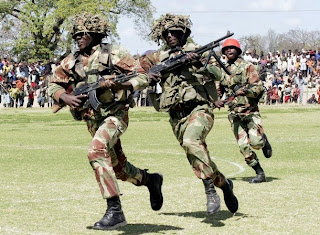 Camouflage clothing has for a very long time been popular urban clothing. If you are lucky enough, you can get yourself a pair of camouflage pants for as little as $1 on eBay. That bargain you get for your piece of clothing could get you into more trouble than you bargained for if you decide to wear it in Zimbabwe. According to the Defence Act (Chapter 11:02), wearing of camouflage materials by civilians, whether Zimbabwean or from any other country, is forbidden. This was something that was mentioned to me a few years ago but didn’t pay much attention to and quickly forgot about simply because of how in most parts of the world it is just a piece of clothing. At the time I was told that people wearing camouflage clothing were beaten up by soldiers and faced possible arrest.
Some weeks ago, a popular Zimbabwean DJ, DJ Squila was accused by soldiers of wearing army replica pants without permission. The soldiers proceeded to assault DJ Squila and threw him into a vehicle and drove off. They later threw him out of the vehicle whilst it was moving and he sustained serious head injuries. Luckily enough, a passer by took him to hospital where he received treatment. The Defence Act also states that anyone who without authority sells, offers or exposes for sale, wears or uses any uniform supplied to or authorized for use by any member of the Zimbabwe Defence Forces or other military forces shall be guilty of an offence.
The act may state that one shall be guilty of an offence but even if one is guilty, it does not give the soldiers such as the ones that assaulted DJ Squila the right to take justice into their own hands. Hearing of such behaviour reinforces all those statements about soldiers being illiterate people who don’t think about what they are doing and the consequences of their actions. This makes them very dangerous group of people who you don’t want to provoke in any way. In a country full of lawlessness it just isn’t worth it wearing camouflage clothing even more so when you have to contend with very poorly paid and disgruntled soldiers.
Would you dare to wear military clothing in Zimbabwe?
-
The Mugabe, Tsvangirai and SADC Circus
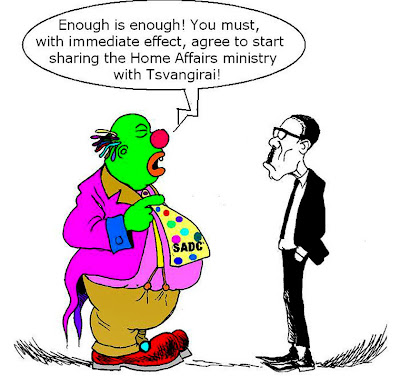 The cartoon (courtesy of newzimbabwe.com) describes the one word that comes to mind when I think of Mugabe, Tsvangirai, Mbeki and SADC, ‘CIRCUS!’ The only difference with my mental image is that I see Mugabe as the ringmaster. The ringmaster is the most visible performer in a circus and guides everyone through the show in a dramatic manner. Mugabe seems to be the one calling all the shots and laying out how the sharing of power will be played out. SADC are bunch of clowns who are just there to do their job and Tsvangirai is there as a performer who wants to be the ringmaster. With that being the case he rebels against how Mugabe wants the show to be played out with the end result being the show not being played out at all.
Almost two months after signing the power sharing agreement there is no power sharing and still no government. The main things that have taken place that are causing dispute include Mugabe taking control of ministries that Tsvangirai feels he should be in control of. SADC has once again been called upon to reach some kind of resolve but no nothing comes of the hours and hours of discussion. If anything, SADC seems to be leaning more towards being in favour of what Mugabe decides upon. How they show any sort of support for Mugabe is a mystery. What is it that he has that SADC cannot confront him with the honest truth about his actions and what he really needs to do?
This is all that SADC had to say about Zimbabwe at the Extra-Ordinary Summit of the SADC Heads of State and Government in South Africa on November 9, 2008 (extract from the summit text):
10. The Extra Ordinary Summit considered the political and security situation in Zimbabwe and observed that no government has been formed subsequent to the holding of the elections and the signing of the Global Political Agreement. As a result, the country is unable to effectively address the challenges facing the people of Zimbabwe .
11. In view of the above, Summit decided that:
(i) the Inclusive Government be formed forthwith in Zimbabwe ;
(ii) the Ministry of Home Affairs be co-managed between the ZANU-PF and MDC-T;
(iii) the efficacy of the arrangement referred to in paragraph 2 above, be reviewed after six (6) months by the Parties with the assistance of the guarantors, SADC, AU and the Facilitator.
(iv) to give effect to these decisions and the provisions of the Global Political Agreement, the Parties must, without any further delay, introduce the Constitution of Zimbabwe Amendment Number 19.
12. The Extra-Ordinary Summit appreciated the efforts of His Excellency Thabo Mbeki, Former President of the Republic of South Africa and the Facilitator of the Political Dialogue on Zimbabwe in finding an amicable solution to challenges facing the Republic of Zimbabwe and encouraged him to continue with his mediation efforts.
13. The Extra-Ordinary Summit will continuously remain seized with the ongoing political situation in the Democratic Republic of Congo and the Republic of Zimbabwe.
What they proposed is basically the same thing that they have been asking Mugabe and Tsvangirai to do over and over again over the months. The same things keep getting repeated and all parties are caught in a vicious cycle that they clearly cannot get out of.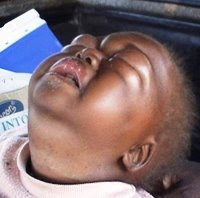 Zimbabwe is hanging on a thread and sees a unity government as the one thing that will bring it out of its crisis. Foreign donor agencies have clearly stated that Aid will not be delivered to Zimbabwe until a new Government is formed. As Mugabe, Tsvangirai, Mbeki and SADC leaders continue to go back and forth and hold talks for hours and hours the people of Zimbabwe who have run out of options and don’t know what to do to survive wait to die. It is estimated that at the beginning of next year, 5.1 million Zimbabweans (45% of the population) will need food assistance. In October Solidarity Peace Trust put out a Hunger Alert report that follows the plight of two children; one with kwashiorkor and the other marasmus (click on the photo of the child with kwashiorkor to read the report). With all of that being the case, a World Food Programme appeal for funds to feed Zimbabweans just went completely unfunded. As a leader, just seeing a picture of a child like that should be more than enough to prompt you to do something about it.
Zimbabwe wants a change, Zimbabwe needs a change. Where is our Obama?
-
Zimbabwe Citizen Visa Applications and New Zealand Immigration Profiling Group
 The UK, US, Canada, Australia and New Zealand are popular destinations for Zimbabweans looking for greener pastures. With this migration brings the issue of family who have stayed behind in Zimbabwe wanting to have a holiday and visit their relatives in their new homes. Being Zimbabwean, applying for a visitors visa for any of the above mentioned countries might be a bit of an ordeal but if you have all your paperwork in order you would expect to get a positive response within a few days of applying. When it comes to applying for a visa, it is not the biggest or most popular destination that poses the most problems. New Zealand, which probably has the least to offer in terms of employment, earning and development potential is the one that gives the most headaches.
Zimbabweans looking to enter New Zealand as a visitor or on a long term basis can expect to be in for a very long wait as their applications are being processed. Let’s say for example someone in Zimbabwe wants to visit a son, daughter, sister etc. They will have to submit an application through the New Zealand High Commission South Africa branch in Pretoria which will set them back ZAR800 plus the cost of couriering the passport, application and supporting documentation to South Africa. In some cases they may need to get the person they intend on visiting to send supporting documentation to submit with the application. Once in SA, they will be told that they don’t process Zimbabwean passport holders applications and that it will sent to NZ for processing which will take two to four weeks (this timeframe seems to vary). The weeks that they were told it would take end up turning into months and at the end of it all the applicant gets a letter that reads along the lines of ‘we regret to inform you that your application for a visitors visa has been declined……’
The New Zealand Immigration Service (NZIS) set up a unit called Immigration Profile Group (IPG) which processes visa applications of citizens from countries it deems as high risk. If you are travelling on a passport from a country on IPG’s list and are applying for any sort of visa the application is sent to Wellington regardless of where in the world you are. Due to the situation in Zimbabwe, it happens to be close to the top of that list which makes it difficult to apply for a visa to travel to and enter NZ. With that being the case, family members of Zimbabwean resident in NZ have missed out on those very special and one off events in life that are just not the same without loved ones around. I have come across a number of Zimbabweans whose parents have applied for visitors visas and been declined after waiting for months and months for a response. A number of these declined applications have been for people who want to visit to attend their son or daughters wedding or the birth of a first grandchild. It is extremely heart-breaking for parents, sons and daughters when a visa application is declined even after explicitly stating the fact to NZIS that someone wanted to travel for those reasons.
When IPG receives the application it is put into a ‘managed queue’ as it waits to be assigned to a case officer and how long that takes or what position it is in the queue, no-one knows. If you call NZIS to find out the status of the application and it hasn’t yet been declined, all that they tell you is whether or not it is in the queue, with a case officer or notes if any that have been placed on the file. You cannot make direct contact with IPG via telephone with only way of getting in touch with them being via fax or email. Even if you are to get in touch with IPG, the chances of getting a response from them are slim to none.
Something else that becomes an annoyance for applicants is the length of time for which IPG holds passports for. Some people might need their passport to travel but when they get in touch with the overseas mission through which they submitted the application they are told that asking for their passport back means withdrawal of the application. But that is not the case, passports can be sent back to applicants as the application progresses in the queue. That shows that there is a break down in communication between IPG and NZIS overseas missions. One thing that is even more pathetic is that fact that if you call their call centre here you can have operators telling you that you can get your passport back as the application progresses and others telling you that if you ask for it back the application is effectively withdrawn. What information do you work on when some of the call centre representatives don’t seem to know how the process works and IPG cannot be contacted directly for the correct information?
Even after satisfying all the requirement there is no guarantee that a visa will be granted. Working on information from personal experience and that of friends whose family members applications have been declined, IPG does not seem to follow their own guidelines and wants excessive amounts of information in order to approve an application. As an example; for evidence of funds you need to show proof that you have enough money to support yourself during your stay. Their minimums are NZ$1000/person/month or NZ$400/person/month if accommodation is paid for. If you are not able to provide this proof, the other acceptable form of evidence is a declaration by a New Zealand sponsor that they will pay for accommodation and maintenance. A few people who have been able to provide proof of funds in the form of very healthy bank statements (not in ZW$) have had their applications declined on the basis that a sponsorship form was did not accompany the application. On top of that they have been deemed as people who were not likely to return to Zimbabwe even if they are well travelled and have enough money to pay for their visit and then some.
The common theme with declined applications is that they do not believe that the applicants will return to Zimbabwe once in New Zealand. Apparently New Zealand cannot send Zimbabweans back home once their permit has expired because of a United Nations Convention. Yes, there may be people who have ulterior motives but I believe that a large proportion of the applicants are genuine visitors. It just makes you wonder if it is worth it trying to go through the hassle of putting in an application, getting your passport back if you need it, following up on the application and having niggling thoughts for months of whether or not you will get the visa. For a lot of genuine applications it ends up being a very big waste of time and money.
Members of the Zimbabwean Community in Wellington (ZIMDARE) meet with Parliamentarians and presented the issue to them. They received a letter stating that the Minister of Immigration and the head of IPG were looking into the issue. It will be interesting to see what the outcome is. In the mean time though NZIS and IPG really need to get their act together and be able to provide clients with useful information in a timely manner. The also need to be more upfront about the application process and not be make applicants and sponsors run around to provide them with all the information they ask for and turn around to decline an application for petty reasons.
-
Fortune Muparutsa Passes Away
 Last night I read the unfortunate news that Fortune Muparutsa passed away on Saturday 25th October, 2008. This came as a even more of a surprise because just a few weeks ago we went through a period in our household where we searched for and played a number of songs by Zimbabwean artists mainly from the 90s and Fortune’s song “Wangu Ndega” was one of the songs that we played repeatedly not only because of how good it is but because of how it reminded us about the Zimbabwe of times gone by.
Way back when, when that and his other songs were being played over the airwaves or videos his being shown on ZBC TV I can remember the volume being put up and people around me enjoying the music. This was a time in life where CD’s and MP3’s were unheard of and it was all about cassette tapes. My first copy of “Wangu Ndega” was one that I recorded onto tape as it was playing on Radio 3. These were the times where you would use a pen to rewind or fast forward the tape to a particular song or part of a song if your tape player was somehow still able to play music but had lost its fast forward and reverse functionalities. You got to know how many turns in one direction or the other to go to get to a certain point. Life then was relatively simple, hassle free and people in Zimbabwe were much much happier than they are today. That is where listening to Fortune Muparutsa’s song took me. It took me to a point in time when life in Zimbabwe was good. It brought joy then and brought joy now. That is how I will remember him. Rest in Peace.
-
Burning Money to Make Money
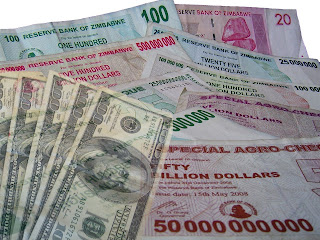
Zimbabwe’s economy might be in the doldrums but there are people there who are making a lot of money. Patrick M at Zimbablog wrote an article on ways of making money in Zimbabwe, “The 13 best ways to make money in Zimbabwe”. He outlines a few things that people have been doing to make themselves ridiculously rich. Some of the methods highlighted in his post include selling fuel, trading in forex and Zim dollars (believe it or not), selling food and alternatives to beating the frequent power cuts. That is not all people are doing to make money. The diamond craze that hit the country a couple of years or so ago is till very much alive despite the efforts of police to try and stop their illegal mining and dealing.
The other day I caught wind of another way in which people are making money called ‘burning money’ where people take advantage of the very wide gap between the cheque rate and the cash rate of the US dollar against the Zimbabwe dollar. If you want to cash your US dollars you will get a much lower rate for it than if you were to go to the bank and exchange it for Zim dollars which are deposited into your account at a much higher rate. For example, if you cash US$50 it would be at a rate of lets say 30 000:1 and if you were to exchange it at a bank with the funds being deposited it would be at a rate of lets say 2,180,000,000:1.
The most obvious choice would be to exchange the money using the bank transfer rate but the problem comes when you want to withdraw your billions of dollars from the bank. If you have contacts at the bank you withdraw the money and then go to parallel market to buy US dollars at a rate of lets say 40,000:1. If you do the math you can see that you end making a very good profit. For those that cant get that amount of money out of the bank, what they do is go to a company and buy some sort of goods such as cement or Econet’s pre-paid buddie top-up cards with a cheque and sell them on the streets for cash.
The kinds of profits that people who ‘burn money’ make can be a bit mind boggling with the number of figures involved in the calculations but those who deal with them on a daily basis are used to it.
One thing though is that with people managing to make huge amounts of money from their forex in both US and Zim dollar terms, a number of industries or should I say those that are left are struggling to survive. They are struggling to survive because everyone is out there trying to get their hands on some of that money and those that have the money are clearing out companies and selling their goods.
Some may see this as being immoral and that the people who are out there carrying out such trades are further destroying the economy. The authorities may be out there trying to clamp down on such activities but as they close more and more loopholes and make it harder to carry out these trades, people are finding other ways of making ridiculous amounts of money. The way I see it, it’s just survival. It’s amazing how people can thrive in chaotic conditions.
-
Robert Gabriel Mugabe, It Is Time For You To Go!
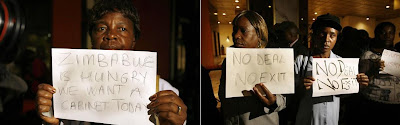 Just the other day, these Zimbabwean women didn’t just hold up these placards for the fun of it. They held them up hoping that you would see them and actually have a heart to do what is right. They are suffering like most of the people in Zimbabwe. They are fast running out of options and are taking whatever steps they can to try and make sure that they and their families get the basics they need in order to survive.You signed the power sharing agreement with MDC more than a month ago and for many it brought a glimmer of hope that there was finally going to be a change for the better in Zimbabwe. To this day nothing fruitful has come of it and as you and the opposition continue to bicker over the power-sharing deal and once again get Mbeki in to mediate, the country continues on its downward spiral. Zimbabwe has collapsed and people who could once make ends meet are really struggling to survive. It’s not normal for a country to have an inflation rate in the hundreds of millions in this day in age. One where the currency is continually being revalued and new bank notes being put into circulation. Steps taken to try and revive the economy have not worked and I don’t think you or your government know what you are doing anymore.Talking about monetary issues gets me thinking about the large sums of much needed foreign currency that you and your cronies have spent on spoiling each other at home and on overseas trips. That money or even a portion of it could have gone towards improving or should I say getting a vital piece of infrastructure up and running again. How many people do you think would still be alive today if you had put a couple of hundreds of thousands of US dollars towards the health system? So many people have died preventable deaths and any amount of money would have helped prevent some of them. A human life is precious and taking steps to prevent ‘x’ amounts of deaths is commendable.You walk around smiling as if everything is okay and should be the way it should be and when you are given the chance to speak to an international audience you are very quick to point the finger at the Bush’s and the Blair’s of this world. Yes, George W. Bush and Tony Blair have made their fair share of errors but they are not related to the collapse of Zimbabwe. You pointing the finger at them and others around the world has done nothing to provide food, clean water or a functioning health infrastructure. Do you not see it for yourself as you are driven around in your luxurious Mercedes-Benz S600 Pullman?Right now I am angry at how you have taken Zimbabwe from being the breadbasket of Africa to where it is today. I am dumbfounded at how us Zimbabweans have managed to let it happen. You need to take a good look at yourself and ask yourself if all that you have done and achieved was in the best interests of the people. Was it all worth it? But, your madness may have taken you past the point of logically reasoning and you are unable to see any wrong doing in your deluded efforts over the years.My family, friends and the rest of Zimbabwe are suffering and taking extreme measures in order to survive. Living life day to day requires a bit of ingenuity and even ruthlessness towards other people. It doesn’t need to be like that, it shouldn’t be like that. Please do what is right. If you don’t know what that is, dig deep down into your Christian roots; you will find the answer there.
