Author: Living Zimbabwe

  • The So Called Targeted Sanctions on Zimbabwe

    The So Called Targeted Sanctions on Zimbabwe

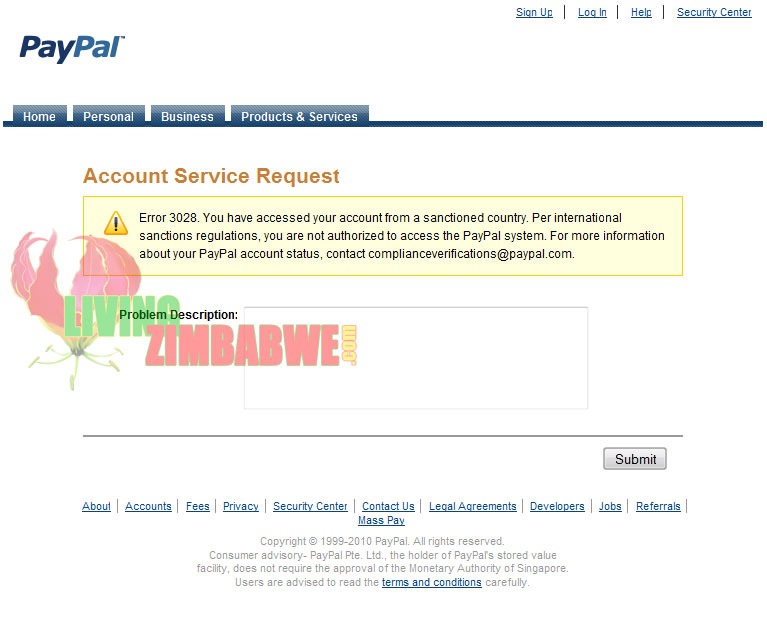
    Whilst in Zimbabwe on a visit, I tried to access my PayPal account and was unsuccessful. All I got after entering in my details was the following message:

    Error 3028: You have accessed your account from a sanctioned country. Per international sanctions regulations, you are not authorized to access the PayPal system, For more information about your PayPal account status, contact complianceverification@paypal.com

    I do not have any political affiliations in Zimbabwe but here I find myself being affected by the TARGETED sanctions. My understanding was that the sanctions were targeted towards certain individuals and that they would not have an effect on the general population. My little experience obviously goes to show that this is not the case.

    A week or two after my arrival there was a newspaper article about a university student who tried to get her hands on demonstration software from ETAP Enterprises Solutions. Getting a hold of the demo disc entailed entering her address into a form which she did do. She was later told that they would not be able to provide her with the disc due to trade sanctions against Zimbabwe.

    I am not on the sanctions list and the student mentioned above may not be either. That experience has been an inconvenience and I am sure that there are a lot more Zimbabweans with no political associations who have experienced similar. It has also made me think about what kind of effect it has had on individuals, businesses and institutions that have been denied access to products and services that they would have otherwise have had the right to access. My guess is that they would have had a major negative that would have led to them finding a roundabout way of getting something or going without it completely and having to deal with it.

    If you take a look at some of the individuals on the sanctions list, they are living very opulently. Many a people in Zimbabwe may have been able to better their lives and those of others had there been no sanctions. It just makes me wonder whether there is a point to the sanctions and whether or not they have really worked?

  • Landing at Harare International Airport

    For those of you who have not been to Zimbabwe for a while, here is footage of what you can expect to see when landing at Harare International Airport in mid November. The footage was taken from a South African Airways Boeing 737-800 flight from O.R. Tambo International Airport, Johannesburg.

  • Perceptions of Zimbabwe – November 2009

    It has been three or so years since I last visited Zimbabwe and the last time around it was so mind boggling having to deal with all the zeros in the currency, the state of the infrastructure and the lack of many basic everyday items.

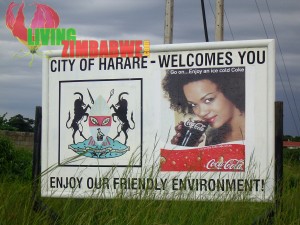
    City of Harare - Welcomes YouThis time around, things have been a little different and after only a few hours in, I was pleasantly surprised by some the changes in the country. First off there was the worry about our luggage as we flew via Johannesburg (which is notorious for luggage being stolen) but everything that we had made it to Harare. Next up was ZIMRA (Zimbabwe Revenue Authority) how in the past have really given me a hard time but this time around we walked right past them without any words being exchanged. All that was exchanged as we walked through the ‘nothing to declare’ area and on to waiting family was a nod of acknowledgement.

    [ad#Adsense 250×250 white-posts]The drive home was pretty much what I expected with potholes all over the place, robots (traffic lights for those of you who do not know that kind of African lingo) on their last legs, people selling airtime and other bits and pieces and just about every street corner, a mix or cars that should be condemned in and amongst really expensive ones (Mercedes still seems to be a favourite over here).

    The day after arriving in Harare I went for a drive around the place and was surprised to see how full the supermarkets were. Just about anything and everything seems to be available provided you have the U.S. dollars to pay for your goods. Some things such as food, alcohol and cigarettes are a lot cheaper over here than they are in the part of the world I am currently living. Other commodities however are ridiculously priced.

    For some, things seem to be a bit rosier but there are still plenty of other people out there who are in a desperate situation. There are people working in certain trades who are being compensated in food rather than cash (by their own preference). One thing that is evident though from just about everyone I have spoken to is that it is a lot better that it was last year. They all say it was very tough and they do not know how they got through it but they did. My hope is that things only get better!

  • A Violent Response: New Documentary Film by Hopewell Chin’ono

    The award winning Journalist and Filmmaker Hopewell Chin’ono is at it again. He has put together another documentary film called A Violent Response. The documentary covers some of the actions carried out by the government after the March 2008 elections. Here is the trailer of the film which is due to be released in December:

  • Hopewell Chin’ono vs. Peter Pasipamire and the Truth

    Last week, New Zimbabwe published an article – Film-maker sued over HIV documentary about Hopewell Chin’ono being sued by Peter Pasipamire for alleged non-payment for participation in the moving HIV/AIDS documentary Pain in my Heart. There were inaccuracies in the article which Hopewell has tried to clear up and also share with people in a mass email. You can read the emails (below) for yourself and form your own conclusions now that you have a bit more information than what was originally reported.

    This just goes to show that sometimes the media can get it wrong or be completely biased for one reason or another and you should always take such things with a pinch of salt.

    Dear all,

    I am sure most of you have read the article that was published on Newzimbabwe.com reporting that I am being sued for not sharing the film prize money with one of the characters in the HIV and Aids film that I made in 2007.

    I am sure you are all aware that I donated all the money that I won in prizes from CNN and Kaiser Family Foundation. This money was used to set up a trust to help the kids of Angeline Chiyanike to go to school.

    I went to look for these kids and asked a long distance relative of their mum to look after them on condition that I give her a monthly stipend and pay their fees until they are 18 years old.

    It is standard practice that we do not pay for interviews that are used in documentaries, it is bad journalism to do so. Jeff Kainonge lost his job for doing so and once its discovered that you pay for interviews your reputation as a journalist will be soiled beyond repair.

    I had offered the man who is now suing me to help him with making sure that he gets good access to medical facilities but he demands money arguing that I am giving money to the kids. I am sure you remember that I sent an email to you letting you know that his relatives had turned down that help.

    The reason why I am giving money to these kids is because their mum died whilst I was filming her and what stuck in my mind was when she said her kids will be street kids when she dies.

    The guy who is suing me is being looked after by the River of Life Church in Harare and that was the story-line to ask why a single mum of 2 was not getting help.

    If broadcasters were supposed to pay for interviews would we be able to cover events like Hurricane Katrina or the tsunami if the victims of these tragedies turned around and claimed US$3000 for the interviews?

    I sent an email to the editor of the website. I have posted the emails I exchanged with him below.

    My problems have escalated after posting a trailer for my new film see www.youtube.com/tvnews2000 or

    This film called a Violent Response exposes the people who were behind last year’s post-election violence and captures the violence itself in action. I have received vile emails from people trying to intimidate me from putting it out.

    These are some of the downs of my job but someone has to do it

    Best regards,

    Hopewell

    Mduduzi,

    I acknowledge receipt of your email. Even if you get tons of articles, the cardinal rule in journalism is that you do not publish before you check your facts.

    That is the job of a good editor. The comments in your article from a Chambati are not in court documents but they are meant to tarnish my image as a journalist for unknown reasons.

    I did not make the film as Television International but as a student. Don’t you question statements that you are given when you seek comment? If someone said to me “Mduduzi is a thief” would I be justified to publish that on the basis that someone has said it or I am supposed to check the facts even if its in court documents.

    Would you publish government documents without checking whether they are factual or not?

    The professional thing for you to do is to remove that article since I have given you all the contact details of the people concerned and check your facts first. You know that as a journalist there is nothing important as one’s reputation.

    I do not understand why you think it is important for you to publish a story simply because it has been send by your correspondent even if it carries untrue information.

    I again attach a website with the information that further confirms to you that the film was made as a Masters project not as a Television International production:

    I expect you at the least to accord me the fairness that we as journalists are supposed to give to all people by not publishing information even when it has been brought to our attention that it is not true.

    I have no intention of engaging in phantom battles with people who resent my success as a journalist and filmmaker and who want to use your platform to tarnish my reputation. I also hope that you have no intention of being party to the now typical syndrome of undignified journalism where people print and refuse to verify simply because information has been put in the public domain.

    Who will guard the guards?

    Best regards,

    Hopewell
    – Hide quoted text –
    On Tue, Oct 13, 2009 at 9:23 PM, Mduduzi Mathuthu <–@newzimbabwe.com> wrote:
    Chief,

    We get dozens of stories everyday and if I tried to follow up every name in those stories to find out if they were properly quoted, contacted or treated fairly I would go mad. As a journalist, you know your editor believes what you write which spares them the trouble of staying on the phone all day checking all stories.

    So it happens that the said story came from one of our correspondents in Zimbabwe, quoting from legal papers before the Zimbabwe High Court and stating you were unavailable to comment.

    We have noted your comment you entered under the story and moved quickly to instate your reaction on the story, and I hope everyone gets an idea of what the two sides think about the matter.

    Accept my personal apologies if you were never asked to give your reaction, and rest assured there was no malice.

    Regards,
    ——– Original Message ——–
    Subject: article
    From: “Hopewell Chin’ono” <–@googlemail.com>
    Date: Wed, October 14, 2009 2:07 am
    To: Michael Wayne <–@brunel.ac.uk>, PreChaka <–@kantorimmerman.co.zw>, Dr Chiratidzo E Ndhlovu <–@mweb.co.zw>, ruebonde@zol.co.zw, –@newzimbabwe.com, Dr Hilda Angela Mujuru <–@mweb.co.zw>, Irene Petras <–@zlhr.org.zw>, “Mabasa, Ignatius (Zimbabwe)” <–@britishcouncil.org.zw>, –@britishcouncil.org, Bernard Kwame Ampaw <–@btconnect.com>, –@yahoo.com, Bright Ncube <–@yahoo.com>, alex magaisa <–@yahoo.co.uk>

    Dear Mathuthu,

    I am disappointed that you could run an article on your website accusing me indirectly of being a fraudster and not seeking comment from me.
    Ref –

    I made the film Pain in my Heart as part of my Masters project at Brunel University in 2007. I made contact with Mr Peter Pasipamire (the man accusing me of not paying him for appearing in the film) through Dr Rutendo Bonde who was running the HIV program at the River of Life Church. I asked for patients who were willing to take part in the film project and Mr Pasipamire agreed to do so.

    Anyone who has watched the film will confirm the fact that I asked Mr Pasipamire in the film why he agreed to appear in the film and he states clearly on camera that he wants people to learn about HIV and Aids.

    At no time did I promise to pay Mr Pasipamire any monetary gain as doing so would be unprofessional and unethical on my part.

    It is true that I am giving financial support to the kids who lost their mother whilst I was filming her story. It should be no crime that I chose to help these orphans. Mr Pasipamire has called in police before and he was asked to produce the contract that he signed. He could not produce this document because I never said I would pay him and there is NO contract that exists.

    I have not benefited financially from making this film since I waived my producer’s fee when e.tv ran the film after it won the CNN African Journalist of the year award.

    All the monies that have been donated by Zimbabweans for the kids in the film have been deposited in an account held by the law firm Kantor and Immerman. I have never touched those funds and you can check with Precious Chaka an attorney with the law firm whom I have copied in this email communication.

    I have used my personal funds to help the kids in the film who lost their mum and I have arranged for a long distant relative of their mother to look after them.

    I find it disrespectful that people can decide to make reckless statements about issues they are not privy to instead of getting in touch with the people concerned first. My email address is attached to the youtube version of the film that you have put on your website. You could have easily send me an email to get my side of the story.

    I hope that you will do the decent thing of attaching my comment and speaking to my University Professor who supervised this project, Dr Michael Wayne(–@brunel.ac.uk)-I have copied him too.

    I made this film when I was on a British Council Scholarship and you can get in touch with Ignatius Mabasa- –@britishcouncil.org.zw whom I have copied.

    He will confirm to you that I was never paid a penny by the British Council to make that film. I used my resources as a student to make this film.

    The person who was responsible for my financial issues when I was a British Council Scholar is Denise Rodgers and she will also be able to confirm to you that I never got paid by the British council to make the film. Denise Rodgers can be contacted on- –@britishcouncil.org

    The doctor treating Mr Pasipamire will also confirm to you that I never made an agreement to pay Mr Pasipamire. Her name is Dr Bonde – –@zol.co.zw and I have copied her in this email.

    You have mentioned in your article that the film was screened on BEN(–@bentelevision.com,OBE(–@btconnect.com) and Passion Television(–@passiontv.co.uk stations. I was never paid by these TV Stations for the screening of the film as it was an academic piece of work.
    I allowed them to screen the film as a way of getting the message out.

    The least I expect from you is to put my side of the story and to get in touch with all the people concerned if you wish to get your facts right. What happened to good old journalism?

    Lastly, I find it unprofessional and shocking that Albert Chambati of an organisation you quoted as Justice Aids Trust would say the following statement without seeking to find out what happened first.

    “This case will serve to highlight the abuse of people living with HIV and AIDS, and it might help others in similar situations to come out and challenge those who are abusing them.”

    How can someone have the nerve to go to newspapers and spread malicious rumours without checking their facts first?

    Best regards,

    Hopewell
  • It’s Tough Being Black!

    A few weeks ago I was directed to Africa Online (NZ) to read the review of the Celeb Wedding where Fortune and Zanele tied the knot. Reading through the review got me thinking about something someone said at an event where there were a number of Africans present. All that this person said shaking his head was, “it’s tough being black”! What he was referring to was the manner in which people arrived at the event and the manner in which they conducted themselves throughout the evening. It was a case of look at the car I am driving, look at who I am with, look at what I am wearing and so on. Reading the review of the wedding just got me thinking about how with so many black people it is all about the ‘show’ and ‘keeping up appearances’.

    Going back to the wedding, to me it seemed like the wedding was put on as a show of God knows what for the guests. It is all well and good to celebrate such a day to the fullest and being a Zimbabwean wedding you can expect it to be a jam packed and joyous event. But, when it goes to the point of talking about how we did this, did that, had this, had that it takes a bit of light off what the day was about. Marriage is the union of two souls and when a wedding goes over the top it can take a lot of essence off of that.

    You don’t have to try hard or even look far to find people out there who go to great lengths to make it look as if they have made it when that may not necessarily be the case. For a lot of them, they are struggling to make ends meet and trying to keep up appearances is fuelling their journey towards more debt. On the outside they may look happy and as if they have got it all together but in actual fact there may be amongst other things emotional turmoil.

    This is something that I failed to understand in the early 90’s when I would observe young Zimbabwean’s in the middle of summer sweating up and down 1st Street for hours on end and wearing heavy jeans and a leather jacket. Regardless of the temperature, the leather jacket would not come off because I guess it looked good. This is the same phenomenon I am still seeing today almost two decades later but I still fail to understand it.

    That there is where “it’s tough being black” came from. Some of these people are likely to spend their last few dollars on something to enhance their social standing than something more beneficial such as food. But, who am I to judge? People can do and are entitled to do whatever they want to do but what is the point when nothing meaningful comes from it?

  • Gringo – Classic Zimbabwean Comedy

    I thought I would give you something a little different and post a snippet of a classic Zimbabwean comedy series featuring Lazarus Boora, ‘Gringo’. Gringo kept many people glued to their screens and in hysterics. It is one of those programs that lets you forget about everything! Enjoy:

  • Gays and Lesbians in Zimbabwe and Their Rights

    “It degrades human dignity. It’s unnatural, and there is no question ever of allowing these people to behave worse than dogs and pigs. If dogs and pigs do not do it, why must human beings? We have our own culture, and we must re-dedicate ourselves to our traditional values that make us human beings. … What we are being persuaded to accept is sub-animal behavior and we will never allow it here. If you see people parading themselves as Lesbians and Gays, arrest them and hand them over to the police!” That being said, you can see that being openly gay in Zimbabwe does not work well in ones interests. Homosexuality is not illegal, it is sodomy that is.

    The issue of gays and lesbians has for a long time been a highly contentious issue in not only Zimbabwe but around the world. It is an area that has put many a world leader to the test in how they respond to the issue of their rights. Mugabe’s disgust towards homosexuality is a sentiment that is shared by many a Zimbabwean as well.

    Gays and lesbians have for a time long been subjected to all forms of discrimination which has lead to them living their lifestyle under the radar. This is not to say that all homosexuals are living under the radar, there are some who are very much out there in the open and made their sexual orientation known to all. With the inclusive government and the new Constitution expected in the near future, gays and lesbians are becoming more vocal and demanding that their rights are recognized and made a part of the new Constitution. A lot of them are fighting hard to see that they are protected under the constitution. Gays and Lesbians of Zimbabwe (GALZ) www.galz.co.zw is at the forefront of seeing to it that there is constitutional equality.

    GALZ Mission Statement

    The principle objective of GALZ is to build a democratic and accountable organisation and to strive for the attainment of full, equal rights and the removal of all forms of discrimination in all aspects of life for gay men, lesbians and bisexual people in Zimbabwe and to inform, educate, counsel and support people in matters relative to their health and well being.

    Sexual rights are human rights.

    Mugabe’s fight against homosexuality was dealt a blow in the mid to late 90s when the 1st president of Zimbabwe, Canaan Sodindo Banana was convicted of sodomy. He was jailed for a year and died a few years later but was not buried at Heroes Acre with full honours as you would expect for a former head of state. This goes to show what happens to people convicted of sodomy regardless of who you are and what you have done for the nation.

    Could the extreme homophobia be a result of Mugabe’s attitudes towards them influencing people to detest homosexuals or is it based on something that they themselves truly believe to be wrong? Many Zimbabweans are Christian and there are passages in the Bible that condemn homosexuality. These include Genesis 19, 1 Corinthians 6:9-10 and Leviticus 20:13 –

    “If a man lies with a man as one lies with a woman, both of them have done what is detestable. They must be put to death; their blood will be on their own heads.”

    This is something that may drive them towards making the decisions they have made about homosexuality.

    This “Satanic”, “Western Import” (not my words but those of Mugabe and his supporters) of homosexuality will continue to be a thorn in the side of Zimbabwean politics for a long time coming. Human rights groups see it as another violation in Zimbabwe and other see it as a moral issue that just shouldn’t be allowed. It may be one of those issues where there will never be a resolve that leaves both parties happy.

    What will become of the gays and lesbians on Zimbabwe?

  • Religion in Zimbabwe

    Religion in Zimbabwe is a very contentious issue. Mainly because we are a religious people from the days of our forefathers and that makes us different from all other cultures. Contentious issue because we have been fought by forcise of evil and deceit to the extend of getting so confused that it is now normal to see a family no longer on talking terms among themselves because of issues of religion.

    I will trace back from the early days of precolonial history of Zimbabwe. The Zimbabwean people mainly of the Shona race were under ancestral spirits, and the centre of governance were the spirit mediums. These were the people who installed chiefs and that by its positioning meant that the chief’s power was derived from their obedience to the order of the spirit mediums.We talk of Chaminuka, Mutota, Murenga, Nehanda, Gwangwadza, Gondondo and many more that we may mention etc. as the centres of power. These were the centre forces of the African religion.

    Midzimu determined where to build your houses, which forests to go hunting and which not to hunt in. Midzimu communicated a code of conduct for each particular dunhu/administrative area. They chose the ‘sabath day’ (Chisi) among their people. They had the power to summon the rains and the rains would come. They would prophesy and prepare their people aginst draught, invasions etc. The spirit mediums advised on what to do and where to go in times of war etc. Also the process of choosing the chief/mambo, where three men from a chiefstainship clan would be selected by midzimu, brouht forward, given bute/snuff to hold tight into their closed palms and three times thrown deep into river pond and see which of them would come out with the snuff dry.

    Therefore, this was the centre of authority where all chiefstainship authority was derived from. And thios is also where punishments came from. If one was found to be in acts of misconduct and a punishment was meted, all would see exactly that happen.The Zimbabwean people believed and worshiped that. This worked for the shona people and they maintained that always as their religion.

    Chaminuka of Dumbwiza(Chitungwiza), told of the coming of the whites, which is well documented. He told of these people’s cunning and evil ways against the national people’s governance and religion. He advised against allowing them any space at all. And he also warned of their mighty power which would defeat the native chiefs and their chiefdom. This all happened. So the shona people remained steadfast. Nehanda commanded the first Chimurenga war. He directed how the fighters should behave and warned against touching any of the whiteman’s things. On the breaking of whjich rules was a defeat for the fighters and subsequently came a demise of the ancestral spirit worship. That was the fall of the Shona rulership and with it the beginning of the fall of the shona culture.

    When the whiteman came, they made sure they destroyed that religion first. This again is most dicumented. The whiteman quickly searched and understood where the shona kingdom power derived from. They then went on the hunt for all the prominent spirit mediums and slaughtered them. In a conclusive brutal stop to a shona resistance. They knew that the shona had a religion. They knew that you could not defeat the shona if you let loose their religion and religious practises. And their hunt for the kill went on into the second Chimurenga era, and many spirit mediums too were murdered. They were murdered for the very simple reason of practising an own religion which their only source of solace and source of power.

    The spirit mediums blessed the second Chimurenga. Many religious songs were sung to go with that. The war went on and even a simple Mujibha and Chimbwido would tell you it was a sacred war. It was a religious war. And the religion won. If it were not for the religion and if it were not for the worship, the whiteman would have won. But our Zimbabwean religion won the war!

    The Great Betrayal! We did not have religious leaders. We did not get religious leaders into the rank and file of ruleship. We got too too excited to recognise and maintain our religion. The liberation war leaders came back on Independence, grabbed power, grabbed influence away, grabbed women, money and all resources of their choice, and they stuck away with their families. They stuck away, far far away from the religion, from the religious leadership and religious influence, and they shunned all that. Also they stuck away and shunned even the religious advice that won them the war and the power and the priviledged.

    Education. That too we grabbed. Not that there is anything wrong with being educated but what type of education. The very educational curriculum that destroys us, that destroyed us that which shuns us as a people is what we grabbed and celebrated and glorified. Thsi brought a devout clinging to the bible. The Christian bible which teaches us that there is a Jesus who curses our religion and a Jesus who says serve the whiteman, remain poor so that you will be rewarded in heaven And so we grabbed the Christian religion and that one many follow, especially the current generation, the young and tomorrow generation.

    Leadership. That too we grabbed and in that we brought the same same people who were shunned by our religion. And those we celebrated and glorified and in the spirit of forgiveness and reconciliation we trusted and promoted at the expense of our own. At the expense of our own religion. Our own religion that brought us independence.

    Culture. Theirs too we grabbed. And our own we ignored and discarded. All this happened with the blessings of our very powerful and most learned leaders. The very leaders who are still in power today, and have brought our religious Zimbabwe down to its waist.

    The War Values. These we abandoned. But these remain the key to a change to our fortune. The war values as dictated by our religion. Through our religious leaders. And so we remain a lost people, a people who shunned an own religion in favour of a foregn religion. The very foregners who became our tormenter, the very foregners who are our tormenters and very foregners who are jeering our ‘new democratic’ leaders. Zimbabwe, a religious people a confused culture,all because of a shunning of a true African religion.

    By: Masimba Murambiwa
    A religious person in the diaspora with a keen interest on the matters of African History and African Rennaissance

  • Zimbabweans Must Go Home Says Tsvangirai

    Morgan Tsvangirai had the pleasure of addressing diasporans in the UK and his main message was that Zimbabweans should return home. The message was met with what seemed to start as applause that progressed to jeering and chanting and the PM was unable to continue with his speech.

    Chinja! Mugabe Must GO! was what the crowd was chanting with some people waving Banners with “Mugabe and Gono Must Go”. People in various forums saw it as an embarrassing move by Zimbabweans in the UK but it may just have been them getting their point across that Mugabe must go before they consider returning home.

    Tsvangirai clearly looked lost for words when he saw that he had no control over the crowd. There was nothing else he could do but step down from the pulpit.

    Take a look at the video for yourself and be the judge of whether or not the jeering was justified: