Author: Living Zimbabwe

  • Impact of ZiG Devaluation: How to Protect Your Wealth in Zimbabwe

    Impact of ZiG Devaluation: How to Protect Your Wealth in Zimbabwe

    On the 28th of September 2024, many a Zimbabwean became aware of the resolutions of the monetary policy committee meeting held the day before. A number of resolutions were made which included an increase in the bank policy rate from 20% to 35% and reduction of the amount of forex an individual can take out of the country from US$10,000 to US$2,000. 

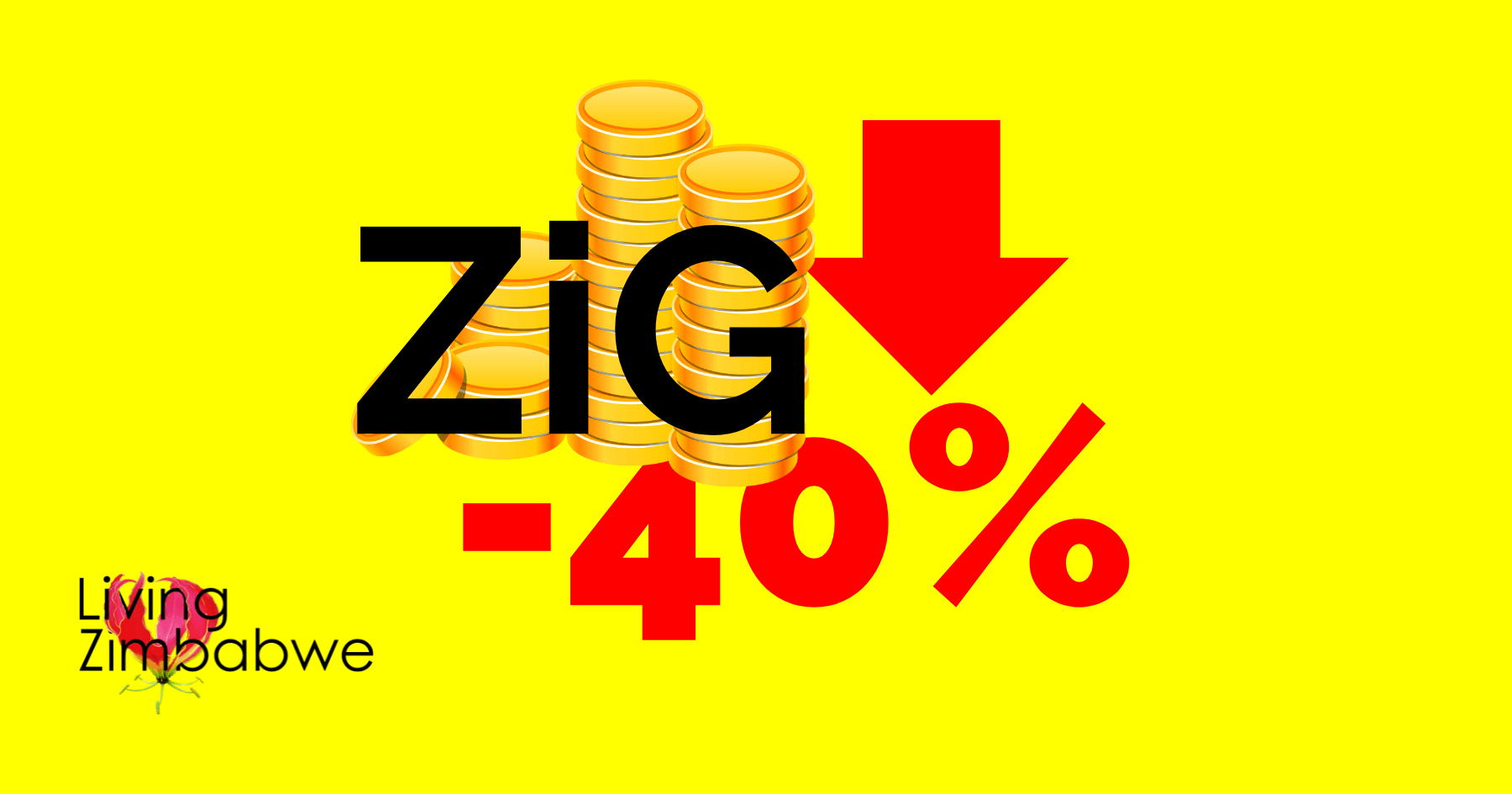
    For people on the ground, the most significant impact was the devaluation of the ZiG from US$1:13.5 to US$1:25. This move knocked just over 40% off the value of the ZiG (The Zimbabwe Gold (ZiG; code: ZWG) just under six months after its introduction as official currency in April 2024). So, from one day to the next, your money was worth a lot less than what it was (again!).

    Is the ZiG a Reliable Store of Value?

    This begs the question, what’s the point of transacting in or holding the ZiG if it can be drastically devalued just like that? Many traders no longer (some haven’t for a while) accept ZiG and prefer to transact in the ‘stable’ US dollars. 

    The US dollar has for the ages been the world’s reserve currency but who knows how long that will hold with BRICS nations looking to establish a new currency? Where would that leave us USD addicted Zimbabweans? How would we trade and save?

    Protecting Wealth in an Unstable Environment

    The daily grind is not just about survival, it’s also about thriving and getting ahead financially. This is easier said than done especially in economies where decisions can take you backwards or almost wipe out possibly years of savings at no fault of your own. How do you build and protect your wealth?

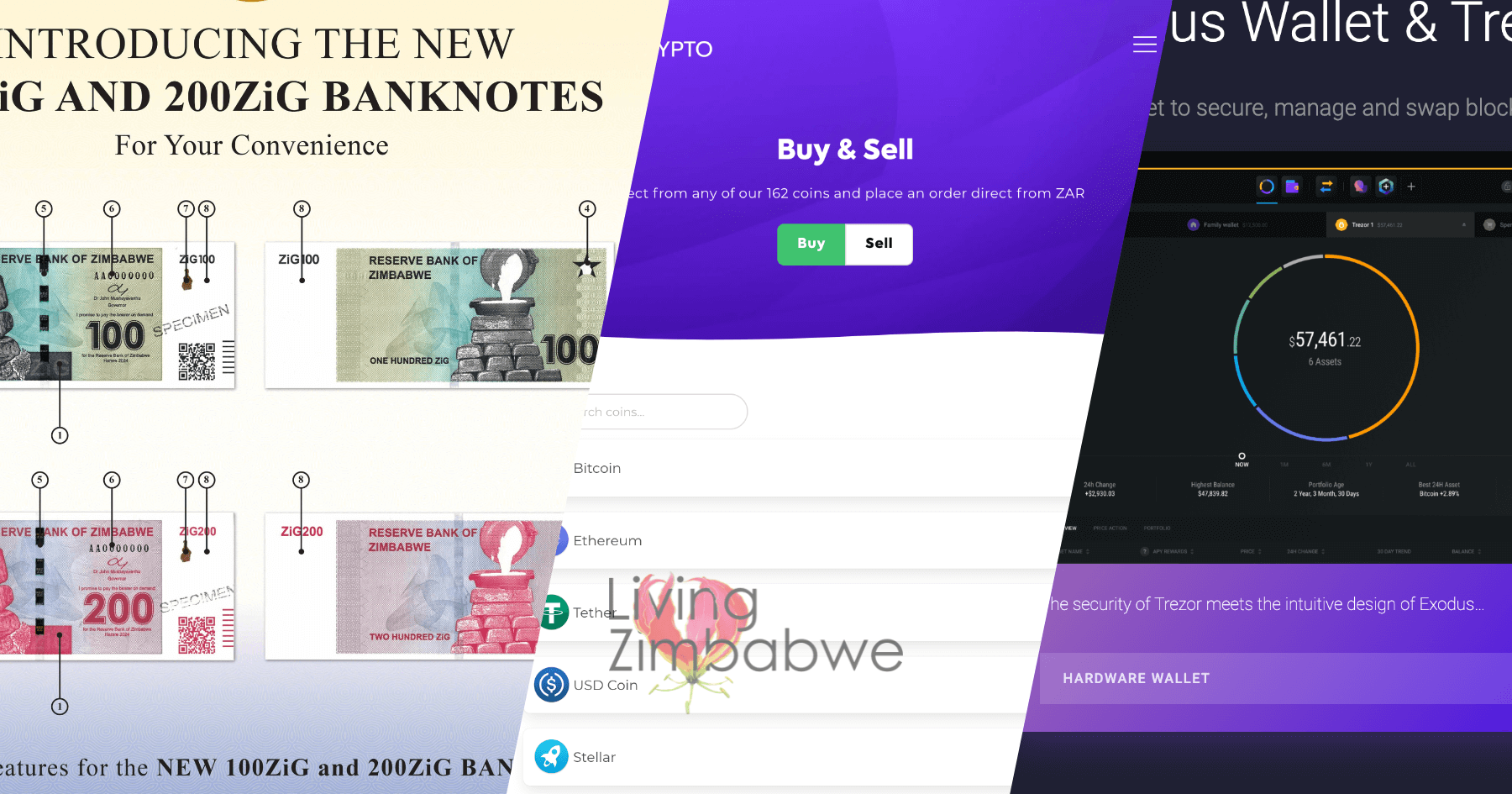
    Should Zimbabweans completely turn their backs on the ZiG and look to alternatives like the US dollar, physical gold, or cryptocurrencies like Bitcoin or stablecoins? These asset classes offer varying degrees of stability and growth potential, but each comes with its own risks. Read: Is it time for Zimbabwe to adopt Bitcoin, stablecoins and other cryptocurrency?

    Gold, for example, is a traditional store of value, especially in uncertain times. Cryptocurrencies like Bitcoin which are volatile are gaining attention for amongst other things being a hedge against inflation and government interference. Stablecoins, which are pegged to assets like the US dollar have the same advantages as crypto without the extreme price swings.

    Key Insights:

    • ZiG to USD: ZiG has devalued by 40% since its introduction in April 2024.
    • Zimbabwe Gold Price (per gram): Local gold prices increased by over 20% between April and September 2024.
    • World Gold Price (per ounce): Global gold prices have risen by 17.2% from April to September 2024.
    • Bitcoin: Bitcoin showed a slight decline (-3.23%) from April to September 2024 but had a substantial gain (+138.74%) from September 2023 to September 2024.

    Planning for the Future

    Time waits for no one and as it ticks along, we age. As we age, financial security becomes even more important, particularly with the potential for increased medical costs and reduced income in later years. Decisions made today about how to protect and grow wealth will have lasting consequences for the future.

    Not only should the short-term impact of currency devaluation be considered, but also a long-term strategy for wealth preservation. Is it better to move completely to US dollars? Is cryptocurrency the way to go? Or is it best to stick with the primary store of value, gold?

    What are you doing to protect your wealth and financial future in this unpredictable environment?

    Disclaimer: The content provided is for informational purposes only and should not be considered financial advice. These are ideas and suggestions for potential ways to preserve and grow wealth in the Zimbabwean context. Always consult with a qualified financial advisor before making any financial decisions.

    Resources

    Reserve Bank of Zimbabwe

    Mining Zimbabwe

    Gold Price

    Google Finance


  • Retirement Planning Considerations in Zimbabwe

    Retirement Planning Considerations in Zimbabwe

    The global elderly population is increasing, and while the Western world is generally better prepared for this trend with assets, retirement packages, savings, and investments, the situation in Zimbabwe is quite different. Many retirees in Zimbabwe lack substantial savings or secure retirementg packages, which creates a challenging situation. Even though some own homes, financial security is a significant concern due to dwindling savings and limited support from adult children.

    In past years, many pensioners have been left waiting for pensions that ultimately amounted to nothing. Several pension funds have failed to pay out dues due to various issues. These include hyperinflation, corruption, greed and poor corporate governance.

    Young people can learn important lessons from observing the retirement outcomes of previous generations. By examining these outcomes and comparing them to their current situation, they can better prepare for their own financial futures. It’s crucial for younger individuals to work hard during their prime earning years, ensuring they can cover their daily expenses while also saving for the future.

    Achieving a comfortable retirement requires diligent saving and investing, particularly for those without substantial assets. Savings can cover unplanned expenses like medical emergencies or car repairs, while investments can generate dividends later in life. Although it might be challenging, consistent saving and wise investment choices are essential for building a secure financial future.

    For those earning a base salary of $500 USD for example, balancing a fulfilling life today with planning for tomorrow can seem difficult. Increasing income is vital, and exploring various financial solutions tailored to individual needs is crucial. While creating a financial plan may be straightforward, executing it often proves more challenging. Persistence and proactive financial management are key to turning these plans into reality.

    All individuals, young and old should prioritise saving and investing, regardless of the current economic climate. Waiting for economic conditions to improve is not a viable strategy, you may be waiting for a very long time. Instead, focusing on actionable solutions like saving and investing is essential for long-term financial stability. 

    Developing a habit of financial prudence early on can significantly impact future financial well-being and see you well on the way to a worry-free retirement. 

    Have you ever considered Bitcoin, stablecoins and other cryptocurrencys as part of your wealth building strategy? 

  • Is it time for Zimbabwe to adopt Bitcoin, stablecoins and other cryptocurrency?

    Is it time for Zimbabwe to adopt Bitcoin, stablecoins and other cryptocurrency?

    The introduction of yet another new currency adds to the ongoing challenges of navigating Zimbabwe’s economic landscape. As history has shown, these moves have not often gone according to plan. The currency changes have led to the dollar losing its value and sky high inflation. The significant loses have affected peoples day to day survival and pensions have been literally wiped out. That is not to say that some have not benefited from the chaos. In times of chaos, there will always be a handful of people who will thrive. 

    The question now looms: what will this new currency bring? With money constantly shifting between different forms, it’s difficult to gauge the true value being lost in these transitions. This uncertainty begs another question: is it time to explore alternative financial strategies, such as adopting cryptocurrency?

    Cryptocurrencies like Bitcoin were designed to address some of the shortcomings of traditional currency systems. They offer decentralisation, putting control of assets directly in the hands of individuals rather than relying on centralised authorities like banks or governments. This means you have full autonomy over your wealth, independent of any single institution’s decisions.

    To add to that, cryptocurrencies operate on transparent public ledgers, ensuring that all transactions are visible and traceable. This transparency fosters trust in the system, which is especially crucial in regions where financial institutions may lack credibility. Some pundits put down TRUST as one of the major issues of Zimbabwe’s economic woes. There is NO TRUST in the government as far as what they will say or do with the money supply.

    One of the most attractive features of cryptocurrencies in Zimbabwe’s context is their potential as a hedge against inflation. Unlike fiat currencies that can lose value rapidly due to economic instability, many cryptocurrencies have built-in mechanisms to limit inflation, offering a more stable store of value over time. For example, in the case of Bitcoin, there will only ever be 21 million. Once that amount has been reached, that’s it! More Bitcoins cannot be mined or in the case of fiat currency, printed. 

    For Zimbabweans accustomed to trading in United States Dollars, converting some of those hard-earned dollars into cryptocurrencies Bitcoin or even a US dollar stablecoin such as USDT (Tether) or USDC (USD Coin) could be a consideration. A stablecoin is a cryptocurrency that is pegged to a currency, in the case of the latter, the U.S. dollar. By doing so, you’re essentially parking your funds in a more stable and potentially appreciating asset until needed. There are opportunities to earn passive income via methods such as staking (we won’t cover this here, please do some research if it is of interest to you).

    Despite the Zimbabwean government’s reservations about cryptocurrencies, there are ways for individuals to buy, hold, and transact with them. With the current state of the financial infrastructure, moving from fiat to crypto may require some creativity but, the process is relatively straightforward with the right guidance.

    Easy Crypto – A safe and easy Bitcoin & Cryptocurrency retailer 
    Exodus – Bitcoin & Crypto Multichain Web3 Wallet
    Trezor – Securely store, manage, and protect your coins with Trezor hardware wallets, app & backup solutions

    To get started, all you need is a cryptocurrency wallet. Software wallets like Exodus or hardware wallets such as Trezor provide secure storage for your assets and give you complete control over your funds. This self-custody (where you hold your assets in a wallet versus an exchange – think FTX!) is generally advisable. It minimises the risk of losing assets held on exchanges due to security breaches or regulatory actions.

    When choosing a cryptocurrency exchange through which to buy and sell crypto, it’s essential to opt for reputable platforms that prioritise security and compliance. Researching exchanges and understanding where your assets will be held is key to safeguarding your investments.

    Exploring cryptocurrency as part of your financial strategy could offer Zimbabweans a way to navigate economic uncertainty more effectively. By embracing the principles of decentralisation, transparency, and inflation resistance, individuals can take greater control of their financial futures. So, consider getting a wallet, signing up with a reputable exchange, and diving into the world of cryptocurrency to see what benefits it can bring to your financial well-being. With the right knowledge and tools, cryptocurrency adoption can empower individuals to thrive in challenging economic environments.

    Yes, we need money to live day to day, you may be in a situation where you have a few dollars to save or invest. What if you could put that money away into an instrument that you have full control over, where it holds value, and possibly increases in value over time? Imagine being able to transact 24/7, from wherever in the world, without limits and without having to queue up. What if?

  • What to do during Zimbabwe’s 21-day coronavirus lockdown

    What to do during Zimbabwe’s 21-day coronavirus lockdown

    Coronavirus, COVID-19 has gripped the world and pretty much brought it to its knees. As of writing, there have been 1,203,923 confirmed cases, 64,795 deaths and 247,273 recovered. It has spread around the world quickly with some parts being hit a lot harder than others.

    Zimbabwe has not been immune to the coronavirus scourge. As at 4 April 2020, there have been 9 confirmed cases and the unfortunate death of Zororo Makamba. There is no telling what the actual number of cases in the country is. A big question mark also hangs over Zimbabwe’s preparedness? Is enough testing being done (349 to date)? Will facilities cope with serious cases?  Do frontline staff have adequate personal protective equipment? And the questions go on.

    Governments around the world have taken measures such as closing borders and ordering their citizens to stay at home in an effort to slow the spread of the virus. Zimbabwe has followed suit with a 21-day lockdown which started on 30 March 2020.

    What to do during Zimbabwe's 21-day lockdown

    This was an unwelcome move for many simply because not being able to go to work means not being able to make money to feed themselves and their families. In developed nations, working from home is something that is possible for many but Zimbabwe isn’t quite there yet. 

    With the lockdown in place, many people who are usually leading busy lives now find themselves with a lot of time on their hands.

    Here are a few ideas on things to do during the lockdown. But first and foremost, stay home, stay safe, only go out only when you really need to and do all that you can to protect yourself, your family and your community.

    Look at this time as an opportunity to somewhat reset and do those things that you want to do that you don’t have the time to do. This may mean being more intentional about where and what time is spent on. If you find yourself wondering how to spend that time, here are some suggestions:

    Connect with family

    Many of you will find yourselves at home with family and possibly spending more time than you have all spent together in a long time, if ever. This is a golden opportunity for families to get to know each other. Couples can get to know more about each other. Families with children can spend some quality time together and create good memories for all to remember.

    Do also reach out to other family not living with you and friends to see how they are doing. If resources permit, connect with them via a video call.

    Reset personal and professional goals

    Take some time out to reflect and take stock of where you are in life and what you want to get out of it.  If after this you feel like you need to reset your goals, do just that.

    This exercise will include actions such as writing down your goals, pathways to achieving them, obstacles you may need to overcome and accountability.

    Goal setting is not limited to personal development goals. If you are in business or thinking about getting into business, it could be business goals. Couples as well can get together and do some goal setting.

    Here are some resources to get you started:

    Goal Setting: A Guide to Setting and Achieving Your Goals

    How to Set and Achieve Life Goals The Right Way

    How to Use SMART Goals: Achieve More in Less Time

    Learn a new skill

    There are many reasons why it’s a good idea to keep learning. These include keeping your mind challenged and learning new things to improve your life. You can look at it as a self-development opportunity.

    From a professional capacity, as you learn new skills or enhance your existing skills, you increase your value proposition. As you develop them and put them into practise, you will give people more of a reason to want to work with you.

    Udemy, one of the best online learning platforms has over 250 free courses across a range of topics such as personal productivity, coding, public speaking and more available.

    Start a free course on Udemy

    Exercise mind, body and soul

    During this time of crisis, fear and anxiety about coronavirus and the situation it has created can be stressful and overwhelming. That said, it is important to pay particular attention to your mental and physical wellbeing. The mind, body and soul are all connected and all need attention.

    Mind – it is very easy for your mental wellbeing (and that of those around you) to go into a downward spiral. It is important to be able to recognise that this may be happening and to take steps to support yourself. Things that you could do include acknowledging your feelings, talking to family and friends and limiting media intake.

    Body – take good care of you body by eating a healthy, balanced diet. Stay active and exercise regularly. ASICS Studio: At Home Workouts is currently free and offers a range of exercises that can be done at home – get it on Google Play or on the App Store. Last but not least, make sure to get enough sleep.

    Soul – maintain inner peace by doing things such as meditation, prayer, mindfulness or whatever it is you do to quiet your mind. Udemy has some free courses on meditation and mindfulness available.

    Indulge in your hobby

    If you have a hobby or hobbies, now is a good time to indulge yourself. Having a hobby has in benefits in that it takes you away from the day-to-day of life. Hobbies can help with reducing stress and developing your creative brain.

    If you need some inspiration, read this guide on How to Find a Hobby.

    The above are some ideas on what you can do to pass the time and keep your sanity. We hope this helps you get through the lockdown and get out of it with renewed and rejuvenated.

    Do you have any other suggestions on what to do during the lockdown? If so, leave a comment below.

  • Travel essentials to pack when visiting Zimbabwe

    Travel essentials to pack when visiting Zimbabwe

    Any sort of travel be it across town, from town to town, from country to country requires planning on how you are going to get from A to B. Whether travelling by road, air or over water for that matter, knowing details such as where, when, how, for how long, where to stay and so on and so forth work towards making the journey easier. All destinations are unique and in a way come with their own set of rules for visitors to follow and travel essentials to pack to make a visit more pleasurable.

    Zimbabwe is facing a raft of challenges which include but aren’t limited to problems with the supply of power, water, money and commodities. All of these put together sees the country operating on a day to day basis in its own unique way.

    Zimbabwe is open and welcoming to visitors and has plenty to offer its tourists. But, Zimbabwe’s daily challenges need to be kept in mind when planning a trip to the country. A slightly different set of travel essentials than when travelling to England, for example, would come in handy to make the trip easier. For example, you spend the day out and about using your phone to communicate, take photos, entertain yourself and the battery runs out. You then think to yourself that you’ll just wait until you get back to your accommodation but when you get there, there is no power. And then, you start thinking about the power bank that you have at home that you wish you had packed!

    Being prepared and having the right bits and pieces with you can make a trip easier. A checklist is a good way to start preparing for a trip. On it, you can list down everything that you think you will need to do or get for a trip. It will also help you stay organised, in that you can tick items off as you complete them. This also gives you peace of mind as you get closer to departure date and tick more items off the list that all bases are covered.

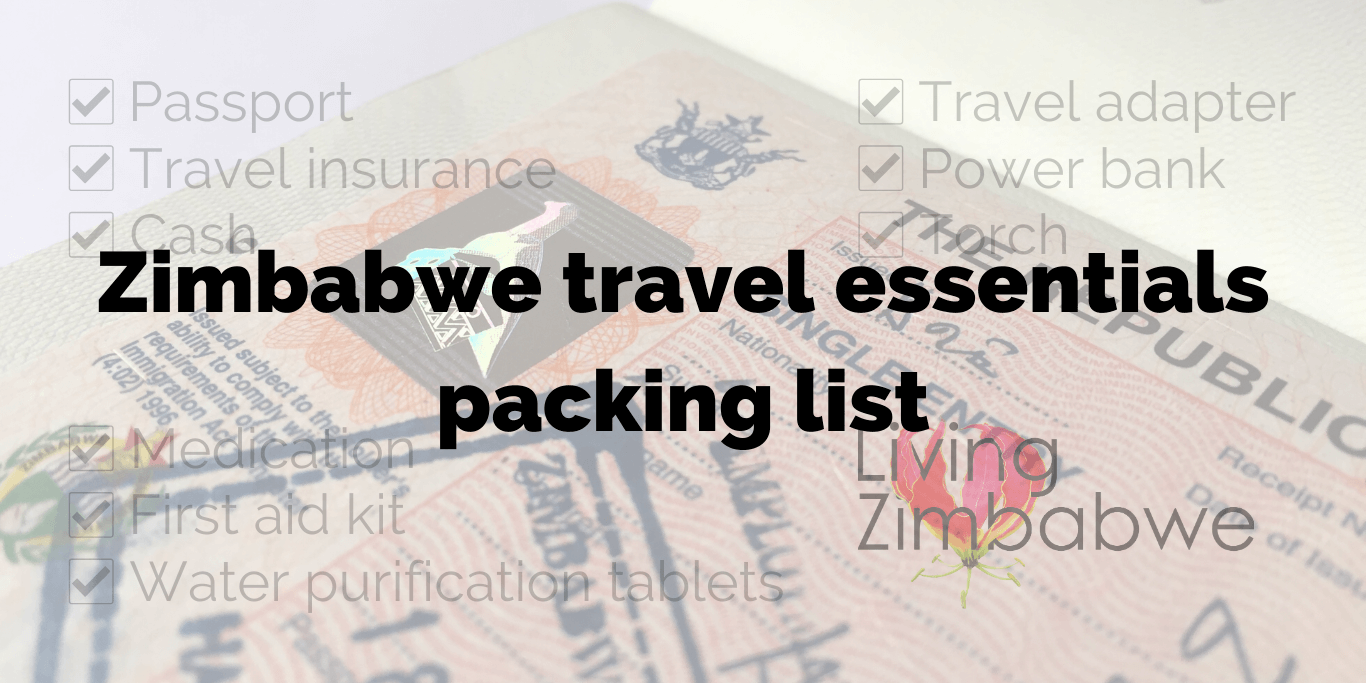
    Zimbabwe travel essentials packing list

    Below is a list to serve as a guide and it includes some essential items that may make a visit to Zimbabwe a little better. It is split into sections with a few items listed within each.

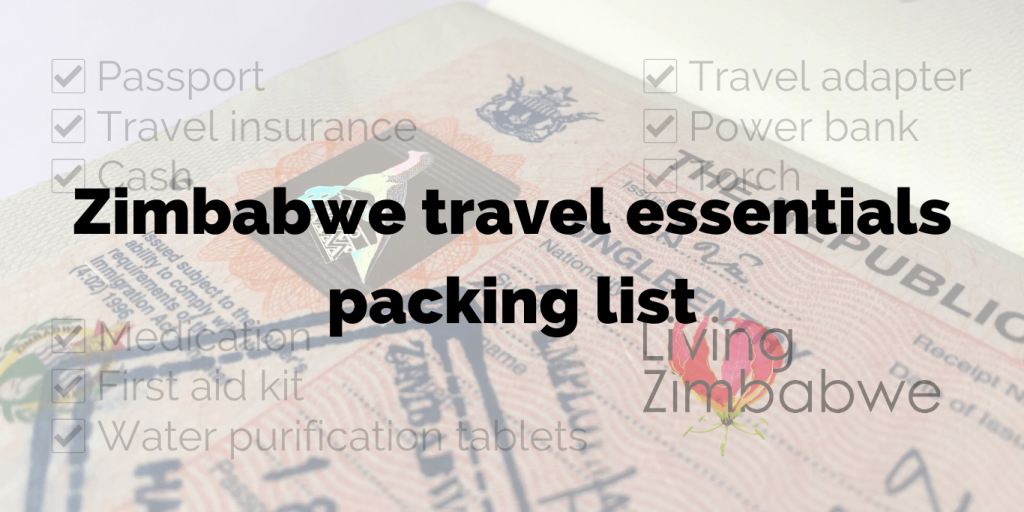
    Zimbabwe travel essentials packing list

    Disclosure: This post contains affiliate links, which means we may receive a small commission, at no cost to you, if you make a purchase through a link.

    Documents

    • Passport(s) – valid for at least six months from date of entry
    • Visa(s) – to see whether or not you need a visa to visit Zimbabwe, visit eVisa Zimbabwe (if that site doesn’t work, visit  IATA Zimbabwe travel documentation advice)
    • Travel insurance
    • Cash – low denomination US dollar notes are a good idea
    • Credit/debit/travel cards

    Clothing and footwear

    • Clothing – season-appropriate and activity appropriate clothing. Ask yourself what you will need if for example you will be out and about on safari and exploring or you will be mainly confined to a city?
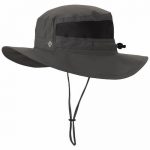
    • Columbia Unisex Bora Bora II Booney HatSun hat – there is plenty of sunshine to be enjoyed in Zimbabwe but too much exposure can cause a range of issues up to and including cancer. If you plan on being out and about a lot, a sun hat is a very good idea. Consider the Columbia Unisex Bora Bora II Booney Hat or –  If a brimmed hat is not your style, could consider an ELLEWIN Unisex Baseball Cap UPF 50

    • Hiking shoes – if you will be out and about exploring what the country has to offer
    • Microfibre towels – ‘conventional’ towels can be bulky and heavy whereas microfibre towels are lightweight, very absorbent and quick drying. They off all that you would expect from a towel without the bulk or weight and are perfect for travelling where you want to keep weight down

    Personal items

    • Toiletries (toothbrush, toothpaste, deodorant, moisturiser, etc.)
    • Vaccinations
    • Prescription medication
    • Sunscreen
    • Sunglasses
    • Insect repellent
    • First aid kit – it is always a good idea to have a decently stocked up first aid kit whenever you travel. You could sustain an injury at any time, and something that you can treat yourself or at least self manage until you get to a medical centre. A  100 Piece Small First Aid Kit for camping, hiking, backpacking and travel should do the trick.
    • Potable Aqua Water Purification Tablets With PA PlusWater purification tablets – tao water in Zimbabwe and many other parts of the world for that matter is questionable. If there are concerns and you don’t want to run the risk of contracting a waterborne disease make sure to pack water purification tablets. Potable Aqua Water Purification Tablets With PA Plus kills bacteria and Giardia lamblia making water suitable to drink in 35 minutes.
    Electronics/Gadgets

    Other

    • Fuel Siphon Hose Pump TubingFuel jiggler shaker siphon hose – This isn’t something that you would find on a conventional checklist. You could easily find yourself in a situation where you need to fuel up a vehicle and have a jerry can full of fuel but, no way to cleanly transfer it to the tank. With a fuel siphon hose on hand, you simply insert the pump end in the fuel vessel and the other in the fuel tank of the vehicle and shake the hose to get the fuel flowing.

    This is in no way an exhaustive list of items needed when travelling to Zimbabwe. It lists out some items that you may not consider but may be necessary. It is sectioned out into categories of items to pack and the downloadable list has spaces in it for you to list out your must-haves. We hope you find this helpful and that it makes planning your trip to and stay in Zimbabwe easier.

    Is there anything else not on the list that you think should be added it? If so, let us know by leaving a comment below.

    DOWNLOADABLE  TRAVEL ESSENTIALS CHECKLIST COMING SOON

    If buying items from US website but don’t have a way of getting them shipped to you wherever you are in the world, consider MyUS.com. You get a US shipping address that you ship your purchases to and they then forward the items to you for up to 80% off the usual shipping costs. Sign up for a Free membership trial and get 20% off your first shipment and, don’t forget to refer friends and get $10 shipping credit for each person you refer (no limit!).

  • How to get a Zimbabwe visitor visa extension

    How to get a Zimbabwe visitor visa extension

    Citizens from all over the world visit Zimbabwe be it for tourism, business or to visit family and friends. As far as getting into the country goes, some do not require a visa, whilst others are required to obtain a visa to enter the country. Zimbabwe visitor visa requirements depend on the nationality of the traveller and the category their country falls under.

    Zimbabwe’s visitor visa regime is split into 3 categories. Each category has different visa/entry requirements for the nationals within the categories. The specifics of the categories are:

    • Category A – visa not required to have a visa to travel to Zimbabwe
    • Category B – visa issued on arrival in Zimbabwe (fees apply) Category
    • C – visa to be obtained before travel to Zimbabwe

    For a list of the countries within each category, visit https://www.evisa.gov.zw/regime

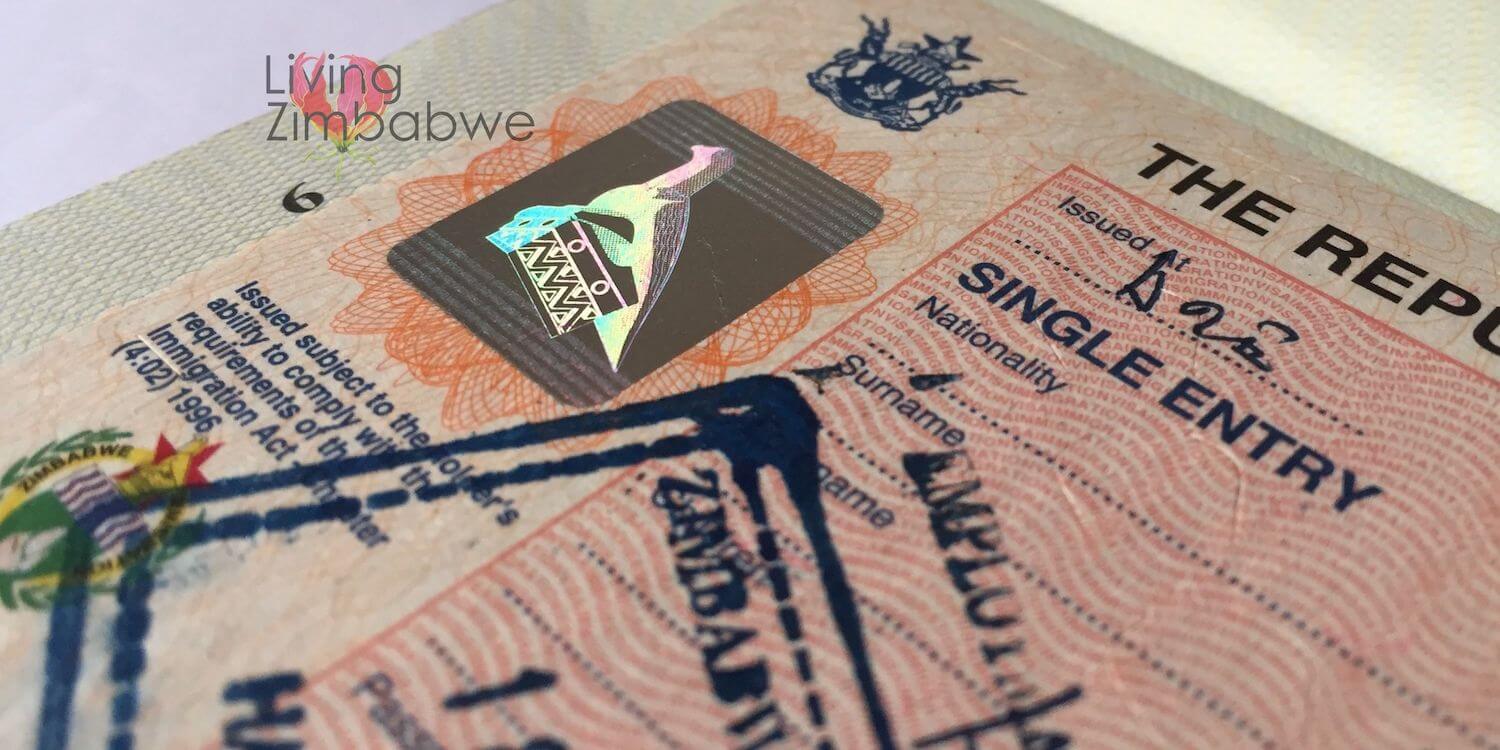
    Zimbabwe visitor visa single entry stamp

    According to visitor statistics, a large percentage of overseas visitors are nationals from countries that fall into Category B. That said, a large proportion of overseas visitors can travel to a port of entry, pay a fee and be granted a visa. The fees will vary depending on the number of entries required and in some instances nationality.

    On occasion, visitors may find themselves in a situation where they need to extend their stay past the expiry of their visa for one reason or another. For example, a Category B (visa on arrival) national granted a single entry visa into Zimbabwe can stay for up to 30 days. If they want to stay beyond the 30 day period and not be in breach of their visa conditions, an extension is required.

    Applying for a visitor visa extension

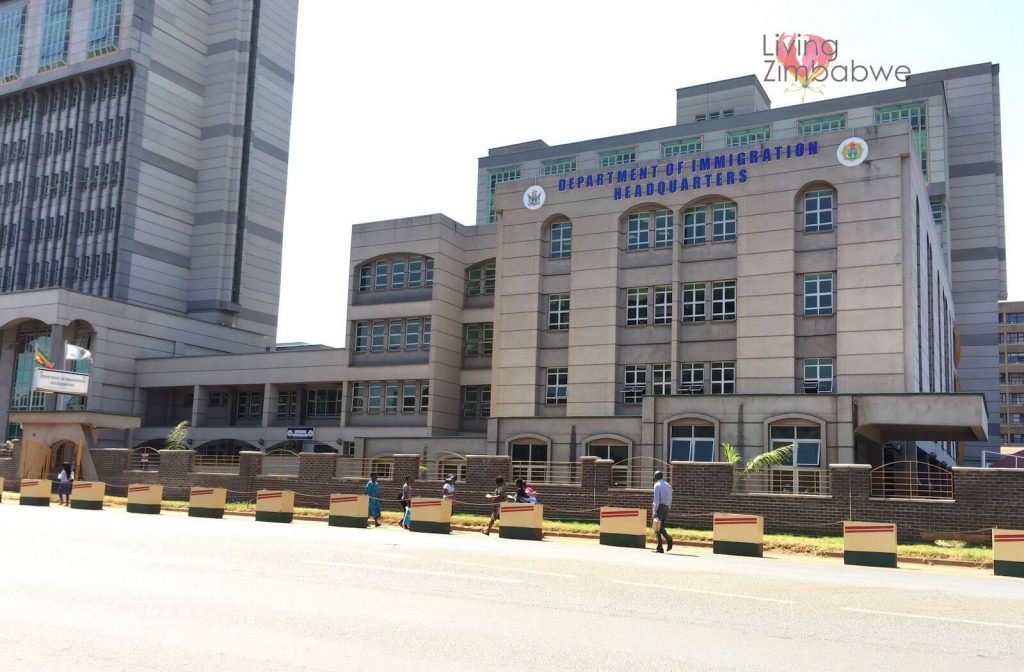
    In the instance of a Category B national, the process of getting a visa extension is relatively simple and straightforward. All that one needs to do is make their way to the Department of Immigration. In Harare, the Headquarters are located on the corner of Herbert Chitepo Avenue and Leopold Takawira Street. For other office locations, visit http://www.zimimmigration.gov.zw/index.php/ghjg).

    Department of Immigration Zimbabwe Headquarters corner Herbert Chitepo Avenue Harare and Leopold Takawira Street

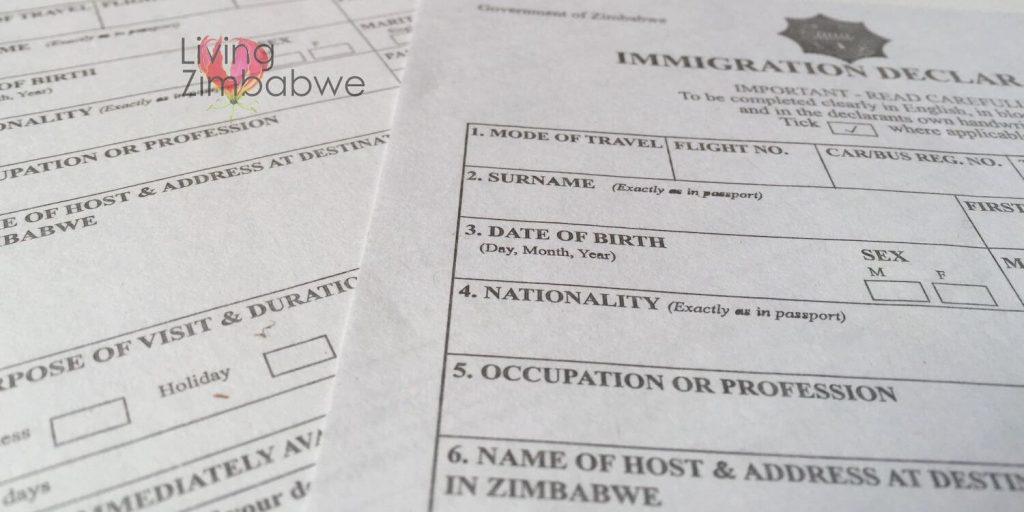
    The first step in the process is to get a Government of Zimbabwe Immigration Declaration Form and complete it accordingly. This is the form that visitors complete on arrival in Zimbabwe. If there is a chance of extending your stay, it may be a good idea to take extra forms on initial arrival.

    The next step is presenting the completed form and travel document to an immigration officer and informing them that you would like to extend your visa. They may ask a couple of questions as to why you would like to extend. All of that said and done, you will be granted with a 30-day extension.

    Government of Zimbabwe Immigration Declaration Form

    No payment is required to extend this type of visitors visa. So, do not be scammed into believing that you need to pay for an extension. Under no circumstances should you get and pay a third party to process the application for you. You can get two free extensions and after that, you will have to pay a fee.

    Note: This information is correct at the time of publishing. Fees, procedures and regime categories can change at any time at the discretion of the Department of Immigration.

  • How a grandmother keeps snakes away from her Harare home

    How a grandmother keeps snakes away from her Harare home

    Winter has pretty much come and gone and we are well and truly into the heat of things as far as the temperature is concerned. For cold-blooded animals such as snakes and lizards, this brings about the time to come out in full force and do what they do best. It is said that animals such as snakes go into hibernation (brumation to be more correct) in winter but do they really? The video below of a snake crossing a road was taken during winter:

    https://www.facebook.com/LivingZimbabwe/videos/2617643591594450/

    “The last thing that you want to do at the end of the day is get into bed and find a snake in your sheets”

    Those were the words uttered by a grandmother living on Harare’s city fringe. The area in which she lives has traditionally had a healthy snake population. On occasion, a snake would be seen around and sometimes in the house. On one occasion, her three-year-old grandchild spotted a snake that had made its way into the house. Thankfully, the child was instinctive enough to get out of the room as quickly as possible and raise the alarm without the child being harmed.

    In another incident, an acquaintance of hers told the story of an encounter her ‘garden boy’ had with a snake. In a small dim room lit by candlelight, as he was preparing for bed, something possessed him to look under his bed. To his surprise, he found a snake under his bed. A lot of commotion ensued with a lot of shouting and items being thrown at the snake which had now displayed its hood. All of this eventually led to the snake (which they identified as a cobra) being killed. As you can imagine this left him and others living on the property a little shaken at the thought of having been in such close proximity of a deadly snake for who knows how long?

    Incidents like these coupled with a seeming rise in the snake population the area prompted this grandmother to search for and put in place measures to try and keep snakes away.

    Reducing the snake population in the yard

    As a start, she decided to completely clean up her yard. This meant cleaning out those ‘things’ that find themselves piling up here and there. It also meant clearing up often neglected parts of the yard where grass and other vegetation are left to grow wild. By doing this, it took away places where snakes could hide.

    Another step was getting rid of the chicken run which was you can imagine is a snake magnet. Chicken runs offer the prospect of an easy meal with the poultry, eggs and as well as rodents that are also looking for an easy meal.

    Other steps that one could take to reduce the number of snakes in the yard include:

    • keeping the rodent population under control
    • keeping the frog population under control (especially so if you have a water body that they live in)
    • putting shade cloth on the perimeter fence (1m high and dug 30cm into the ground)
    • invite a snake handler to your property to identify possible areas that may attract snakes or where they may hide

    Repelling snakes with Garden Rue

    Garden-rue-Zimbabwe

    One recommendation from a friend and another third step that she took was to plant garden rue around the yard.

    Rue is a plant that many believe repels snakes. There are many people selling this and other plants and touting them as effective snake repellents.

    But, science tells us otherwise. These kinds of plants and other commercially available chemical repellents have strong smells that irritate human noses. A snakes nose and how they smell the world is very different from that of humans. This makes such repellents effectively useless.

    However, as far as this grandmother goes, after taking the steps above, she saw a marked reduction in the number of snakes spotted around her yard. As she took so many measures to control the snake population, there is no real way of pinpointing what the most effective method was or what worked or didn’t work. It may have all been a matter of chance? Whatever the case may be, she is sleeping a little easier.

    How do you deal with snakes that make their way onto your property? Leave a comment below.

    Here is some information that may come in handy if you ever encounter a snake

    What to do when bitten by a snake

    The first thing to do is to try and not get bitten. It is said that a big percentage of snake bites occur when people are trying to kill snakes. If you don’t have the necessary skills to handle a snake, leave it alone and get a hold of someone who does.

    If you or someone else is bitten by a snake, take the following steps:

    • get them to a hospital/trauma centre as soon as possible
    • keep them calm and as still as can be
    • take a photo of the snake (if possible) to aid in treating the snakebite
    • do not cut the bite area and try to suck out the venom
    • do not apply a tourniquet

    Who to call for help when you spot a snake in Harare, Bulawayo & Victoria Falls

    Whenever you come across a snake in an inhabited area and there is no safe and easy way for it getting away on its own, get help! There are a few snake handlers around the country who can be called upon.

    Zimbabwe Snake Handlers is good first port of call for all things ‘snake’ in Zimbabwe https://www.facebook.com/zimsnakers/. You can get in touch with them to find a snake handler in your area.

    The Lion Park & Snake World has a few snake removal contacts listed on their Facebook page and they include:

    Harare

    Ben Grainger 07771758682

    Chawatama Marimo 0772269647 https://www.facebook.com/chawaman/

    Daniel Van Tonder 0775707118

    Ben Vermeulen – Reptile Rescue 0772275550 https://www.facebook.com/Bens.reptile.rescue/

    Steven Shearer 0776825983

    Bulawayo

    Ahmed Esat 0775714014

    Christopher Burton 0772162815

    Norman Crooks 0778730145

    Ross Johnston 0778547331

    Christopher Burton 0772162815

    Norman Crooks 0778730145

    Ross Johnston 0778547331

    Victoria Falls

    Abraham Singano 0782894732

    Devine Matemba 0774020853

    Paul Teasdale 0772368010

    Stuart Danks 0772302747

    Some interesting facts about snakes

    • Zimbabwe has 81 different types of snakes
    • 13 species are potentially deadly 
    • Ophidiophobia is the fear of snakes. Ophis, Greek for serpent
    • The black mamba is considered the most dangerous snake due to its size and very potent venom
    • Puff adders are responsible for most snakebite deaths

    Featured image source: Snouted Cobra by Steven Gilham– Under Creative Commons license

  • Learn to code and be part of Zimbabwe’s digital transformation

    Learn to code and be part of Zimbabwe’s digital transformation

    Strive Masiyiwa recently put out a piece on a range of activities that he is carrying out in Botswana. One of them was the set up of a school run through the Muzinda Hub Botswana where people learn how to code. The school aims to equip students with tech skills and business acumen to set them up for success in the digital economy.

    Some interesting statistics mentioned about Muzinda Hub:

    • Since its launch in 2014 alumni have earned US$120 million-plus as freelancers
    • Alumni earn $1500 per month on average

    Students enrolled in the Zimbabwe training program take five months to complete the course. Upon completion, participants are equipped with skills in various programming languages. These include; Python, PHP, HTML, CSS, JavaScript, WordPress and more.

    Some of the most in demand programming languages

    Disclosure: This post contains affiliate links, which means Living Zimbabwe may receive a small commission, at no cost to you, if you make a purchase through a link. 

    Tech jobs are currently in high demand worldwide. A number of reports show the need for software engineers outpaces the number of qualified developers.

    The good thing about a number of tech jobs is that they are location independent. There is no requirement to be in a specific physical location. To add to that, you can work full-time for a company or work for yourself as a freelancer. This flexibility means that one could even take on tech jobs as a side hustle in addition to a 9 to 5. All that you need to work is the right skills, a computer, internet connection, software (a lot of which you can get for free), and the right mindset.

    Armed with the right set of skills, the world is your oyster as far as job opportunities are concerned. If you play your cards right and manage to get clients outside of the country this is guaranteed payment in foreign currency. Considering our current economic conditions, setting yourself up to earn in forex is not a bad idea at all.

    An example of a developer who has taken his knowledge of coding to the next level is Gwinyai Nyatsoka. His passion for code led to him creating an online course on Udemy, iOS 12 & Swift 5 – App Design, UI/UX plus Development. This bestselling course has over 2000 students enrolled. It costs $199.99 to enrol in the course but on occasion, you can get a discount of up to 90%+ off.

    In Gwinyai’s instance, he has used his skills to set up a successful digital agency and create a course. With regards to the course, it would have taken a considerable amount of work to set up it. But, it is now at a stage where each enrolment is earning him passive income.

    You may now be thinking that it’s a good idea to have coding skills under your belt. Now comes the question of what to learn and where to learn how to code?

    What are the best programming languages to learn?

    There are a host of programming languages out there to choose from. This can make it confusing to know what to start your learning journey. We looked through a handful of reports and publications from those in the know in the programming and gig economy world. From this, we compiled a list of the five most popular or most in-demand programming skills featured across the lists. In no particular order, the skills are:

    Java – one of the most popular programming languages which is widely used for back-end development and Android app development.

    Python – an easy to learn general-purpose programming language that can amongst other things be used for web and/or software development and mathematics.

    JavaScript – the most widely used scripting language and the core language of the web used to create dynamic websites.

    C++ – used for system and application development and more so those where speed and efficient memory management are critical.

    PHP – a server-side scripting language used to build dynamic web applications.

    Bonus: SQL – even though it is technically not a programming language, SQL makes the list due to it being in high demand. Structured Query Language (SQL) is used to communicate with databases and perform tasks such as storing or retrieving data.

    Where to learn to code in Zimbabwe?

    If you want to learn how to code, Muzinda Hub is a good place to start. As mentioned above, they run a 5-month course that equips you with skills in coding. There are a couple of other players (who you can find via a quick Google search) in the market where you can learn how to code.

    For one reason or another, what is on offer locally may not be suitable. If you find yourself in that situation, this isn’t the be-all and end-all.

    A good place to look for and enrol in coding courses is Udemy. Udemy hosts a number of coding courses taught by experts in their field. A good thing about the platform is that once you enrol in a course, you have lifetime access – there is no subscription or annual fee. Here are some courses (perfect for beginners) to consider enrolling in: (note: most of the courses are listed close to the $200 mark. On occasion, you can get a discount of up to 95% off. Simply head over to Udemy via the links below and if a discount is available, it will automatically reflect)

    Where to get a job with your coding skills

    Armed with your new set of skills, the next step is to find work. Getting work with an established may be easier said than done as many of them may want someone with experience.

    To get experience consider signing up as a freelancer on marketplaces such as Fiverr or Upwork. Both marketplaces list thousands of jobs across a range of categories thus increasing your chances of getting work.

    You can bid for jobs and over time, build a portfolio that leads to bigger, better and higher-paying jobs.

    Getting paid is simple and easy and the best way would be through Payoneer. The good thing about Payoneer is that you can get paid in multiple currencies. Funds can be withdrawn into local bank accounts but for us here in Zimbabwe, that may not be the best. The best option would be to get a Payoneer Prepaid Mastercard and use the funds as you see fit. (if you are considering signing up for a Payoneer account, make sure to do so today. It takes them a few days to review and approve applications)

    Whether it be as an avenue towards a career in the tech industry or an area that is of interest for you, being able to code has its benefits. It wouldn’t hurt to invest a little time and money in yourself and work towards something that could lead to a better you.

    There is no better time than the present to learn how to code!

  • Was the January 2019 Shut Down Zimbabwe protest worth it?

    Was the January 2019 Shut Down Zimbabwe protest worth it?

    On 12 January 2019, President Mnangagwa announced that the government had decided to raise the fuel prices by more than 200% with petrol pump price being set at $3.33 per litre and diesel at $3.11 per litre. This he said was put in place to address the fuel shortage and illegal currency and fuel trading activity in the black market. This was also the day that the Zimbabwe situation became a lot more interesting.

    The next day, Pastor Evan Mawarire and Peter Mutasa (President of the Zimbabwe Congress of Trade Unions) put out a call for the people of Zimbabwe to stand together and reject all that is happening in the country such as the fuel increases and the bond note. They called for a national stay-away #SHUTDOWNZIM on the 14th, 15th and 16th of January.

    https://www.facebook.com/evan.mawarire/videos/10155999900212043/

    The shutdown went ahead with many people deciding to stay at home. For some, they really didn’t have a choice as they found themselves in a situation where they couldn’t afford the combi fares which had jumped quite significantly as a result of the price hikes.

    As the day progressed, what was supposed to have been a stay away or peaceful protest quickly escalated into something else! Those who had made their way into the city centres found themselves making a hasty exit as the situation started getting chaotic. Not before long, things, started turning violent in various areas with the armed forces having to step in to restore order.

    Many people’s lives were changed forever last week. A range of activities took place which includes:

    Looting

    Damage to property such as buildings and vehicles

    Beatings causing serious injury to scores of people

    Loss of life

    Days of lost productivity that has amounted to millions; with Sifelani Jabangwe (President of the Confederation of Zimbabwe Industries (CZI)) putting that figure for the three days at $300 million???

    https://www.facebook.com/TheHeraldZimbabwe/posts/1987239244687947

    Fake news/updates being spread

    https://twitter.com/CitizensForumZW/status/1086931111123533825

    Internet being shut down or social media platforms being blocked due to ‘security concerns’

    Soon after making the announcement on the fuel price increase, President Mnangagwa made his way to Russia aboard a Boeing 787 Dreamliner Deer Jet charter. Chartering that particular aircraft is said to cost an astronomical US$74,000 per hour.

    Russia was the first stop of a multi-nation trip was to also include attending the World Economic Forum in Davos. But, due to the situation at home, the president decided to cut the trip short and fly home to restore calm. And then again, there were messages being passed around pointing towards a possible coup attempt (fake news?).

    That said, if we look at the almost 12-hour flight from Astana, Kazakhstan to Harare, it would have cost the government US$888,000! Does this get you thinking? Were there no cheaper options available? Could Air Zimbabwe have been an option for the trip with the money being spent in the country versus it going to an entity out of the country?

    The last week or so has seen a lot happen in Zimbabwe and all of it has been so disruptive in so many ways. As it stands, there is still uncertainty about the way forward. A lack of internet (or blocking of certain social media applications) which for many meant an almost total loss of communication created an ‘information gap’. This gap left people in a situation where they did not know what to do upon waking up some mornings; to go to work or not go to work etc.? As it stands, there are still a number of question marks with regards to the way forward because what we think is going on (or are told is going on) and what is really going on behind the scenes are completely different!

    As far as the international community is concerned, events that have taken place can’t bode well for us as far as attracting foreign investment goes. What do you think an investor would say if you were to approach them today and say that Zimbabwe is open for business?

    People have returned back to their day to day life. Their situation is as it was more than a week ago, if they were broke, they are still broke! If they were managing to get by, they will probably still be managing to get by! If they were sitting pretty, then they are still sitting pretty! However, regardless of one’s socioeconomic status, living Zimbabwe is becoming more challenging.

    So now we ask the question, was the #ShutDownZim protest worth it? Please do comment below!

  • How to use dirty Zimbabwean US Dollars outside Zimbabwe

    How to use dirty Zimbabwean US Dollars outside Zimbabwe

    Zimbabwe’s economy is definitely an interesting one with the multi-currency system, shortage of foreign currency and the trending away from Bond notes. With the multi-tiered pricing and recent shortages, one thing that has stood out is that cash is king and more in particular, US dollars.

    It is no secret that a large percentage of the US dollar notes in circulation have seen better days. One does begin to wonder how some of the notes are accepted for payment? With the USD being a global currency, it is one that is accepted for trade worldwide. But, this is not quite the case with our dirty ‘Zimbabwean’ US dollar notes.

    Dirty-Zimbabwean-US-dollar-notes-Living-Zimbabwe

    Disclosure: This post contains affiliate links, which means we may receive a small commission, at no cost to you, if you make a purchase through a link.

    TechZim recently wrote an article about their experience of not being able to change some of their ‘Zimbabwean’ USD at various Bureau De Change outlets in South Africa. Other travellers have had similar stories to tell where they were not able to change their dirty money in other parts of the world be it at a bank or currency exchange outlet.

    People travelling out of the country need foreign currency to pay for food, accommodation, shopping sprees or whatever it is they have travelled for. For many, the only cash that they have at hand or access to is the dirty US dollars that have done their rounds. Not being able to change their currency or have it accepted as payment leaves them in a situation where their money is worthless outside of Zimbabwe.

    Once you reach this point, it may seem as if all is lost as far as the seemingly worthless money goes. But, this isn’t quite the case as there is a solution that will revive the value of your notes for use outside the country.

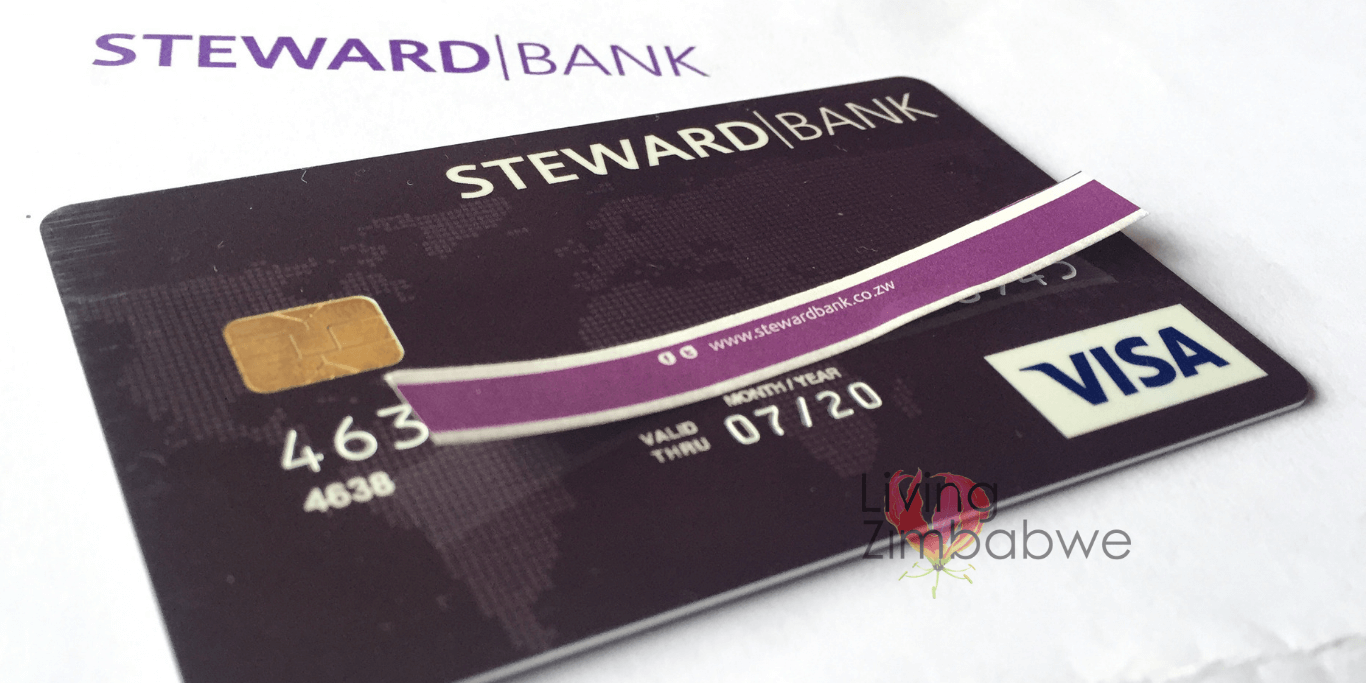
    Steward Bank Globetrotter Visa Card

    Steward-Bank Globetrotter-Visa-Card-Living-Zimbabwe

    A friend recently told us about how he manages to make use of his dirty money when travelling out of the country. His simple solution was the Steward Bank Globetrotter Visa Card.

    This pre-paid VISA card which is available to Steward Bank and non-Steward Bank customers is one that the cardholder funds in foreign currency. Applying for the card is simple and straightforward with all that’s needed being, a completed application form, copy of ID, proof of residence and a US$10 card issuance fee. To fund the card, deposits can be made into the card at a Steward Bank branch, Steward Bank agent or Econet Shop.

    Our friend produced a few US dollar banknotes (the ones pictured above), some of which we thought would not be accepted by the bank due to them being extremely tattered. But, to our surprises, they were accepted for deposit, no questions asked!

    With the money loaded onto the card, it was now in a form where it could be used anywhere in the world or online where Visa is accepted.

    Do you have any other ways of converting dirty US dollars into a useable form?

    Get (or send) money from the diaspora through WorldRemit – Pay ZERO fees on your first money transfer!