Tag: Internet

  • The real cost of free WiFi in Zimbabwe

    The real cost of free WiFi in Zimbabwe

    Zimbabweans and Zimbabwean businesses are becoming more and more connected to the world wide web. This is a good thing because increased connectivity opens us up even more to a world of opportunity. To add to that, from a business point of view, increased connectivity (more so broadband) can increase business process efficiency. But, that said, connectivity costs in Zimbabwe are comparatively higher than those in other countries in the region which makes access somewhat restrictive to the everyday Zimbabwean.

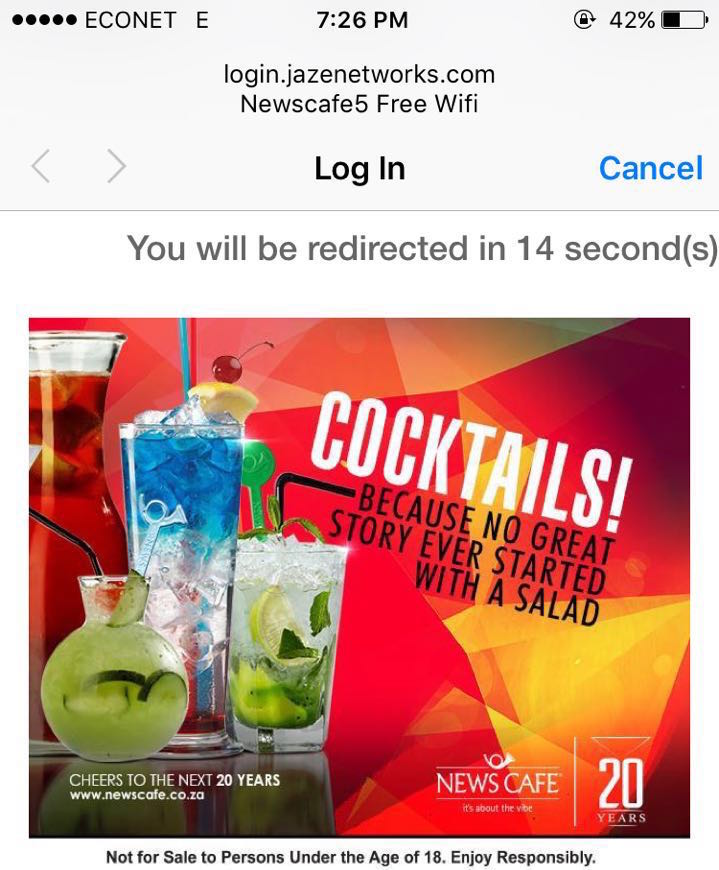
    A number of establishments are as part of their service offering, providing customers with free WiFi. There may however be conditions of use which may include limits on the amount of data available. Or, you may be forced to view an advertisement such as is the case with using the free WiFi at News Cafe.
    (continued below)
    Free-WiFi-News-Cafe-Harare-Zimbabwe-Advertisement-2

    Having free access to the internet would have many jumping for joy, with the cost of having to view an advertisement or having limited data being a small price to pay. But, at the end of the day, the cost of connecting to a free WiFi connection may be much more than you bargained for.

    The risks of using free public WiFi

    When you connect to free WiFi, you don’t know how secure the network is and who else is connected to it. There may be a hacker lurking around who manages to position themselves between you and the WiFi network (Man-in-the-middle attack (MitM)) and gets access to all traffic, therefore ALL the information sent between you and the internet.

    An even more dangerous method that hackers could use when you connect to free WiFi is malware. This is where they install infected software onto your device. The malware can potentially give attackers full access to your device and can take over everything that you do online.

    Once a hacker has a hold of the information that they need, they are free to do the damage that they need to. They could potentially clear out your bank accounts and whatever other damage they may feel they need to inflict depending on what they find.

    How to protect yourself

    The best way to protect yourself on free WiFi is to not connect to a free network in the first place. If that for you is easier said than done, there a options to secure your information and device. One thing to note is that some publications may say that you are safe if accessing an HTTPS website but, with MitM, your data is still accessible to attackers.

    The best way to protect yourself is with a virtual private network (VPN) where all information transferred between you and the internet is passed through a secure tunnel where data is encrypted and out of the reach of attackers. For a brief explanation on what a VPN is, take a look at the video below or read: Become anonymous online with a VPN & prevent the Zimbabwe government from spying on you.

    https://www.youtube.com/watch?v=yC9hsjjvZ2g

    There are a number of VPN options to choose from and some of them come free. But remember, there can be a cost attached to free. As a start, you can take a look at PureVPN, Hide.me (both offer free plans with limited features) and Norton WiFi Privacy as per the video above.

    So, the next time you decide to connect to free WiFi connect, think about what it could really cost you if you don’t have security measures in place.
  • Become anonymous online with a VPN & prevent the Zimbabwe government from spying on you

    Become anonymous online with a VPN & prevent the Zimbabwe government from spying on you

    Over the last few weeks, Zimbabweans have been exercising their freedom of speech and especially so via social media and messaging platforms such as WhatsApp. All that you have to do is log into Facebook or Twitter where you will more than likely come across updates from friends expressing their sentiments on the situation in Zimbabwe. If it’s not them expressing their own sentiments then it may be them sharing various content from other Zimbabweans who have had enough. Even if you aren’t active on social platforms but are on WhatsApp, then you will probably have received an image or video of people expressing their feelings.

    Movements such as #ThisFlag which was started by Pastor Evan Mawarire may have been one thing that really got the fire burning. Using the Zimbabwe flag as a centrepiece, it inspired people to share their frustrations online by either uploading a video of them saying what they have to say or them being part of the movement by proudly displaying their Zimbabwean flag. This eventually led to a call to action being made for citizens of Zimbabwe being asked to shut Zimbabwe down and stay away from work because of inaction from the government.

    #ShutdownZim2016/#ZimShutdown2016 took place on 6 July 2016 and it saw city streets being deserted on a day where they would have otherwise been hustling and bustling.

    https://instagram.com/p/BHhDmh9juiW/

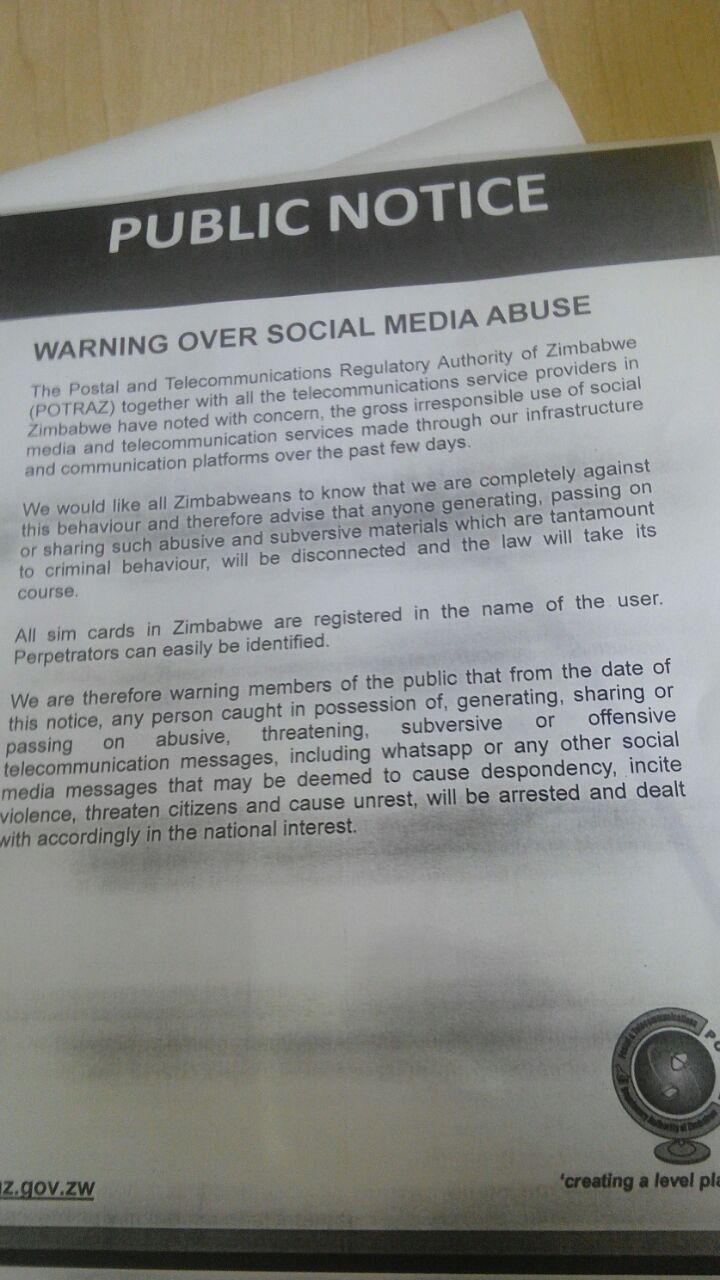
    All of this activity has not gone unnoticed by the government and other associated organisations. The government decided to act on the matter and released a statement via the Postal and Telecommunications Regulatory Authority of Zimbabwe (POTRAZ). The statement served to inform citizens that certain types of communications will not be tolerated in Zimbabwe and anyone caught with or distributing such would be dealt with accordingly. (continued below)

    Warning-Over-Social-Media-Abuse-POTRAZ

    An extract of the statement reads:

    “All sim cards in Zimbabwe are registered in the name of the user. Perpetrators can easily be identified. We are therefore warning members of the public that from the date of this notice, any person caught in possession of, generating, sharing or passing on abusive, threatening, subversive or offensive communication messages, including WhatsApp or any other social media messages that may deemed to cause despondency, incite violence, threaten citizens and cause unrest, will be arrested and dealt with accordingly in the national interest,”

    Strangely so, on the 6th of July, scores of people were not able to use WhatsApp. Was this the government showing that it has the ability to block various forms of communication in their interests? A tweet by Jonathan Moyo caused a bit of a stir as some people took it as an informal admission that there would be difficulties using WhatsApp.

    Whatever the case may be, as far as blocking certain services go, who knows what the government is or isn’t capable of doing? Internet traffic, yes, that is easy enough to monitor. But, services like WhatsApp do say they have end to end encryption which only works when all parties are using the latest version of WhatsApp. More often than not, groups messages aren’t secure. If only one person in the group has not updated their WhatsApp then messages within the group won’t be secure. Are you part of a group that frequently discusses and shares content that could result in your arrest?

    You never really know who may be monitoring your online activity and even with services that say they encrypt data, you can’t always take their word for it. The best thing you can do for yourself if you are concerned about the possibility of being spied upon by the authorities or other unscrupulous individuals online, is to install a VPN.

    What is a VPN (Virtual Private Network)

    Besides giving you a good layer of protection, a VPN which is a virtual private network does three main things and that is to keep you secure online, makes you invisible online and give you internet freedom (being able to access content and/or services that have been blocked by your service provider or government).

    It creates a secure tunnel (so to speak) between you and whatever you are accessing on the internet. A VPN hides your IP address and location and makes you appear as if you are in a location (country) different to where you actually are. It also encrypts your communication thus preventing, hackers, your ISP (internet service provider) and the government from accessing, tracking and monitoring you. Because it gives you the ability to choose your location, this allows you to use services that may otherwise become blocked in Zimbabwe.

    VPNs can be installed on Windows, Mac, iOS, Android and other devices that connect to the internet such as TVs and game consoles.

    How do I set up a VPN

    If you are technically inclined, it is possible to set up your VPN server at home. To set one up on your own, there is a wealth of information on Google on how to do this. Be aware that if the setup is not done correctly it can leave you vulnerable, leaving your IP address and data being visible to prying eyes.

    The other way of setting up a virtual private network is through one of the many VPN providers put there. Most of these providers offer easy setup options that will see your network up and running in only a few clicks. Most of them do come at a cost but some offer free service options that will get you up and running. Hide.me and PureVPN.com offer free options that give 2GB data transfer per month.

    Now it’s time for you to take a look at your digital life and ask yourself, ‘is my data secure and is my online activity hidden from the government or anyone else who might want to spy on me’?

  • Become anonymous online with a VPN & prevent the Zimbabwe government from spying on you

    Over the last few weeks, Zimbabweans have been exercising their freedom of speech and especially so via social media and messaging platforms such as WhatsApp. All that you have to do is log into Facebook or Twitter where you will more than likely come across updates from friends expressing their sentiments on the situation in Zimbabwe. If it’s not them expressing their own sentiments then it may be them sharing various content from other Zimbabweans who have had enough. Even if you aren’t active on social platforms but are on WhatsApp, then you will probably have received an image or video of people expressing their feelings.

    Movements such as #ThisFlag which was started by Pastor Evan Mawarire may have been one thing that really got the fire burning. Using the Zimbabwe flag as a centrepiece, it inspired people to share their frustrations online by either uploading a video of them saying what they have to say or them being part of the movement by proudly displaying their Zimbabwean flag. This eventually led to a call to action being made for citizens of Zimbabwe being asked to shut Zimbabwe down and stay away from work because of inaction from the government.

    #ShutdownZim2016/#ZimShutdown2016 took place on 6 July 2016 and it saw city streets being deserted on a day where they would have otherwise been hustling and bustling.

    https://instagram.com/p/BHhDmh9juiW/

    All of this activity has not gone unnoticed by the government and other associated organisations. The government decided to act on the matter and released a statement via the Postal and Telecommunications Regulatory Authority of Zimbabwe (POTRAZ). The statement served to inform citizens that certain types of communications will not be tolerated in Zimbabwe and anyone caught with or distributing such would be dealt with accordingly. (continued below)

    Warning-Over-Social-Media-Abuse-POTRAZ

    An extract of the statement reads:

    “All sim cards in Zimbabwe are registered in the name of the user. Perpetrators can easily be identified. We are therefore warning members of the public that from the date of this notice, any person caught in possession of, generating, sharing or passing on abusive, threatening, subversive or offensive communication messages, including WhatsApp or any other social media messages that may deemed to cause despondency, incite violence, threaten citizens and cause unrest, will be arrested and dealt with accordingly in the national interest,”

    Strangely so, on the 6th of July, scores of people were not able to use WhatsApp. Was this the government showing that it has the ability to block various forms of communication in their interests? A tweet by Jonathan Moyo caused a bit of a stir as some people took it as an informal admission that there would be difficulties using WhatsApp.

    Whatever the case may be as far as blocking certain services go, who knows what the government is or isn’t capable of doing? Internet traffic, yes, that is easy enough to monitor. But, services like whatsapp do say they have end to end encryption which only works when all parties are using the latest version of WhatsApp. More often than not, groups messages aren’t secure. If only one person in the group has not updated their WhatsApp then messages within the group won’t be secure. Are you part of a group that frequently discusses and shares content that could result in your arrest?

    You never really know who may be monitoring your online activity and even with services that say they encrypt data, you can’t always take their word for it. The best thing you can do for yourself if you are concerned about the possibility of being spied upon by the authorities or other unscrupulous individuals online, is to install a VPN.

    What is a VPN (Virtual Private Network)?

    Besides giving you a good layer of protection, a VPN which is a virtual private network does three main things and that is to keep you secure online, makes you invisible online and give you internet freedom (being able to access content and/or services that have been blocked by your service provider or government).

    It creates a secure tunnel (so to speak) between you and whatever you are accessing on the internet. A VPN hides your IP address and location and makes you appear as if you are in a location (country) different to where you actually are. It also encrypts your communication thus preventing, hackers, your ISP (internet service provider) and the government from accessing, tracking and monitoring you. Because it give you the ability to choose your location, this allows you to use services that may otherwise become blocked in Zimbabwe.

    VPNs can be installed on Windows, Mac, iOS, Android and other devices that connect to the internet such as TVs and game consoles.

    How do I set up a VPN?

    If you are technically inclined, it is possible to set up your VPN server at home. To set one up on your own, there is a wealth of information on Google on how to do this. Be aware that if the setup is not done correctly it can leave you vulnerable, leaving your IP address and data being visible to prying eyes.

    The other way of setting up a virtual private network is through one of the many VPN providers put there. Most of these providers offer easy setup options that will see your network up and running in only a few clicks. Most of them do come at a cost but some offer free service options that will get you up and running. Hide.me and PureVPN.com offer free options that give 2GB data transfer per month.

    Now it’s time for you to take a look at your digital life and ask yourself, ‘is my data secure and is my online activity hidden from the government or anyone else who might want to spy on me’?

  • Broadband in Zimbabwe Coming of Age

    People in Zimbabwe love being on their cell phones. To see them in action all you need to do is walk on the streets of Harare and you will see that every Tom, Dick and Chikwama has a cell phone and a number of them are using it. People are beginning to access the internet more and more both via computers or a 3G mobile phone if they are lucky enough to have a 3G subscription and be able to afford Econets monthly subscription fee. There are however some spots in Harare where you can get free Wi-Fi access. These include the Harare Information Centre at Unity Square and a major hotel (whose name I will not mention for obvious reasons) in the city whose network you can access but may not actually be free. It is not rare to find people sitting outside HIC or in the hotel parking lot and taking advantage of the free connection.

    However, using the internet in Zimbabwe is an extremely painful process especially if you are accustomed to using broadband connections that are reasonably fast (lets say 10-25 Mbps). Even if you connect to a number of broadband connections you disconnect a while later disappointed that you didn’t achieve what you wanted to or could have achieved. It’s after experiences like that that you get to appreciate fast connections. It is then that you also get to have a bit of an idea about what people mean when they say that in a business setting, internet connection speeds have effects on efficiency and productivity.

    The country does seem to be moving in the right direction and working towards making fast and reliable internet a reality. As already mentioned you can connect to the web via Econet’s 3G network if you were lucky enough to get your hands on a connection before the suddenly stopped signing up new subscribers. It has been reported that Econet is laying down their own fibre optic cables as well as launching a 4G network. Information Technology Minister Nelson Chamisa also recently announced that Zimbabwe have started laying down a fibre optic link that would connect Zimbabwe to the Beira under-sea cable. If this project does go to completion it will be welcome news for all who access the internet as it could lead to true broadband being available. The only question that stands if it does happen is that of how much it will cost. At the moment accessing the internet is not cheap. You can visit various ISP websites such as ZOL, Africa Online or YoAfrica just to name a few.

    These are all very exciting developments that will have a number of positive flow on effects. Telecoms penetration rates are high in Africa and this could present a number of investment opportunities for locals, Diasporans and foreigners who want to cash in on what Zimbabwe has to offer. Please don’t take cashing in to me people literally taking advantage off, cashing in and running away after leaving a big mess. Cashing-in in this context could mean returns on capital investment or profits on sales of devices perfect for mobile browsing such as netbooks, smartphones and the recently released iPad.

    Are you going to take part in the internet revolution that is about to hit Zimbabwe?