Tag: Rights

  • The Devil’s Advocate: What Price for Morality?

    The Devil’s Advocate: What Price for Morality?

    This piece was submitted on 15 December 2019 and was not published at the time due to a system error. Read it, leave a comment and share it with your tribe. The Living Zimbabwe Team.

    WR 29: THE DEVILS ADVOCATE: WHAT PRICE FOR MORALITY?

    Warmest greetings to you all despite the turbulent weather. In a week where we find ourselves in the midst of a fractious election, a particular topic has captured the imagination of a number of us, the ethics of a criminal defense attorney.

    Senior MDC member and [crucially] Masvingo Mayor Collen Maboke is representing Zanu PF youth accused of violently locking a Bikita engineer out of his office recently. The same Maboke who was ordered by President Chamisa to step down as the mayor of Masvingo on allegations that he had defied the party position in which he stood against MDC Alliance preferred candidate Godfrey Kurauone during the mayoral elections.

    Maboke was also accused of making a pact with Zanu PF councillors in the elections that saw the ruling party’s Wellington Mahwende coming in as a deputy mayor [The two have since buried the hatchet and Chamisa has since given Maboke the green light to take up his office at the Civic Centre].
    ZANU-PF has chided MDC politicians who are lawyers for taking up cases of ruling party officials accused of corruption.

    Zanu-PF political commissar Victor Matemadanda expressed concern over the development as it comes at a time when the Zimbabwe Anti-Corruption Commission (Zacc) recently arrested Tourism Minister Prisca Mupfumira over the criminal abuse office.

    “At the moment, every person who is accused of being corrupt in Zanu-PF is being represented by an MDC lawyer, not your ordinary lawyers, some who are MPs and one wonders what moral ground they have when they talk about corruption.’’

    “Are they really fighting corruption, or they just fight for money,” Matemadanda said.

    Zimbabweans have also expressed their concern over the representation of corrupt Zanu-PF officials by the opposition.

    Several members of the MDC, who are lawyers, are representing under-fire Zanu-PF officials – from the party’s vice national chairperson Job Sikhala, who has been retained as Walter Mzembi’s lead counsel, vice president Welshman Ncube who is representing former VP Phelekezela Mphoko. Mphoko is now suing Ncube for allegedly “neglecting” to transfer more than US$1.4m (R20.7m), part of an amount awarded to Mphoko and his son Siqokoqela after a protracted ownership battle for retailer Choppies Enterprises Ltd., and Tendai Biti who at one point represented former Reserve Bank governor Gideon Gono.

    Now, there is controversy about whether lawyers aligned to the MDC – which is a proponent of punishment for alleged Zanu-PF thieves – can mount a defence as to why the same alleged thieves should not go to jail.

    CASE FOR THE DEFENCE

    Defense lawyers are ethically bound to zealously represent all clients, those whom they think will be justly found guilty as well as those whom they think are factually innocent. A vigorous defence is necessary to protect the innocent and to ensure that judges and citizens—and not the police—have the ultimate power to decide who is guilty of a crime.

    A defendant may have done the act in question, but the client may have a valid defence that would exonerate him. For these reasons, among others, defence lawyers often do not ask their clients if they committed the crime. Instead, the lawyer uses the facts to put on the best defence possible and leaves the question of guilt to the judge or jury.

    The things you have to realize are (1) A person is innocent until proven guilty (usually beyond a reasonable doubt), (2) the government has unlimited resources at its disposal to prove a case, (3) prosecutors, judges, juries are all human beings, and not infallible and (4) there is a moral obligation to uphold the rights of all, especially the unpopular.

    The job of a lawyer is to ensure the government, from the arresting officer to the prosecutor, follow the rules that govern the criminal justice system. These rules are to protect the citizens from overreaching by the police and prosecutors. It’s a check against government power.

    “Whether the client is in fact guilty or not” is a common theme in anti-justice system arguments. First, your client is not guilty until proven otherwise. Second, just because someone thinks you’re guilty does not make them guilty, nor does it make them less deserving of their civil rights.

    You might think that shady-looking fellow “looks guilty” and fortunately, that’s not a reason to incarcerate someone. People can be mistaken, they can be wrong, they can have it “in” for your client, they can make errors along the way or they can be so blinded by vengeance, that they will want to punish a likely culprit, even if it’s not the correct person. As the accused’s lawyer, you have a moral obligation, both to your client and to the justice system, to ensure that none of that happens.

    ‘’It is the duty of a lawyer to accept any briefs in the Court in which he professes to practice provided the proper professional fee is offered unless there are special circumstances which justify his refusal.”
    ” A legal practitioner is obliged to accept the brief from the client….(he) is not only bound to accept the brief, he should put his best in discharging his responsibilities towards the cause. The rationale behind this rule is that legal practitioners should not pick and choose briefs they should handle in court. As officers of the court, they are not at liberty to select the cases to appear in since the primary duty of a legal practitioner appearing in a case in court is to assist the court in arriving at a just decision.

    The fact that a case is unpopular or that a client has a very bad criminal record or public record or that the legal practitioner believes that the accused person is guilty, may not justify his refusal to accept the client’s case. (This) …cab rank rule is mostly applied in criminal cases to prevent accused persons from being denied legal representation by lawyers owing to their bad record… “

    Below is an argument presented by my lecturer when l asked him this thorny question:

    ‘’Say you’re an A&E doctor. Into the A&E one night is wheeled a gang member who has just been shot in a gunfight and is bleeding out. The gang member himself is a bad man, and you hear he shot an innocent person in the gunfight himself. You may feel, morally, that he deserves punishment, deserves the gunshot, maybe even deserves to die.

    Do you let him die?

    Not if you’re an ethical doctor. You do your absolute bloody best to save the no-good’s life, because that’s your job. Judging him is up to the courts and to God. If you let him bleed out, no matter how bad he is, you have failed him, you’ve cheated him, and you’ve cheated yourself. You’ve even cheated the courts, because it was their right, not yours, to decide his punishment.’’

    There’s a reason that Maimonides’ Oath says, “May I never see in the patient anything but a fellow creature in pain.”

    Lawyers are the same way. We don’t have to like our clients. We can morally disapprove of them. We can even send them to another lawyer if our dislike of them is so intense that we can’t protect their interests adequately. But so long as we represent them, we do our absolute best, because that’s our moral obligation, just like the doctor with the gangster.

    Everyone deserves a fair hearing, even people accused of the most heinous crimes, and whether or not they actually committed those crimes. Even if they did commit them. So the ethics of defence lawyers, if you want, are the defence of liberty, of everybody’s right to due process, equal protection, and other technicalities, namely, the fundamental law of the land and the rules for a fair hearing involved in the rules of criminal procedure, evidence and the like.

    MORAL ARGUMENT

    For those in private litigation practice, no lawyer has to take the case of any client if they do not wish to. If the lawyer doesn’t believe in the client’s case, they shouldn’t take it on — in fact, doing so might run them at risk of violating one or more of our professions Rules of Professional Conduct, since it’s hard to provide someone with the best representation if you honestly believe them to be in the wrong in the matter.

    Disclosure of interest

    When lawyers are consulted about matters in which they have a personal interest, they must explain that interest to the client. This will let the client decide whether or not they want the lawyer to continue working for them.

    If the personal interest is significant and a lawyer’s advice could be affected by it, the solicitor must decline to work for the client and advise them to look for another solicitor.
    I would argue that corruption, embezzlement, murder, terrorism and wholesale violation of human rights, is of significant personal interest to all democrats in the MDC and in particular its leadership.

    Conflict of interest

    Equally, a lawyer cannot work for a client when there is a conflict between the interest of the client and the lawyer. This also applies to other organisations that lawyers work for. Where there is a conflict of interest, lawyers must inform all of the clients involved. Even where there is only a possible conflict of interest, lawyers should be very careful.

    There is an obvious and powerful argument that unjust advocacy is morally wrong: as a general rule, one should not knowingly pursue injustice.

    The ethical dilemmas facing a lawyer with a guilty client appear frequently in popular drama, where the ethical resolution is often supposed to be for the lawyer to betray his client by intentionally sabotaging the case.

    I propose a less extreme means of avoiding contributing to injustice: The lawyer should inform his client up front that he will refuse to advocate for a position that he, the lawyer, finds to be unjust. If the client wishes to retain the lawyer’s services after being informed of this condition, the lawyer then does no wrong by following through on the stated condition and indeed would do wrong by failing to follow through.

    Equating the bad acts of the accused with the lawyer representing them is a natural human impulse, especially when the crimes alleged are heinous and the defendants are unpopular.

    While we respect that every accused person has the right to legal representation of their choice, I would like us to be aware that people like Walter Mzembi are accused of corruption and it was Deputy Vice Chairperson Sikhala who took up the case.

    We once had Gono being a client of Vice President Biti and also of late Professor Ncube taking up Mphoko’s battles with the government.

    The masses out there are not so sophisticated that they see the difference between Biti the lawyer and Biti the politician. To them, they are seeing a top opposition leader defending a man accused of corruption, accused of murdering and maiming their relatives.

    The same people who you purport to fight as part of a system that has ruined their lives decimated their livelihoods and caused unimaginable suffering.

    The principle that one is innocent till proven guilty does not exist in the court of public opinion.”

    Have a wonderful weekend.

    By Tim Mutsekwa: Political Science and International Relations[University of Greenwich]
    Secretary for Party Business & Investments [MDC UK & Ireland]
    Twitter: @tsumekwa

    This has been a submission by Tim Mutsekwa.
    I am a honours graduate in Political Science and International Relations from the University of Greenwich[UK].l write a weekly piece called the WR [ Weekend Read] ,which is found on the MDC Southend Blog, as ”Weekend Read With Tim”, details l have supplied below. lt is also published on all relevant Whatsapp platforms and on the MDC London Facebook pages.l have been published in the online publication Nehanda Radio. link l provide below:
    https://nehandaradio.com/2019/11/28/tim-mutsekwa-mnangagwas-repression-a-case-for-a-peoples-revolt/ I am also the Secretary for Party Business and Investments [UK & Ireland] for the MDC.

    The views expressed in the article are those of the author and not necessarily Living Zimbabwe.

  • Become anonymous online with a VPN & prevent the Zimbabwe government from spying on you

    Become anonymous online with a VPN & prevent the Zimbabwe government from spying on you

    Over the last few weeks, Zimbabweans have been exercising their freedom of speech and especially so via social media and messaging platforms such as WhatsApp. All that you have to do is log into Facebook or Twitter where you will more than likely come across updates from friends expressing their sentiments on the situation in Zimbabwe. If it’s not them expressing their own sentiments then it may be them sharing various content from other Zimbabweans who have had enough. Even if you aren’t active on social platforms but are on WhatsApp, then you will probably have received an image or video of people expressing their feelings.

    Movements such as #ThisFlag which was started by Pastor Evan Mawarire may have been one thing that really got the fire burning. Using the Zimbabwe flag as a centrepiece, it inspired people to share their frustrations online by either uploading a video of them saying what they have to say or them being part of the movement by proudly displaying their Zimbabwean flag. This eventually led to a call to action being made for citizens of Zimbabwe being asked to shut Zimbabwe down and stay away from work because of inaction from the government.

    #ShutdownZim2016/#ZimShutdown2016 took place on 6 July 2016 and it saw city streets being deserted on a day where they would have otherwise been hustling and bustling.

    https://instagram.com/p/BHhDmh9juiW/

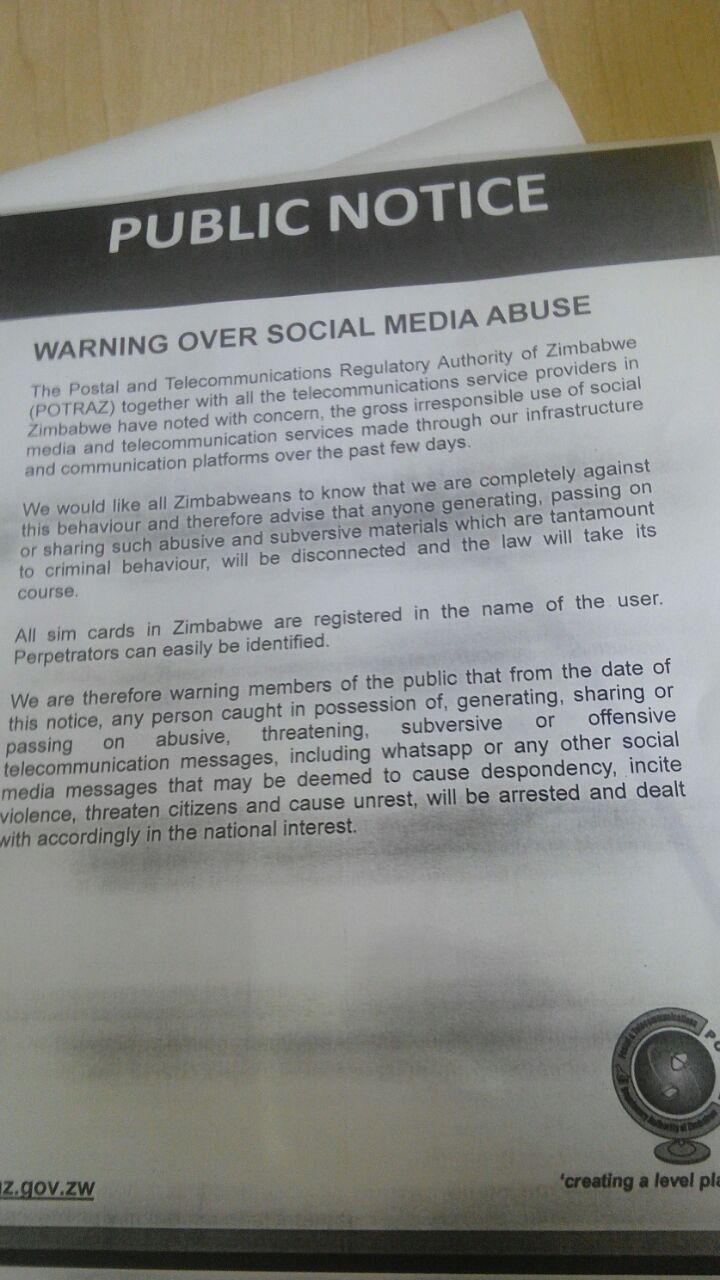
    All of this activity has not gone unnoticed by the government and other associated organisations. The government decided to act on the matter and released a statement via the Postal and Telecommunications Regulatory Authority of Zimbabwe (POTRAZ). The statement served to inform citizens that certain types of communications will not be tolerated in Zimbabwe and anyone caught with or distributing such would be dealt with accordingly. (continued below)

    Warning-Over-Social-Media-Abuse-POTRAZ

    An extract of the statement reads:

    “All sim cards in Zimbabwe are registered in the name of the user. Perpetrators can easily be identified. We are therefore warning members of the public that from the date of this notice, any person caught in possession of, generating, sharing or passing on abusive, threatening, subversive or offensive communication messages, including WhatsApp or any other social media messages that may deemed to cause despondency, incite violence, threaten citizens and cause unrest, will be arrested and dealt with accordingly in the national interest,”

    Strangely so, on the 6th of July, scores of people were not able to use WhatsApp. Was this the government showing that it has the ability to block various forms of communication in their interests? A tweet by Jonathan Moyo caused a bit of a stir as some people took it as an informal admission that there would be difficulties using WhatsApp.

    Whatever the case may be, as far as blocking certain services go, who knows what the government is or isn’t capable of doing? Internet traffic, yes, that is easy enough to monitor. But, services like WhatsApp do say they have end to end encryption which only works when all parties are using the latest version of WhatsApp. More often than not, groups messages aren’t secure. If only one person in the group has not updated their WhatsApp then messages within the group won’t be secure. Are you part of a group that frequently discusses and shares content that could result in your arrest?

    You never really know who may be monitoring your online activity and even with services that say they encrypt data, you can’t always take their word for it. The best thing you can do for yourself if you are concerned about the possibility of being spied upon by the authorities or other unscrupulous individuals online, is to install a VPN.

    What is a VPN (Virtual Private Network)

    Besides giving you a good layer of protection, a VPN which is a virtual private network does three main things and that is to keep you secure online, makes you invisible online and give you internet freedom (being able to access content and/or services that have been blocked by your service provider or government).

    It creates a secure tunnel (so to speak) between you and whatever you are accessing on the internet. A VPN hides your IP address and location and makes you appear as if you are in a location (country) different to where you actually are. It also encrypts your communication thus preventing, hackers, your ISP (internet service provider) and the government from accessing, tracking and monitoring you. Because it gives you the ability to choose your location, this allows you to use services that may otherwise become blocked in Zimbabwe.

    VPNs can be installed on Windows, Mac, iOS, Android and other devices that connect to the internet such as TVs and game consoles.

    How do I set up a VPN

    If you are technically inclined, it is possible to set up your VPN server at home. To set one up on your own, there is a wealth of information on Google on how to do this. Be aware that if the setup is not done correctly it can leave you vulnerable, leaving your IP address and data being visible to prying eyes.

    The other way of setting up a virtual private network is through one of the many VPN providers put there. Most of these providers offer easy setup options that will see your network up and running in only a few clicks. Most of them do come at a cost but some offer free service options that will get you up and running. Hide.me and PureVPN.com offer free options that give 2GB data transfer per month.

    Now it’s time for you to take a look at your digital life and ask yourself, ‘is my data secure and is my online activity hidden from the government or anyone else who might want to spy on me’?

  • Widespread Human Rights Violations Threaten Elections in Zimbabwe

    FULL REPORT:

    PRESS STATEMENT

    With just weeks to go before a watershed election, a political atmosphere of intimidation and violence has taken hold in Zimbabwe. Rather than promoting an environment in which civic participation and political tolerance are encouraged, the government of Zimbabwe has engaged in a systematic crackdown on civil society and the human rights community, including arbitrary detention of activists and opposition supporters, and widespread violations against freedom of expression and access to information.

    These are the findings of a report released today by the Robert F. Kennedy Center for Justice and Human Rights (RFK Center) entitled, “A Promise in Peril: How Widespread Rights Violations Undermine Zimbabwe’s Elections.” The report comes one month before Zimbabwe’s July 31 election, and presents findings that were collected during an international delegation organized by the RFK Center in March 2013.

    “The routine intimidation, harassment, and arbitrary criminal prosecutions of human rights defenders, lawyers, and political activists in Zimbabwe threaten the rights of all citizens to participate freely in public affairs,” said Kerry Kennedy, President of the RFK Center. “With an election upcoming, the government must ensure an electoral environment that is consistent with international standards.”

    “These ongoing human rights violations set the stage for the type of violence and chaos that has marred past elections in Zimbabwe. State authorities have engaged in a pattern of suppression that specifically targets groups engaged in voter registration, education, and mobilization initiatives,” said Santiago A. Canton, Director of RFK Partners for Human Rights. “This behavior is unacceptable and represents clear breaches of domestic and international law.”

    In the report, the RFK Center urges the government of Zimbabwe—which is largely dominated by President Robert Mugabe and the Zimbabwe African National Union–Patriotic Front—to immediately cease the continued harassment, intimidation, and violence perpetrated against civic actors. The report also encourages the government to respect international legal conventions to which Zimbabwe is a party or state signatory, including the Universal Declaration of Human Rights, the International Covenant on Civil and Political Rights, the African Charter on Human and People’s Rights, and the Declaration of Principles of Freedom of Expression in Africa.

    This has been a submission by Jeffrey Smith.
    You can connect with Jeffrey Smith via the following:
    You too can become a Citizen Journalist by submitting your story here: Citizen Journalism by Living Zimbabwe
    The views expressed in the article are those of the author and not necessarily Living Zimbabwe.

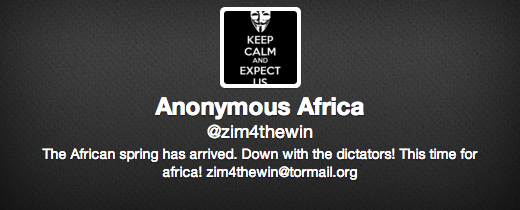
  • Anonymous Africa – Our End Game For Zimbabwe & Africa (@zim4thewin)

    Anonymous Africa – Our End Game For Zimbabwe & Africa (@zim4thewin)

    Greetings and Salutations fellow Africans and Earthlings.

    We are Anonymous Africa and we were asked to write a short blog explaining our motivations. By now you may have noticed some of our ops hitting Southern Africa. We hope you like our work. We would like to thank you for the overwhelming support you are giving us.

    So far our targets have included:

    • IOL – A partly South African government owned media publication that pushed pro-Mugabe propaganda – www.iol.co.za
    • ZANU-PF – The website for the completely corrupt ruling party in Zimbabwe – www.zanupf.org.zw
    • Zimbabwean Herald – The ZANU-PF owned puppet media publication – www.herald.co.zw
    • ZIMRA – The Zimbabwe Revenue Service, the Zim tax collectors – www.zimra.co.zw
    • ZIM MOD – The Zimbabwe Ministry of Defence – www.mod.gov.zw
    • ANC – The corrupt ruling political party in South Africa that supports Mugabe – www.anc.org.za

    Why are we upset?

    TWe believe most of Africa’s modern day problems stem from corrupt and evil leaders that have sold the people out (mostly to corrupt private commercial interests). Much of Africa has entered a cycle of corruption and we believe we are the generation to start breaking up that cycle. Not only can the youth of Africa change Africa. They have to.

    Who are we?

    The Hacker Manifesto best describes who we are:

    “This is our world now… the world of the electron and the switch, the beauty of the baud. We make use of a service already existing without paying for what could be dirt-cheap if it wasn’t run by profiteering gluttons, and you call us criminals. We explore… and you call us criminals. We seek after knowledge… and you call us criminals. We exist without skin color, without nationality, without religious bias… and you call us criminals. You build atomic bombs, you wage wars, you murder, cheat, and lie to us and try to make us believe it’s for our own good, yet we’re the criminals.”

    We are a tight collective of hackers and coders. Some of our members have been part of anonymous since their origins in the Scientology protests. We have been involved in previous ops from around the world including and not limited to, South America, South East Asia and Europe.

    What are we doing?

    Following what happening in the Middle East we are hoping to help start the launch of the African spring. We believe that the Internet is the last place that free speech truly exists. We hope to use whatever skills and abilities we have to bring as much attention to the crimes and corruptions of our African leaders.

    What do we have planned for the future?

    We have many non-violent forms of electronic protest planned. We also hope in the near future to release an African specific version of wikileaks where Africans can expose corruption without fear.

    This has been a submission by Anonymous Africa.
    You can connect with Anonymous Africa via the following: .
    You too can become a Citizen Journalist by submitting your story here: Citizen Journalism by Living Zimbabwe
    The views expressed in the article are those of the author and not necessarily Living Zimbabwe.

  • Our Fiduciary Duty to YOU The Public

    Our what? Exactly! Who even understands big words like that? Not many, but it is my job to understand, and explain it to you so that you know what is expected of someone who presents themselves to you as an Estate Agent.

    Estate Agents in Zimbabwe are controlled by a very strict set of conduct rules that most of the public are completely unaware of.

    When one becomes registered as an Estate Agent in Zimbabwe, they have had to have had at least 3 years practical experience in the industry and pass a rigorous set of exams. The most important of which is Estate Agency Practice. This covers all the legal aspects of property sales and rentals, as well as an Estate Agent’s Duty to the Public.

    I have listed below, in English, not legalese, what you not only can expect, but must demand from your Estate Agent:

    1. An agent must put the interests of his client above his own at all times, and must treat the business dealings of his clients as well as he would treat his own, if not better. This means that you can and should demand confidentiality at all times from your agent. He should never try to purchase or lease your property himself, without having first made it very clear to you of his personal interest.

    Any Estate Agent is obliged to offer you advice and professional knowledge about the industry, regardless of whether you employ his services. (Much like a doctor is obliged to save lives even if they are not his patients!)

    2. Agents should not defame other agents, or treat them in a manner that is inconsistent with fairness, courtesy and professionalism.

    3. Agents should not tout, i.e. should not try to canvass for business by door to door calling. They should not approach you if your house is on the market and ask to sell it. So many people don’t realize this and an agent will call them and say, “I have a buyer for your house, please can I bring them around?” If the property is with another agent then you should tell the caller, that they must go through your appointed agent. Sellers can get themselves into all sorts of trouble when allowing a non mandated agent to sell their property as they will be liable for the mandated agent’s commission, even if that agent did not sell the property.

    4. Agents should not pose as buyers to illicit information from sellers or other agents.

    5. Money held in an agent’s trust account does not belong to the agent, and under NO circumstances is that agent allowed to use the money for the running of his business or personal expenses, (not even bank charges!) The agent should not move any money in the trust account out of the account without the written permission of the owner of that money. The number of cases that exist of agents “borrowing” money from the trust account and never repaying it, is quite frightening.

    The deposit paid for a rental property belongs to the tenant until the end of the lease, and at such time the money will either be returned to the tenant or used to repair the property and pay outstanding bills.

    At any stage that you have money in an Estate Agent’s trust account, you can and probably should ask to see a statement. All rental properties should have a monthly statement of their account forwarded to the owner and tenant, if the tenant requests it.

    If at any stage, you feel an agent is not fulfilling these obligations, you can report them to the Estate Agents Council, and the matter will be taken up by them. If you have been unfortunate enough to lose money from an Estate Agent’s Trust Account, the Estate Agents Council has a Compensation Fund, which all agents have to pay money to each year, so that the public can be reimbursed for their losses. Bet you didn’t know that…I am letting out all the secrets today, aren’t I?

    But remember, you have the right to expect the best from the person you are entrusting with your most valuable possessions, so don’t settle for less…

    Visit my website for more on property www.pageproperties.co.zw

    To read more articles like this visit my blog http://www.pageproperties.blogspot.com

    This has been a submission by Nicky Versfeld. If you have something to share, you too can become a Citizen Journalist by submitting your story here: Citizen Journalism by Living Zimbabwe.

  • Transitional Justice In Zimbabwe, Seeking Ways To Heal The Nation

    On Wed July 6 a workshop was convened at the Diakonia Centre in Central Durban by Zimbabwe Exiles Forum (ZEF) in partnership with other Zimbabwean civic groups which are based in South Africa. Keynote speakers were Gabriel Shumba (ZEF), Munjodzi Mutandiri (NCA), Janet Munakamwe (Southern Africa Women’s Institute for Migration Affairs~SAIMA), Sox Chikohwero (Zimbabwe Global Forum) and Patience Rusere (Media Consultant).

    The purpose of the workshop was to analyse how Transitional Justice can be applied in pre and post crisis Zimbabwe. Transitional Justices looks at the various avenues both judicial and quasi-judicial, which can used to address human rights abuses. In the case of Zimbabwe this entails strategies needed to bring closure and healing to victims of state sponsored violence and to ensure that perpetrators are held accountable for atrocities committed since 1980.

    This Workshop proved quite interesting because ordinary Zimbabweans who attended the event were given the opportunity to contribute and present their own perspectives on how Transitional Justice can work in Zimbabwe. The workshop was basically divided into 2 components, comprised of contributions by the main speakers representing Zimbabwe Exiles Forum, National Constitutional Assembly and SAIMA. These speakers expressed their views on how Transitional Justice can be applied in Zimbabwe.

    On the other hand, other participants were also given an opportunity to present their views on reforms needed to transform institutions like the police and justice system. Also discussions centred on how to promote truth, reconciliation, justice and gender equality in Zimbabwe.

    There was an impressive turnout by ordinary Zimbabweans, based in and around Durban, from all walks of life. This could be a sign that exiled Zimbabweans, particularly in SA, are now more actively interested in participating in the shaping of a new Zimbabwe.

    What came out from this workshop was a clear common understanding by everyone that Transitional Justice will work if applied in a holistic approach. This will ensure that national harmony, justice and sense of nationhood can return to our traumatised nation.

    Article submission by: Chamunorwa Nhau

  • Fire leaves Zimbabaweans Homeless in Durban, South Africa

    On Sat night 2 July, a fire outbreak damaged a building in Central Durban which housed Zimbabwean refugees. The fire destroyed most of their belongings including passports and other personal documentation. This building is one of the many commercial properties in Durban which have been converted to housing, comprised of small sized rooms, by unscrupulous businessmen to exploit desperate Zimbabweans. They are being charged exorbitant rentals in these buildings which are flouting municipal fire and health standards. These buildings are over crowded and have become health hazards due to poor maintenance and overcrowding.

    Most of the Zimbabweans who were victims of this fire are now being housed in homeless shelters in Durban.

    However, according to eye witness accounts at the scene the damage to property could have been minimal if the Fire Department personnel had acted more competently in putting out the fire. In addition, the Municipal Fire Department response to the scene was hours late and the residents helplessly watched as their possessions were consumed by the fire.

    Article submission by: Chamunorwa Nhau

  • Happy That Bona Mugabe Was Raped?

    Over the weekend, reports surfaced that a Tracy Guvamombe was allegedly raped by two Tanzanian students in the South East Asian country where she attends university. The twist in this story is that Tracy is Bona Mugabe, the daughter of President Mugabe.

    Without going into the details (which you can read here), the thing that was a little disturbing was the fact that some people found it quite amusing that she went through the ordeal. Some of the comments scattered across the internet include:

    – Now she knows what it is like and what her father has been unleashing on innocent civilians its a pity she is not also made to dance on her parents grave singing mdc songs.
    – Have not heard such good news in a very long time. Nditumireiwo mvura, kwandiri kunopisa.
    – You see God is fair, those who rape other peoples children will also have their children raped. Too bad Bona, you were pretty.
    – let Mugabe and Grace taste their own medicine, girls were raped during his 2008 violent campaign, now zvaitikawo kwake, that is revenge from the all mighty.Cde the same bitterness you feel is exactly how we felt when our beloved ones were raped. Zvaiwana ngwarati
    (note: these are the comments expressed by various individuals across the internet)

    The few listed above are the more “tamer” ones. There are a few out there where the commenters did not hold back any feelings.  The questions at hand is whether or not those types of comments were warranted? Her father is who he is and he has done what he has done. That being said, should she be held accountable for her father’s actions? This is not to say that all the comments that people are making are ones of joy and celebration. Some individuals were unhappy that others were revelling in the fact that someone was raped.

    If Bona was in fact raped, this is a violation of her human rights. Should she not then be accorded the same kind of justice that other victims of this crime seek? Or, is this something that she does deserve because of who she is?

    Share your thoughts by leaving a comment.

  • Zimbabwe and Human Trafficking

    Zimbabwe and Human Trafficking

    For the past few weeks BBC has been showcasing; Working Lives: Human Traffic that highlights the experiences of people who have succumbed to traffickers. This is something that is a problem all over the world. Those who are in desperate situations are even more prone to becoming victim of traffickers. South Africa is a hot stop for such activities and is a source, transit point and destination for human trafficking. Because of Zimbabwe’s proximity to South Africa and perceived greener pastures across the Limpopo, many of its people are vulnerable.

    A certain individual living in Zimbabwe had been hearing all sorts of stories about the kinds of employment that a number of Zimbabwean women were involved. He wanted to find out a bit more about how they ended up in the situations they were in. A number of them were working as prostitutes in not so inviting areas such as Hillbrow, Johannesburg and against their will. On a trip to South Africa, this person decided to find out how some these women ended up in the situations they were in.

    Here is a quick rundown of how a young woman who has her whole life ahead of her ends up selling her body against her will (please note that this is only one of the many ways that a young woman or child ends up as a victim of such a crime):

    • Recruiters who may or may not be from Zimbabwe end up in Zimbabwe showing off material possessions and lots of cash
    • They befriend people who they think they could easily entice to South Africa to live the life they are living and be able to support their loved ones back home
    • Once the recruiter has left Zimbabwe, they make plans for their target to travel to South Africa and stay in touch with them to put them at ease and make them feel more secure
    • They two arrange with each other to meet at Park Station for example but when the unsuspecting girl arrives in Johannesburg her new friend is nowhere to be found
    • The recruiter who knows when the girl she had recruited is due to arrive from where on in she is pretty much handed over into the hands of the traffickers
    • On arrival in South Africa and not knowing what to do, the girl is also robbed of everything and with no passport (if she entered into the country legally), money or belongings she is left in an even more vulnerable position
    • With her in state of distress, she is approached by a concerned citizen who offers to help her get on her feet and make enough money to either go back home or start a life over there
    • By accepting the offer this girl has gotten herself into situation where she is eventually ‘broken down’ by these syndicates. She then finds herself on the streets working as a prostitute and making hundreds if not thousands of rands a night not for themselves but the human-trafficking syndicates they work for

    Another question that may come to mind is why don’t they get out of these situations once in them. That’s a hard one to answer. The syndicates may be that good at breaking down their victims psychologically to the point where they feel they have no way out. Once there, escape from that world is an impossible dream. Those who do manage to escape but are caught again by the syndicates face very harsh consequences. This serves as a further deterrent for others thinking about doing the same.

    Why even write about human trafficking? To show that Zimbabwe is not immune to such activities as some people may seem to think it. Zimbabwe, like South Africa is also a source, transit point and destination for trafficking. Not all of the victims end up being sexually exploited, some of them end up in forced labour and become modern day slaves. Human trafficking is a billion dollar industry and about half of those trafficked are children. Who is to blame for trafficking and who should be held accountable? Is it the traffickers? The people buying people? Those selling off their family members? The people who solicit prostitutes? Governments? May all are to blame and some more than others.

    Some of you may turn a blind eye to this but for a minute or two, just imagine your daughter, sister, cousin, aunt or someone else you care about is trafficked? Imagine you get to learn that they have been forced into such a situation. Imagine they are being raped multiple times night after night and/or being forced to work day and night without fair compensation?

    More needs to be and can be done by governments in Southern Africa to combat the issue. People are at risk but the situation in Zimbabwe makes people even more vulnerable. Zimbabwe just happens to be one of the countries on a recently released report that is failing to meet international standards in addressing the problem. Until such a time when people can come up with effective ways of combating human trafficking, more and more people will succumb.

    If you would like to find out a bit more about human trafficking, visit the United Nations Office on Drugs and Crime. You may also be interested in taking a look at the Trafficking in Persons Report 2010 by the U.S. Department of State. Maybe there is something you can do to help fight against human trafficking.

  • The Harare Passport Office Experience

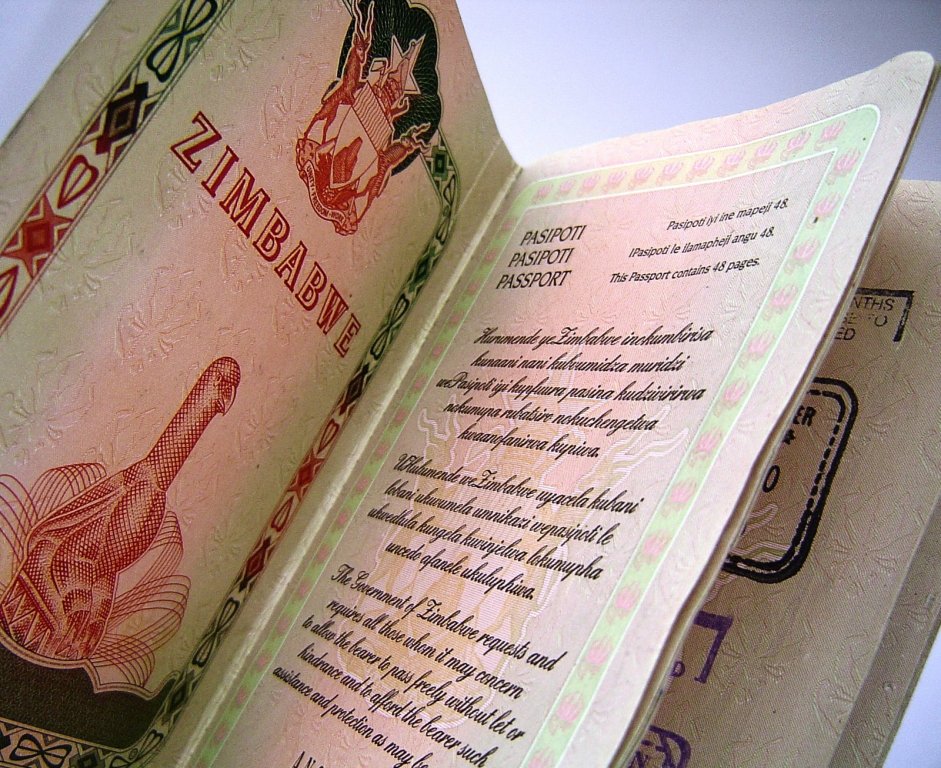
    To be frank, the Registrar-General’s Makombe building passport office experience was a ‘bitch’! Hoards of people, queues that at first didn’t make sense, civil servants full of attitude, soaring summer time temperatures, irritable applicants and the list goes on.

    When I first went over there to check what the price of a new passport was, it did not make much sense at all to me as to where to start off with the application process. There were queues and groups of people all over the place. One to pay for the application form and application fee, another to get this checked on the form after you have filled it out, another to get that checked on the form after you have gotten ‘this’ checked and another to submit the application after this and that has been checked. After that, depending on what type of application you put in, you return in 1, 3 or 14 days to collect you brand spanking new Zimbabwean Passport or ETD which you hope is not fake (we will get into that in another post).

    One thing that you should expect though is to not get you passport in the 1, 3 or 14 days. I have personally come across people who have put in applications for 24 hour passports at the start of one week and when they have gone back the next day to pick it up, they have been told to return the following week.

    It is not fun to be lining up outside at the height of summer to get your hands on an application form. You would think that it would be a bit more bearable once you get into the building but that is not the case. In the corridors you will find queues or people lining up to get into various rooms. There is no ventilation and it can be almost impossible to pass through various sections unless you literally push people out of your way in order to get through. All of that leads to tempers flaring with a few words being exchanged and on a couple of occasion fists being exchanged so you best be careful what you do and say.

    If you do not want to be driven completely insane, the best thing to do is to something that ever since way back when has always been done, get a hold of someone who works in the office and ask them to assist you. Their assistance will see you jump queues (maybe not all of them) and avoid the stress of pushing and shoving with people all day long to get the application through. For some it can be a very stressful experience and if you pay the office a visit, do not be surprised if you find someone in tears and not knowing what to do.

    It is extremely irritating for some to go through the hassles of trying to get a passport given that if you are a Citizen of Zimbabwe you have every right to have a passport and the process of getting one should not be as complicated and stressful as it is. Some put it down to not only beaurocracy but to the civil servants working in these and other government departments seeing themselves as being in a position of power where they can and may very well make life hell unless they are compensated accordingly. Who is to blame for this corruption and exploitation? Is the government, the civil servants or has society just taken up that frame of mind?