Last week, l visited my mother in the country side, Zvishavane communal areas and l was privileged to witness a gathering in which one of the many non governmental organisation, the Australia aid was giving money to rural people which they were supposed to use to buy livestock thereby alleviating poverty. But, what l personally observed prove otherwise .
Firstly, people are shared my observation, it is important to highlight that in rural areas in Zimbabwe the majority of people are living below the poverty datum line. More interesting, is the fact that the majority of people relied on the agrarian economy of the country and hence they need livestock and seed in order for them to cultivate their pieces of land. I’m quiet convinced that the Australia Aid put this into cognisance, hence prioritising the provision of funds to people to purchase livestock.
But, here is what the workers in that organisation failed to put into consideration in order to achieve community-oriented development. Firstly, you can not give a person who can not afford to buy sugar a sum of $US160.00 because he/she will use that money to buy other basic commodities like sugar, rice etc and this is exactly what is happening in Zvishavane. Secondly, a mechanism to ensure that the money is used to achieve the intended goal must be in place to ensure transparency and accountability and this is not happening in this community. So for a community-oriented development all of the aforementioned issues must be put into consideration
This has been a submission by Musavengana Hove.
You can connect with Musavengana Hove via the following: http://www.soldierjournalist.blogspot.com
You too can become a Citizen Journalist by submitting your story here: Citizen Journalism by Living Zimbabwe
The views expressed in the article are those of the author and not necessarily Living Zimbabwe.
The British Red Cross launched an appeal on 11 December to help thousands of people affected by cholera and food shortages in Zimbabwe and the surrounding region.
In Zimbabwe, the Red Cross has been on the ground since the beginning of the cholera epidemic, focusing largely on public education. Cholera is a treatable and curable disease, but people need to know the simple steps they can take to minimise or even eliminate risk of the disease.
In the last two weeks, Red Cross volunteers have reached more than 11,000 people with health and hygiene messages. Funds have also been used to provide cholera kits and water purification equipment, which are being distributed to affected communities.
The International Red Cross and Red Crescent Movement is increasing its assistance across the region in response to the worsening humanitarian situation and further funding is vitally needed. The appeal will support emergency relief to support health, water and sanitation, and hygiene needs.
Donations can be made on their website – Zimbabwe Appeal
Cholera according to the world health organization is: an acute intestinal infection caused by ingestion of food or water contaminated with the bacterium Vibrio cholerae. It has a short incubation period and produces an enterotoxin that causes a copious, painless, watery diarrhoea that can quickly lead to severe dehydration and death if treatment is not promptly given. Vomiting also occurs in most patients.
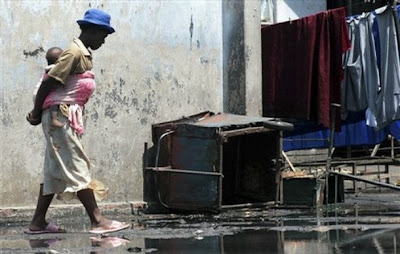
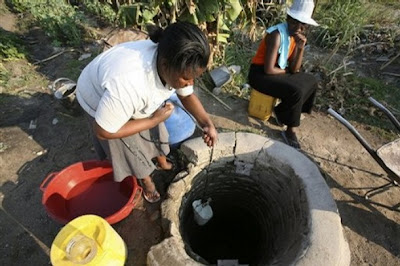
Cholera is hitting Zimbabwe hard at the moment with an estimated 300 people having succumbed, 6,000 reported cases and 1.4 million people at risk. Zimbabwe National Water Authority (ZINWA), the government body responsible for water provisions and sewage management has failed to provide adequate services which has lead to the cholera outbreak. Those who once had running tap water now have no choice but to seek out water in shallow wells and rivers but the pools of stagnant sewage dotted around the streets does not make the situation any better.
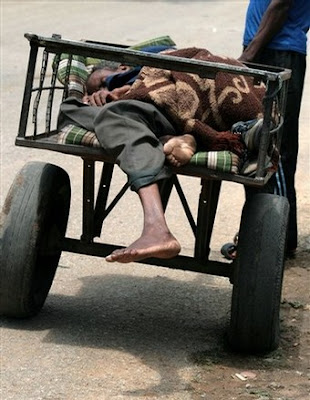
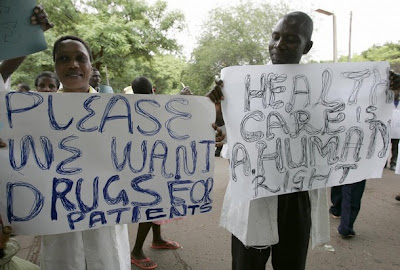
The already crippled health system is struggling to ease the situation and for all we know, the actual number of people with cholera could be well above the reported estimates. The government has been urged by Zimbabwe’s Medical Association to declare a national disaster which would bring aid to ease the situation. At the moment it seems as if the Zanu PF government may not see the need to take such measures. With the onset of the rainy season the epidemic could get a whole lot worse and see many more people dying.
I came across this video a week ago and I must admit that watching it got me a little hot under the collar. The way in which the video was put together got to me and some of the topics that got me upset included:
– mention of needing assistance for rent
– mention of not having eaten meat in a few weeks
– having access to a doctor who offers his services for free and provides them with medication (just to name a few). Part way through I literally yelled “WHAT ABOUT THE BLACK ZIMBABWEANS!?” and I started thinking about the millions who are facing starvation, a number of whom have no shelter and are unable to get medical treatment. “What about the black majority, where were they mentioned in the video?” that was on big question I had and I labelled the video as being racist. Yes, the elderly white people in the video may be in need of help but what about making it more inclusive? Yes, elderly white people are human and have the right to and should be provided with the necessities required to sustain life. Every one is entitled to that. I took offence to the way in which the video was presented and think it could have been presented in a better way and the idea of it being racist kept swirling in my mind.
I started a thread on a forum (click here) to see what people thought about the video and there were a number of people who were clearly quite upset about it and thought that the elderly white people were getting what they deserved. Some even went as far as to say they were getting off lightly and deserved a whole lot worse. There were some people who had different opinions and one that really caught my attention was a person who has tried to help people in the Mashonaland region. He stated that when he has tried to assist in non-white circles has had his efforts viewed upon with a lot of suspicion and had been told he was trying to subvert the people. This doesn’t make reaching certain groups easy for white people who are then not really left with much of a choice but to channel their efforts to where they are effective and appreciated. He went on to say that it is not all blacks who are like that because there are those who welcome aid openly.
A comment that someone else made was a lot of people regardless of colour would be starving were it not for outside support and that in African cultures, children support their parents and less fortunate family members, a practise not common in the Eurocentric culture. The elderly white people may be getting ignored by their children which leaves them in the same boat as many of the Zimbabweans who have nothing.
Text at the end of the video stated that, “hunger in Africa has always been a concern. A problem being addressed for the masses by donor organizations, government help programs and NGO institutions. There is a group of people that fell through the cracks, and do not receive ANY of this help or funding. They are the elderly white people living in Zimbabwe. Life is hunger, destitution and being forgotten if you are old and white living in Zimbabwe.” In my original state, that was something I did not pay attention to on the day I first watched the video. That has played a part in changing the way I view Catherine Sargant and the people of the Bulawayo Help Network. All they are trying to is help people which is commendable and I do need to apologise to Catherine for abusive comments I made.
The comments made by people who were supportive of the efforts of the Bulawayo Help Network also played a part in changing my perceptions. Being Black, White, Coloured, Indian or whatever does not make you immune to the crisis in Zimbabwe. What the network is trying to do is help a group of people who happen to be white and there is nothing wrong with that. If they don’t get help they too will become a statistic of a government that doesn’t have the interests of its people at heart. The anger that I felt may have been a lot of misdirected anger. During the past week I have been thinking about how things in Zimbabwe would be if people were willing to and able to change their perceptions which may be otherwise distorted?
If you feel inclined to help the Bulawayo Help Network, do whatever you can to do so: